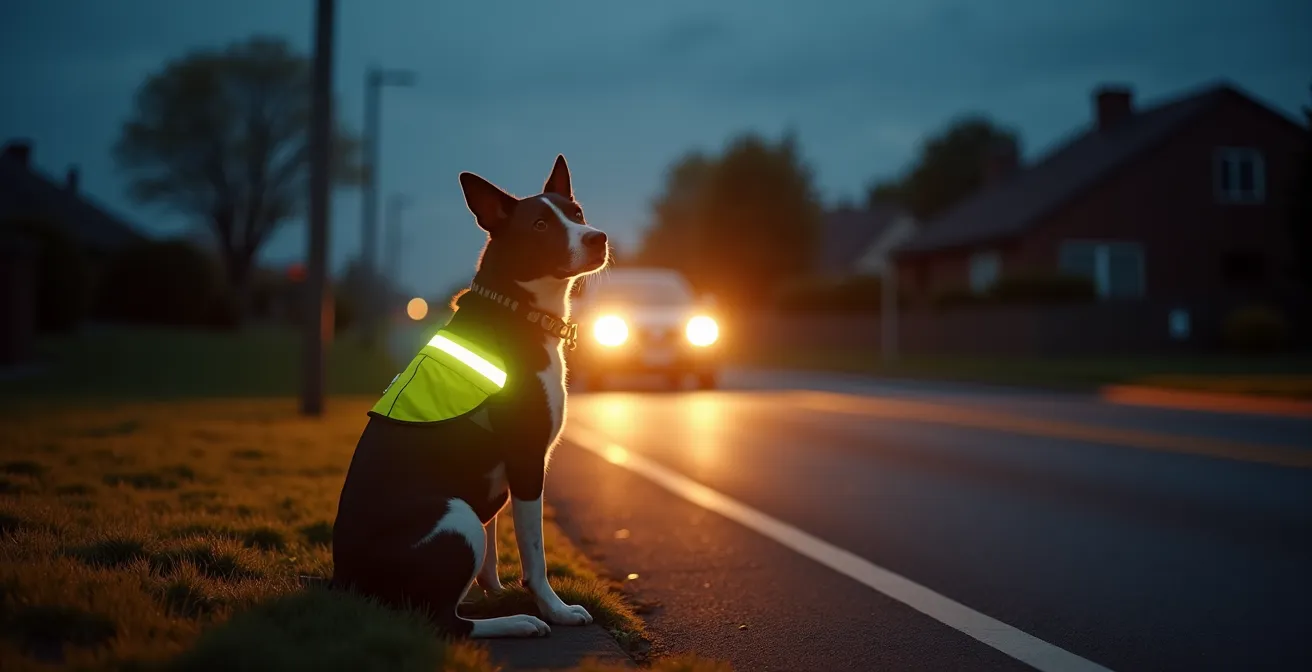
Effective nighttime pet safety isn’t about being seen—it’s about being identified early enough to give a driver time to react.
- Reflective gear can increase a pet’s visibility tenfold, from a mere 55 feet to over 500 feet.
- The wrong equipment, however, can introduce new dangers like tracheal damage or shoulder joint restriction.
Recommendation: Audit your pet’s gear not just for brightness, but for its impact on driver reaction time, ergonomic safety, and long-term joint health.
As winter sunsets creep earlier, the simple act of walking your dog transforms into a high-stakes exercise in risk management. Many owners reach for a reflective leash or a basic flashing light, believing any form of visibility is sufficient. This common approach, however, overlooks a critical factor from the world of traffic safety: reaction time. A driver traveling at 40 mph needs approximately 186 feet to come to a complete stop. If your pet is only visible from 55 feet away, the math simply doesn’t work.
The market is flooded with gear promising to keep your pet safe, from simple bells to complex LED harnesses. But most advice stops at “be bright.” It fails to analyze gear as a safety system. This article moves beyond generic tips. We will adopt the mindset of a traffic safety consultant to deconstruct what truly makes a pet visible and safe at night. The key isn’t just illumination; it’s a calculated strategy of Reaction Time Engineering, where every foot of detection distance buys crucial seconds for a driver to prevent a tragedy.
We will dissect the performance of active versus passive lighting, evaluate the hidden dangers of poorly designed safety features, and provide a framework for choosing equipment that enhances safety without introducing new risks. This is about transforming your pet’s safety gear from a simple accessory into a life-saving system.
This guide provides a systematic breakdown of the critical factors in nighttime pet safety. Explore the sections below to build a comprehensive understanding of how to protect your companion effectively.
Summary: The Engineering Behind Nighttime Pet Safety
- Active Light vs. Car Headlights: Which Is Safer for Country Roads?
- The Safety Buckle: Ensuring Your Outdoor Cat Doesn’t Get Strangled?
- Battery Life: Choosing Light Collars That Survive Rain
- Bulky Battery Packs: How to Avoid Chafing on Small Necks?
- Do Bells Actually Warn Birds? The Efficacy Debate
- How to Introduce City Noises to a Country Puppy?
- Collar vs. Harness: Protecting the Trachea of a Pomeranian
- Y-Harness vs. T-Harness: Which Restricts Shoulder Movement?
Active Light vs. Car Headlights: Which Is Safer for Country Roads?
The core of Reaction Time Engineering lies in understanding the two primary types of visibility aids: passive and active illumination. Passive gear, like reflective vests or tape, works by bouncing light back to its source. Its effectiveness is entirely dependent on an external light source, such as car headlights. Research shows that standard clothing makes a person visible at just 55 feet, which is insufficient for a driver to react. In contrast, studies on motorcycle safety confirm that with reflective materials, visibility can increase to 500 feet, giving a driver nearly 10 times the distance to brake.
Active illumination, such as LED collars or harnesses, generates its own light. This makes your pet visible in complete darkness, independent of car headlights. This is a critical advantage on unlit country roads, trails, or in situations where a car’s headlights might be angled away during a turn. The visual comparison below highlights this fundamental difference in how visibility is achieved.
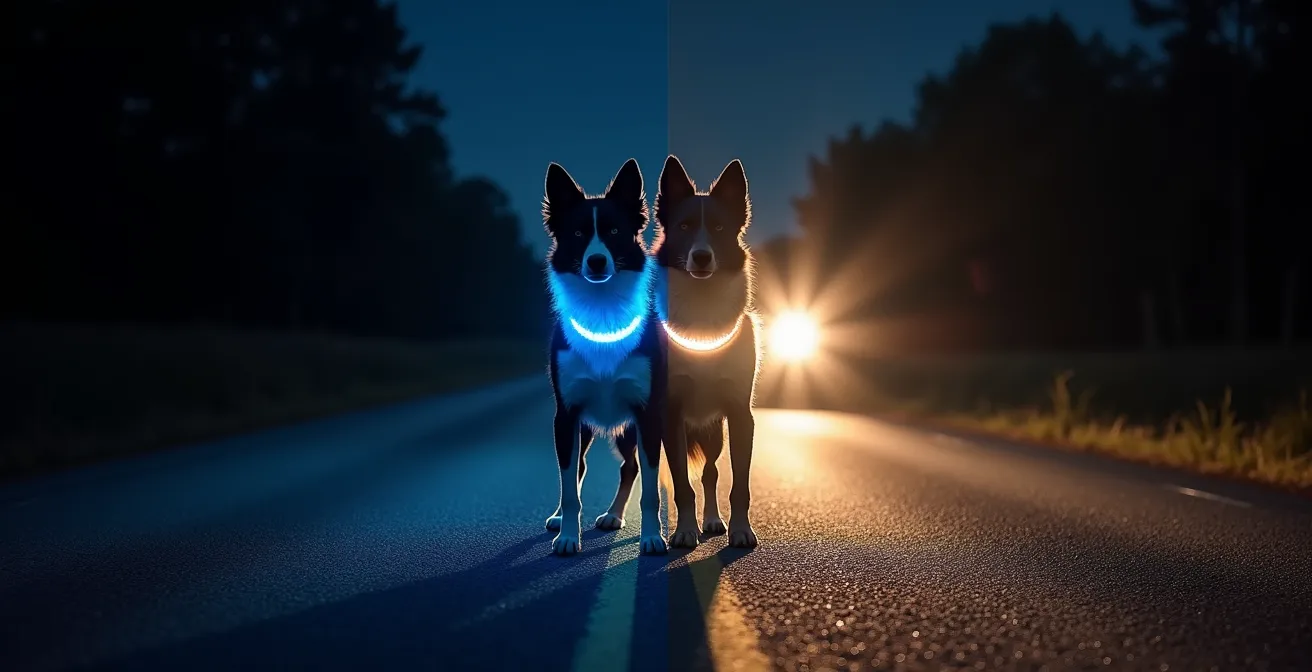
As the image demonstrates, an active LED light creates a “halo” of visibility, while the reflective gear is only effective when directly in a vehicle’s beam. The choice between them depends on your environment. For suburban streets with consistent traffic, high-quality reflective material is effective. For rural areas with intermittent light, an active LED system is non-negotiable for establishing a reliable safety margin.
This table breaks down the operational differences, providing a clear framework for selecting the right technology for your specific walking environment.
| Feature | Active LED Lights | Reflective Gear |
|---|---|---|
| Visibility Range | Up to 500m in darkness | Up to 500ft with direct light |
| Power Source | Battery (2-12 hours) | Physics (no power needed) |
| Weather Impact | Reduced battery in cold | Works in all conditions |
| 360° Visibility | Yes | Only when lit directly |
| Reaction Time Gained | 10 seconds | 10 seconds (when illuminated) |
The Safety Buckle: Ensuring Your Outdoor Cat Doesn’t Get Strangled?
Maximizing visibility is only one part of the safety equation. The equipment itself must not introduce new hazards, with entanglement being a primary concern, especially for cats or dogs exploring dense terrain. A collar that gets snagged on a branch or fence can become a strangulation risk. This is why a properly calibrated breakaway buckle is a critical, non-negotiable feature for any collar worn by an unsupervised pet.
A breakaway buckle is designed to release under a specific amount of force, freeing the pet before injury occurs. However, not all buckles are created equal. The release force must be strong enough to withstand normal play but light enough to snap under the weight of the animal. The SafetyPUP XD case study highlights this crucial balance. Their field tests confirmed that reinforced stitching and durable fabric could withstand rough use, yet the breakaway mechanism functioned reliably during dangerous snagging events. This demonstrates that durability and safety are not mutually exclusive when engineered correctly.
Case Study: SafetyPUP XD’s Balance of Durability and Safety
Over a decade of field testing with thousands of pets, SafetyPUP XD perfected a breakaway mechanism that performs in real-world conditions. Their 300D Oxford weave fabric and reinforced stitching proved durable enough for rough terrain and play. Crucially, the breakaway feature consistently released when snagged, preventing potential strangulation while remaining secure during normal activity. This testing on foggy trails and suburban streets underscores the engineering required to balance high visibility with entanglement risk management.
For any pet owner, especially those with outdoor cats, verifying the function of a breakaway collar is a vital safety check. You can perform a simple test at home to ensure the buckle’s release force is appropriate for your pet’s weight.
Your 5-Step Breakaway Buckle Safety Check
- Weigh your cat or small dog to determine the appropriate force range (a buckle should typically release at 5-8 lbs of force for an average cat).
- Attach the collar to a fixed point, like a doorknob, at the approximate height of your pet’s neck.
- Using a luggage scale hooked to the collar, pull horizontally and steadily to measure the force required for the buckle to release.
- Verify that the buckle releases within approximately 20% of your pet’s body weight to ensure it will snap if your pet becomes suspended.
- Test the release from multiple angles (pulling from the top, side, and bottom of the D-ring) to ensure the safety mechanism is consistent.
Battery Life: Choosing Light Collars That Survive Rain
An active illumination system is only effective if it’s working. The reliability of an LED collar hinges on two factors: battery performance and weather resistance. For anyone walking a dog in winter, the impact of cold on battery life is a significant concern. As a safety consultant, it’s my duty to point out that lithium-ion batteries, common in these devices, can lose up to half their runtime in freezing temperatures. A collar rated for 8 hours in mild weather may only last 4 hours on a cold winter night, a critical failure in your Reaction Time Engineering.
As the Noxgear customer service team notes, high-quality products can perform in extreme cold. They state:
We have received positive feedback from some customers in as low as -50°F
– Noxgear Customer Service, LightHound LED Harness FAQ
This highlights the importance of choosing products from manufacturers who test for and disclose performance in harsh conditions. Equally important is weather resistance. Rain, snow, or even a run through a wet field can disable a poorly sealed electronic device. The IP (Ingress Protection) rating is the industry standard for measuring this. A rating of IPX4 means the device is resistant to splashes, suitable for light rain. For all-weather reliability, an IPX7 rating is the gold standard, indicating the device is waterproof and can withstand brief submersion.
This table clarifies what these ratings mean for real-world use, helping you select a collar that won’t fail when you need it most.
| IP Rating | Protection Level | Real-World Use | Suitable For |
|---|---|---|---|
| IPX4 | Splash resistant | Light rain, splashes | Urban walking |
| IPX7 | Waterproof to 1m | Heavy rain, brief submersion | All-weather use |
| Not rated | Unknown | Dry conditions only | Indoor/fair weather |
Bulky Battery Packs: How to Avoid Chafing on Small Necks?
A safety device is useless if the pet refuses to wear it due to discomfort. For small dogs or pets with sensitive skin, a bulky, poorly designed LED collar can cause chafing, irritation, and distress. The weight and placement of the battery pack are the most common culprits. A heavy pack can create a pressure point on the delicate structures of a small dog’s neck, leading to hair loss or skin sores. This is not just a comfort issue; it’s a compliance issue. An uncomfortable dog is less likely to tolerate the gear, defeating its safety purpose.
Innovative manufacturers are addressing this by integrating technology directly into the materials. The goal is to distribute weight evenly and minimize hard-edged components. The macro shot below illustrates a modern approach, where light fibers are woven into soft, breathable fabric, eliminating the need for a separate, bulky housing.
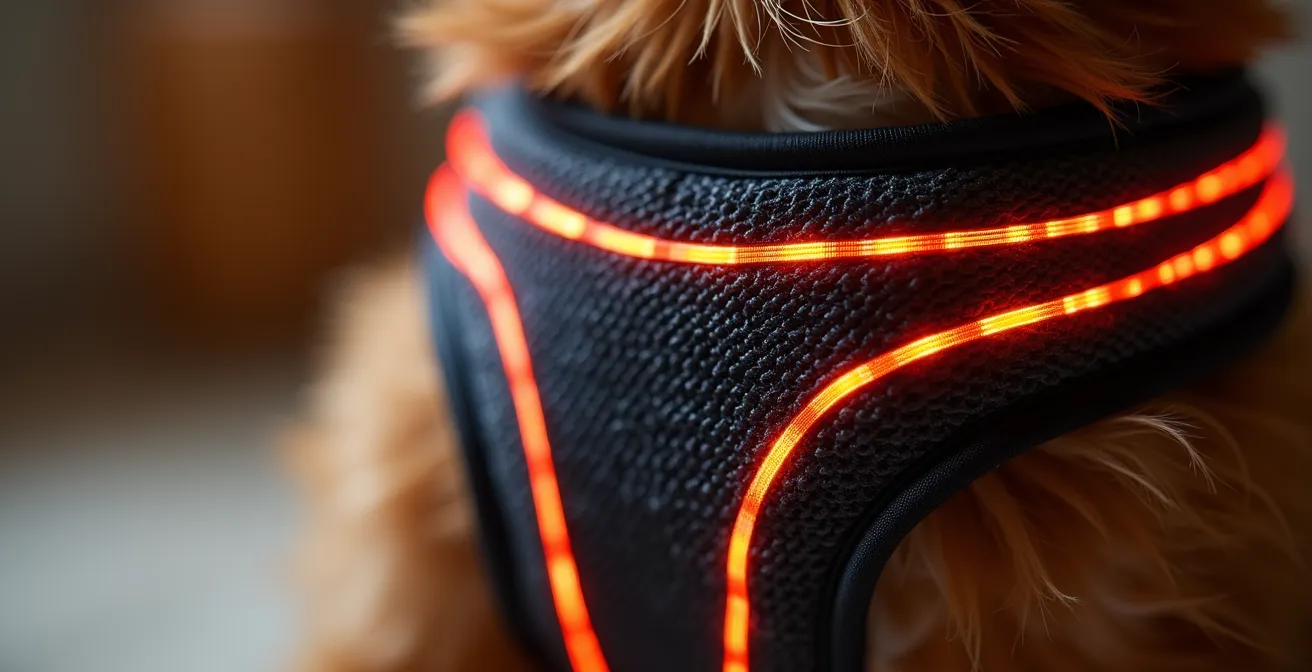
This design philosophy is about making the technology disappear into the product. It prioritizes the animal’s well-being without compromising on performance. The Mighty Paw case study provides an excellent example of this principle in action.
Case Study: Mighty Paw’s Focus on Comfort and Material Science
During the development of their LED collar, Mighty Paw prioritized comfort for extended wear. Their testing identified premium nylon with integrated rubber charging seals as the ideal combination for durability and skin comfort. Instead of a single bulky pack, they integrated two bright light strips directly into the collar’s fabric, ensuring even weight distribution. This design provides 6 hours of continuous light while eliminating the heavy, chafing components of older models, proving that high performance and ergonomic comfort can be achieved simultaneously.
Do Bells Actually Warn Birds? The Efficacy Debate
While the primary focus of Reaction Time Engineering is preventing collisions with vehicles, some owners add bells to collars to prevent a different kind of incident: attacks on wildlife. The theory is that the jingle will warn birds and small mammals of the pet’s approach. However, the efficacy of this method is a subject of intense debate among experts. The core of the issue is twofold: frequency and habituation.
First, many standard, cheap bells produce low-frequency sounds that fall outside the optimal hearing range of most songbirds. They may simply not hear it in time. Second, in areas with predators like coyotes or foxes, a constant, predictable sound could inadvertently signal your pet’s location, turning a warning system into a homing beacon. This illustrates a key principle of safety: a poorly implemented solution can be worse than no solution at all. In contrast, visual deterrents, such as brightly colored collar covers, leverage the advanced color vision of birds to create a silent but effective warning.
This debate underscores the importance of relying on proven safety measures. While the effect of a bell is ambiguous, the impact of high-visibility gear on vehicle safety is not. For example, a comprehensive New Zealand study on motorcyclists found that those wearing reflective or fluorescent gear had a 37% lower crash risk than those in plain clothing. This data provides a clear, quantifiable benefit that auditory warnings for wildlife lack. When engineering safety, we must prioritize strategies with proven, measurable outcomes over those based on anecdotal evidence.
How to Introduce City Noises to a Country Puppy?
A comprehensive safety strategy extends beyond gear. A dog’s behavior is a critical variable in any environment, especially near traffic. A puppy raised in the quiet countryside can become easily overwhelmed and reactive when exposed to the barrage of urban sounds—sirens, air brakes, and dense traffic. A panicked dog is an unpredictable dog, capable of bolting into a street regardless of how visible it is. Therefore, a crucial element of safety is sensory desensitization.
The goal is to proactively and gradually introduce these stimuli in a controlled, positive setting. This process, known as “sensory stacking,” involves slowly increasing the intensity of sounds, sights, and even smells associated with a city environment. By pairing these new experiences with high-value rewards like food or play, you change the dog’s association from fear to positive anticipation. A Petco training expert emphasizes a key tool in this process: “Teaching Jasper a ‘look’ command where he learns to watch you closely while on a leash is quite helpful.” This command redirects the dog’s focus from the scary stimulus back to the owner, reinforcing the owner as the source of safety and guidance.
This proactive training builds a dog’s confidence and resilience, making it a more reliable and predictable partner in a busy environment. A calm, focused dog is a safer dog. The following protocol outlines a structured, week-by-week plan to achieve this.
Sensory Stacking: A 7-Week Desensitization Protocol
- Week 1: Play recordings of city sounds at a very low volume (20%) exclusively during your puppy’s meal times.
- Week 2: Increase the sound volume to 40% and expand its use to include fun play sessions.
- Week 3: Introduce visual stimuli by playing videos of city traffic (with sound still at 40%) during play.
- Week 4: Add a new sensory layer by placing a cloth with synthetic city smells (e.g., from a training supply store) in the play area while sounds and videos are on.
- Week 5: Take a short, 5-minute visit to a quiet, mostly empty parking lot, providing plenty of high-value treats and praise.
- Week 6: Graduate to slightly busier areas, like the edge of a shopping center, for 10-minute sessions focused on positive reinforcement.
- Week 7: Attempt full city exposure, bringing along a “safe zone” mat where the puppy has learned to settle, and keeping the first few sessions short and positive.
Collar vs. Harness: Protecting the Trachea of a Pomeranian
The choice between a collar and a harness is not merely a matter of preference; for many small breeds, it is a critical health decision. Brachycephalic (short-nosed) breeds and toy breeds like Pomeranians, Pugs, and Chihuahuas are often genetically predisposed to tracheal collapse, a condition where the windpipe weakens and flattens, causing severe respiratory distress. For these dogs, a traditional collar places direct pressure on this fragile area. A single lunge or a constant pull on the leash can exacerbate or even trigger this chronic condition.
This is where equipment selection becomes a form of preventative medicine. A well-designed harness bypasses the neck entirely, distributing pressure across the much stronger sternum and rib cage. As outlined in the veterinary case study below, the consensus is clear: a Y-shaped harness is the superior choice for protecting at-risk breeds.
Case Study: Veterinary Consensus on Tracheal Collapse Prevention
Veterinary experts overwhelmingly agree that small breeds predisposed to tracheal collapse require specialized equipment to prevent injury. Clinical observations show that Y-harnesses, which distribute pulling force across the dog’s sternum (breastbone), significantly reduce incidents of coughing, gagging, and respiratory distress compared to collars. A properly fitted Y-harness converts leash pressure into chest pressure, a force that small dogs can tolerate far better than the direct, damaging pressure on the throat from a traditional collar.
Choosing a harness is the first step, but ensuring it fits correctly is just as important. The pressure point must be on the chest bone, not creeping up toward the throat. Even with a harness, an improper fit can still pose a risk. A simple “gag reflex test” can help you determine if your current setup is safe. Apply gentle pressure where the leash attaches and observe for any signs of coughing or gagging. Any sign of respiratory distress means the equipment is unsafe and needs to be refitted or replaced. For vulnerable breeds, this diligence is not optional; it is essential for their long-term health and well-being.
Key Takeaways
- Effective visibility is not about brightness, but about the distance and time it gives a driver to react.
- Safety gear must be audited for hidden risks, such as improperly calibrated breakaway buckles or poor ergonomic design causing chafing.
- The performance of electronic gear is dependent on its battery’s resilience to cold and its certified level of water resistance (IP rating).
Y-Harness vs. T-Harness: Which Restricts Shoulder Movement?
Once you’ve made the crucial decision to use a harness, the next level of analysis involves understanding the biomechanical impact of different designs. The two most common styles are the Y-harness and the T-harness (also known as a Roman or restrictive harness). A Y-harness has a strap that forms a “Y” shape over the dog’s chest, leaving the shoulder joints completely free to move. A T-harness, conversely, features a strap that runs horizontally across the dog’s chest, directly over the shoulder points.
From a biomechanical perspective, the difference is profound. A T-harness can significantly restrict the dog’s natural gait by blocking the forward extension of the front legs. This can lead to a shortened, choppy stride and, over time, may cause the dog to develop compensatory movements that strain other joints and muscles. For active dogs, running partners, or any dog wearing a harness for extended periods, this restriction can contribute to long-term orthopedic issues. A Y-harness, by allowing a full and natural range of motion, is the superior choice for all-day wear and athletic activities.
As a traffic safety consultant, I view this as another form of risk management. A harness that causes discomfort or alters gait is a poor long-term investment in your dog’s health. The following table, based on gait analysis studies, summarizes the impact of each harness type.
This comparative data, drawn from gait analysis featured in resources like a guide from Non-Stop Dogwear, clearly shows the biomechanical advantages of a Y-harness.
| Harness Type | Shoulder Freedom | Best Use Case | Potential Issues |
|---|---|---|---|
| Y-Harness | Full range of motion | Long walks, running, all-day wear | Less control for heavy pullers |
| T-Harness | Restricted forward extension | Short-term training or occasional walks only | Joint compensation, reduced stride, long-term strain |
| No-Pull Harness | Moderate restriction | Leash training sessions only | Not for extended wear or running |
You can and should verify if your dog’s harness is restricting its movement. A simple physical check and visual analysis can reveal potential issues before they cause long-term problems.
Action Plan: Test for Shoulder Movement Restriction
- Have your dog stand naturally on a flat, level surface.
- Place your hand on the point of your dog’s shoulder (the top of the large bone in the front leg).
- Gently guide the dog’s leg forward, mimicking a walking motion. Check if the horizontal strap of the harness physically blocks your hand or the leg’s forward movement.
- Use your phone to film your dog walking or trotting in slow-motion, both with and without the harness on.
- Compare the videos side-by-side. Look for a visible shortening of the front leg’s stride length when the harness is on. If the stride shortens by more than 10%, the harness is likely causing significant restriction.
Frequently Asked Questions on Visibility Distance: How Reflective Gear Adds 3 Seconds of Braking Time?
Do standard bells work at frequencies birds can hear?
Many cheap bells produce frequencies outside optimal songbird hearing ranges. Specially designed bells with higher frequencies may be more effective at warning birds.
Could bells attract predators instead?
In rural areas, consistent bell sounds might signal small pet locations to coyotes, foxes, or large owls that associate sound with prey movement.
Are visual deterrents more effective than bells?
BirdsBeSafe collar covers use bright unnatural colors that startle birds through their advanced color vision, offering silent protection that may be more effective than bells.