
That recurring dark debris in your cat’s ears is rarely just dirt; it’s the clinical sign of a microscopic parasite infestation requiring a specific, scientific approach.
- Surface cleaning and home remedies fail because they don’t interrupt the mite’s 30-day reproductive cycle.
- The infestation is highly contagious, meaning all pets in the household, even those without symptoms, are likely carriers and require simultaneous treatment.
Recommendation: Consult your veterinarian for a definitive microscopic diagnosis and a tailored treatment plan to ensure complete and safe eradication.
As a cat owner, you’ve likely encountered it: a dark, waxy, crumbly substance in your cat’s ears that resembles coffee grounds. You diligently clean it, only to find the stubborn debris has returned a few days later. This frustrating cycle leads many to believe their cat simply has dirty ears or is prone to wax buildup. Some may even turn to common home remedies, like olive oil, hoping to resolve the issue once and for all.
But what if you are only addressing the symptom, not the cause? What if that debris is not dirt at all, but the visible evidence of a microscopic battlefield? This perspective, that of a diagnostic technician, shifts the focus from simple cleaning to strategic eradication. The “coffee grounds” are a mixture of ear wax, blood, and inflammatory byproducts created by the presence of Otodectes cynotis, the common ear mite. To successfully eliminate them, one must understand their lifecycle, their contagious nature, and why superficial treatments are destined to fail.
This guide will take you beyond the surface appearance, providing the diagnostic framework to understand the problem. We will dissect the differences between various parasites, analyze why certain treatments fail while others succeed, and explore the critical importance of a complete, vet-guided protocol. By understanding the enemy, you can become an effective partner in your pet’s recovery.
Summary: A Diagnostic Guide to Understanding and Treating Ear Mites
- Treating the Symptom-Free Cat: Why You Must Treat All Pets?
- Genetic Mange vs. Contagious Scabies: What is the Difference?
- Why Olive Oil Does Not Cure Ear Mites Effectively?
- The 30-Day Cycle: Why Stopping Drops Early Leads to Relapse?
- The Moving White Specks: Identifying Zoonotic Mites on Rabbits and Cats
- To Pluck or Not: The Current Vet Consensus on Hairy Ears
- Permethrin Danger: Why Dog Spot-Ons Can Kill Cats?
- Why Your Indoor Cat Still Needs Deworming?
Treating the Symptom-Free Cat: Why You Must Treat All Pets?
A common mistake in treating ear mites is focusing only on the animal showing symptoms—the one shaking its head or scratching its ears. This approach ignores the parasite’s primary survival strategy: high contagion. Ear mites spread easily through brief, direct contact, making every pet in a multi-pet household a potential reservoir for infestation. In fact, research indicates that up to 25% of pet cats are infested, many of whom may act as silent, asymptomatic carriers.
These carriers show no obvious signs of distress. Their ears may look clean to the naked eye, yet they harbor a small population of mites, ready to re-infest the treated pet or spread to others. This “Silent Spreader Phenomenon” is why treating a single animal is often a temporary fix. The mites will simply travel from an untreated dog, cat, or even ferret back to the original host once the medication wears off, restarting the cycle of itching and debris production. The only effective strategy is to assume all pets are infected and treat the entire household population simultaneously.
To move from a reactive to a proactive stance, a systematic household audit is necessary. This involves identifying all potential hosts and environmental factors to ensure a comprehensive eradication strategy.
Your Household Parasite Audit Plan: 5 Key Verification Points
- Points of Contact: List all pets in the household (cats, dogs, ferrets) that have any level of interaction, as they are all potential carriers.
- Symptom Inventory: Observe all pets for subtle signs of ear discomfort, such as minor head shaking, occasional scratching, or any visible debris, even if it doesn’t look like “coffee grounds.”
- Professional Diagnosis: Schedule a veterinary appointment for all pets to be examined. A definitive diagnosis can only be made by identifying mites or eggs via microscopic ear cytology.
- Environmental Sweep: Inventory and plan for the deep cleaning of all shared items, including bedding, grooming tools, cat trees, and soft toys where mites could temporarily survive.
- Treatment Coordination: Create a calendar to ensure all pets begin and end their prescribed treatment on the exact same schedule to break the cycle of re-infestation.
Therefore, a successful treatment protocol is not just about medication; it’s a coordinated, household-wide strategic operation against the parasite’s ability to hide and spread.
Genetic Mange vs. Contagious Scabies: What is the Difference?
The term “mange” is a broad descriptor for skin disease caused by mites, but not all manges are the same. A key diagnostic step is differentiating the highly contagious ear mite (*Otodectes cynotis*) from other types, as their treatment and prognosis differ significantly. The dark, granular debris is a strong indicator of ear mites, but other conditions can cause itching and skin changes.
This is where microscopic identification becomes critical. The three most common mite-related conditions a veterinarian will differentiate are: Otodectic Mange (ear mites), Sarcoptic Mange (scabies), and Demodectic Mange. While all involve mites, their location, the type of debris they create, and, most importantly, their method of transmission are distinct. Understanding these differences is essential for correct treatment and for managing risk to other pets and even humans.
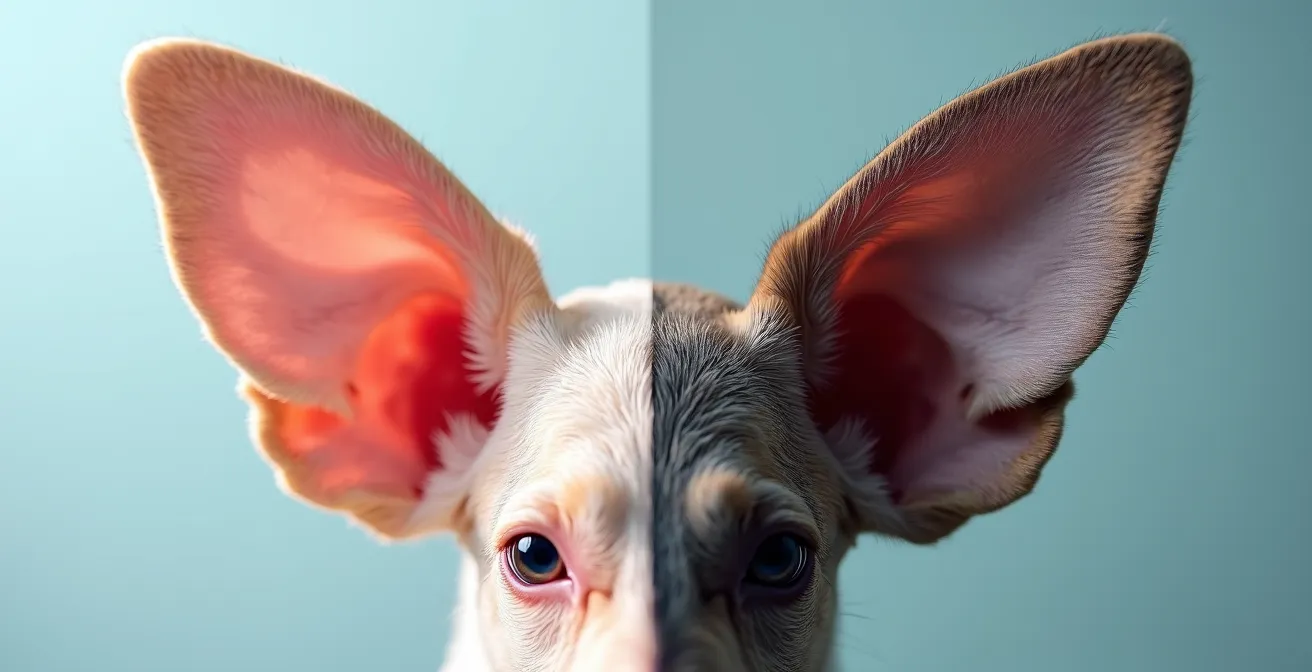
As the image visually contrasts, the healthy pink tissue of a normal ear canal stands in stark opposition to the inflamed, debris-filled canal of an ear mite-infested ear. This visual change is a primary clue, but the definitive answer lies in analyzing the debris itself and the mite’s characteristics.
The following table provides a clear diagnostic guide to distinguish between these common parasitic conditions. It highlights the key factors your veterinarian assesses to reach an accurate diagnosis.
| Condition | Scientific Name | Location | Debris Type | Contagion Level |
|---|---|---|---|---|
| Ear Mites | Otodectes cynotis | Ear canals, occasionally skin | Dark brown ‘coffee grounds’ debris | Highly contagious between pets |
| Scabies | Sarcoptes scabiei | Body-wide, especially elbows, ears | Crusty sores, intense itching | Highly contagious to pets and humans |
| Demodectic Mange | Demodex canis | Face, legs, trunk | Hair loss, red skin, secondary infections | Not contagious (genetic/immune-related) |
Only by correctly identifying the specific parasite can a safe and effective treatment plan be initiated, preventing the use of incorrect medications and addressing the specific contagion risk each mite presents.
Why Olive Oil Does Not Cure Ear Mites Effectively?
The internet is filled with home remedies for ear mites, with olive oil, mineral oil, or baby oil being the most frequently recommended. The theory is that the oil smothers the adult mites, providing a “natural” cure. While it’s true that a thick oil can suffocate some adult mites, this approach is fundamentally flawed and fails from a parasitological standpoint. The core issue lies in the mite’s lifecycle, which includes eggs and pupae.
These immature stages are highly resilient and protected, rendering them impervious to simple smothering agents. As experts at VCA Animal Hospitals explain, the strategy must target the parasite’s full development. This insight is captured in their veterinary guidelines.
No medication can penetrate the eggs or pupae, so treatment is directed at killing the adult and larval forms
– VCA Animal Hospitals, VCA Veterinary Expert Guidelines
An oil-based home remedy fails because it doesn’t have a residual effect to kill the new larvae that hatch from the protected eggs. A study from the Cornell Feline Health Center on a similar remedy highlights the practical impossibility of this method: success would require perfect application multiple times a day for over a month without fail. This level of compliance is nearly impossible for most owners. Furthermore, creating a constantly moist, oily environment in the ear canal can suppress the immune response and encourage dangerous secondary bacterial or yeast infections, turning a mite problem into a more complex medical issue.
Instead of ineffective home remedies, veterinarians use products with active ingredients specifically designed to kill mites. While some are synthetic, others are derived from natural sources but formulated for efficacy and safety. These are not products for DIY application but are prescribed based on a correct diagnosis.
- Pyrethrin-based products: Derived from chrysanthemum flowers, these are effective miticides available in veterinary-approved formulations.
- Prescription ear cleaners: Medicated cleaners may contain agents that help break down the debris and have antimicrobial properties to address secondary infections.
- Monthly topical preventatives: Many modern flea and tick spot-on treatments (like those containing selamectin or moxidectin) are also labeled for the prevention and treatment of ear mites.
Ultimately, a successful outcome depends on using a medication that can outlast the mite’s reproductive cycle, a task for which simple oils are not equipped.
The 30-Day Cycle: Why Stopping Drops Early Leads to Relapse?
One of the most common reasons for treatment failure is non-compliance. An owner may see that their cat’s ears look much better after a week of treatment—the scratching stops, and the “coffee grounds” disappear. Assuming the problem is solved, they stop administering the medication. This is a critical error that almost guarantees a relapse. The visible improvement only signals the death of the adult and larval mites, not the entire population.
Beneath the surface, a new generation of mites is waiting to emerge. The complete ear mite lifecycle—from egg to larva, to nymph, and finally to a reproductive adult—takes approximately 21 to 30 days. The eggs, protected by a tough outer layer, continue to develop, unaffected by most medications. If treatment is stopped early, these eggs will hatch, and the infestation will re-establish itself within a few weeks. This is why veterinarians prescribe treatments that last for a full 30 days or recommend single-dose, long-acting medications.
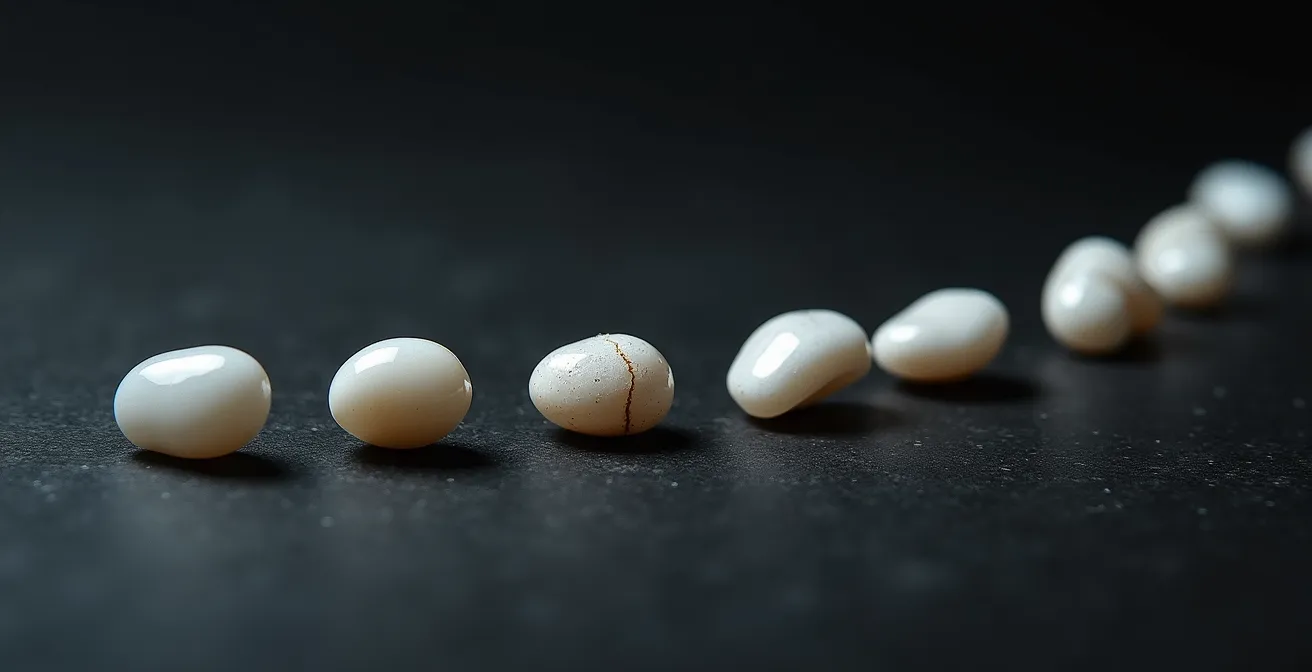
This visual representation helps conceptualize the unseen progression. Effective treatment isn’t a single battle; it’s a month-long campaign designed to kill the existing adults and then eliminate each new wave of larvae as they hatch before they have a chance to mature and reproduce. The goal is lifecycle sabotage. Any break in this campaign allows the enemy to regroup and multiply, forcing you to start all over again.
Stopping treatment based on visible improvement is like declaring victory after the first skirmish of a long war. True success is only achieved when the full course of treatment is completed, ensuring no survivors are left to rebuild their population.
The Moving White Specks: Identifying Zoonotic Mites on Rabbits and Cats
While *Otodectes cynotis* is confined to the ears, another mite can cause confusion and presents a different type of risk: *Cheyletiella*, commonly known as “walking dandruff.” This mite is larger than the ear mite and can sometimes be seen moving amongst flakes of skin on the animal’s back and neck. It is not an ear mite, but its presence can cause intense itching and scaling that may be mistaken for a generalized skin problem.
The key diagnostic feature of *Cheyletiella* is the appearance of what looks like a severe case of dandruff, particularly along the spine. Upon close inspection with a magnifying glass or during a veterinary exam, these “dandruff flakes” can be seen to move, hence the nickname. This mite is highly contagious between cats, dogs, and especially rabbits, which are a common reservoir. An infestation in a cat may have originated from a household rabbit.
Unlike ear mites, *Cheyletiella* has a zoonotic potential. This means it can be transmitted from animals to humans. The mites do not burrow or live on humans, but they can bite, causing a series of itchy, red bumps on the arms, torso, or anywhere a person has had close contact with an infested pet. The rash is often misdiagnosed as mosquito bites or an allergic reaction. The human symptoms will resolve on their own once the animal host is properly treated, as humans are not a suitable long-term environment for the mite.
If you notice “walking dandruff” on your pet or experience an unexplained itchy rash yourself, it is crucial to inform your veterinarian. They can perform a skin scraping or tape test to identify the *Cheyletiella* mite under a microscope and prescribe the appropriate topical or systemic treatment for all affected animals in the household.
Key Takeaways
- The “coffee ground” debris is a clinical sign of an active parasitic infestation, not just dirt; its presence demands a medical diagnosis.
- Ear mites are highly contagious, making it mandatory to treat all in-contact pets (cats, dogs, ferrets) simultaneously, even if they show no symptoms.
- Effective treatment must last for the full 30-day lifecycle of the mite to kill newly hatched larvae; stopping early based on symptom improvement will lead to relapse.
To Pluck or Not: The Current Vet Consensus on Hairy Ears
For certain dog breeds and some long-haired cats, the question of whether to pluck hair from the ear canal is a frequent topic of debate. The traditional belief was that removing this hair improved airflow and prevented infections. However, the modern veterinary consensus has largely shifted away from routine plucking. From a diagnostic and physiological perspective, the act of plucking itself can create problems.
Each hair is rooted in a follicle. Pulling it out causes microscopic trauma and inflammation to the delicate skin of the ear canal. This inflammation can lead to swelling and an increase in wax production. In essence, the “solution” of plucking can create a warmer, more humid, and more nutrient-rich environment—the perfect breeding ground for secondary yeast and bacterial infections. If an underlying ear mite infestation is already causing inflammation, plucking can severely exacerbate the condition and make diagnosis more difficult.
The current veterinary recommendation is to avoid plucking unless the hair is so dense that it is physically trapping debris and wax, forming a mat that completely blocks the canal. In these specific cases, a veterinarian or experienced groomer may carefully remove only the obstructive hair. For most pets, a better approach is to use a gentle, vet-approved ear cleaning solution to keep the canal free of excess wax and to trim the hair around the opening of the ear canal rather than plucking from within it.
Therefore, unless specifically advised by your veterinarian for a clear medical reason, it is best to leave the hair inside the ear canal alone to avoid creating an inflammatory state that complicates parasite control.
Permethrin Danger: Why Dog Spot-Ons Can Kill Cats?
In a multi-pet household, it can be tempting to use one product for all animals. However, this is one of the most dangerous mistakes an owner can make, especially with flea and tick spot-on treatments. Many products designed for dogs contain permethrin, an insecticide that is extremely effective for canines but is highly toxic and often fatal to cats. This is not a matter of dosage; it is a fundamental difference in feline physiology.
Cats lack a specific liver enzyme, glucuronosyltransferase, that is necessary to metabolize permethrin and other similar compounds. In a dog, this enzyme efficiently breaks down the chemical and allows it to be safely eliminated from the body. In a cat, the absence of this pathway means the toxin accumulates rapidly, leading to severe neurological damage. Even a small amount of a high-concentration dog product applied to a cat can be a lethal dose.
The signs of permethrin toxicity in cats are severe and unmistakable: profuse drooling, muscle tremors, seizures, hyperthermia (high body temperature), and loss of coordination. It is a veterinary emergency that requires immediate and aggressive treatment, including decontamination, IV fluids, and anti-seizure medications. Sadly, even with intensive care, many cats do not survive. Toxicity can also occur through secondary exposure, such as a cat grooming or sleeping next to a recently treated dog. For this reason, it is critical to use only cat-specific products on felines and to separate cats from dogs for several hours after a dog-specific spot-on has been applied.
Always read product labels carefully and never, under any circumstances, apply a “dog-only” flea and tick product to a cat. The risk is simply too high.
Why Your Indoor Cat Still Needs Deworming?
The conversation about ear mites naturally leads to a broader understanding of parasite control. A common misconception among owners is that an “indoor-only” cat is completely safe from parasites and therefore doesn’t need preventative care like deworming. This creates a dangerous gap in protection. While the risk is reduced, it is far from eliminated. Parasites are masters of transmission and have numerous ways to infiltrate a home.
Fleas, for instance, are the primary vector for tapeworms. A single flea can hitch a ride into your home on your clothing, on a visitor, or on another pet. If your cat ingests that flea during grooming, it can become infected with tapeworms. Similarly, roundworm eggs are microscopic and resilient; they can be carried indoors on the bottom of your shoes after walking through contaminated soil in a park or garden. Even insects like flies or cockroaches, if eaten by your cat, can serve as intermediate hosts for certain types of worms.
This same logic applies to external parasites. While an indoor cat is less likely to get ear mites from another cat, the risk isn’t zero if other pets come and go, or if the cat was exposed in its litter before you brought it home. Parasite control is not just about treating an active problem; it’s about managing risk and preventing infestations before they start. Your veterinarian can assess your cat’s specific lifestyle risks and recommend an appropriate, year-round parasite prevention plan that covers fleas, ticks, heartworms, and common intestinal worms, even for a cat that never sets a paw outside.
To ensure your cat is fully protected, discuss a comprehensive parasite prevention strategy with your veterinarian that addresses both the visible external threats and the invisible internal ones.
Frequently Asked Questions about Coffee Grounds in Ears: Is It Dirt or Ear Mites?
Why do my pet’s ears look better but I need to continue treatment?
The visible improvement you see comes from killing the adult and larval mites, which are causing the immediate irritation. However, mite eggs are still present in the ear canal and are not affected by most medications. Because the full mite lifecycle is about 21 days, you must continue treatment for the prescribed duration to kill the new mites as they hatch, preventing a new generation from establishing itself.
Can incomplete treatment create resistant mites?
While not extensively documented for ear mites specifically, the principle of antibiotic and antiparasitic resistance suggests this is a risk. Incomplete treatment allows the strongest or most resilient mites to survive and reproduce. Over time, this could theoretically lead to a population that is more difficult to treat with standard medications, making future infestations harder to clear.
How do I know when treatment is complete?
Visible improvement is not a confirmation of a cure. The only way to be certain that the ear mites are completely gone is to return to your veterinarian for a follow-up examination after the treatment course is finished. They will perform another ear cytology, examining a sample of ear debris under a microscope to confirm the absence of any mites or eggs.