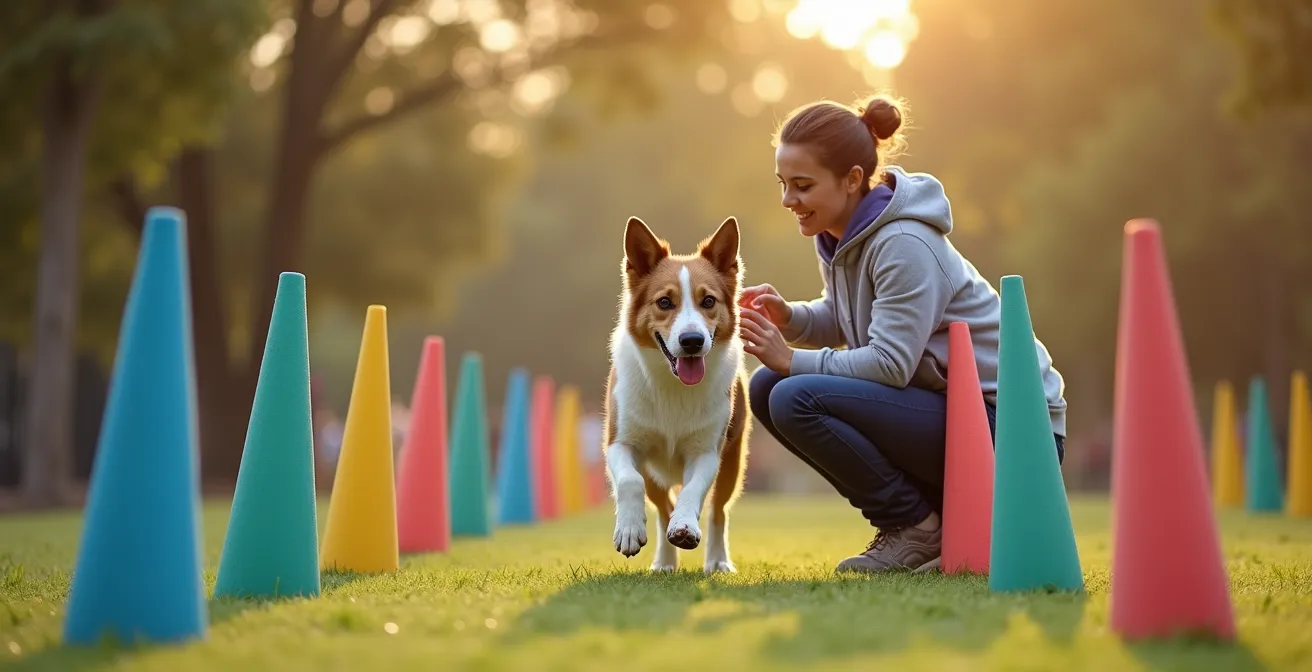
Agility is not about speed or obstacles; it is a structured communication system that gives a fearful dog a sense of control and rewires their confidence from the inside out.
- Foundation skills like targeting and body awareness teach a dog a predictable “language” before they ever see a real obstacle.
- The handler’s consistent body language is more critical than the equipment, creating a safe and understandable world for an anxious dog.
Recommendation: Begin not with an agility course, but with simple, ground-based body awareness games in your living room to build a foundation of trust and communication.
Watching your rescue dog flinch at shadows or bolt from a dropped set of keys is heartbreaking. As their owner, you feel a mix of compassion and helplessness. You’ve likely heard the standard advice: “just give them time,” “use positive reinforcement,” “start socializing slowly.” While well-intentioned, this advice often lacks a clear, actionable framework for building the one thing your dog desperately needs: a sense of agency and control over their world. Many owners of skittish dogs would never consider a high-energy sport like agility, viewing it as a trigger for more anxiety.
But what if we re-framed agility entirely? What if, instead of a race against the clock, we saw it as a therapeutic tool? The secret to building confidence in a fearful dog doesn’t lie in avoiding challenges, but in teaching them, step-by-step, how to successfully navigate them. This is where the principles of agility, stripped of their competitive pressure, become a powerful language of communication and trust. This is not about the sport of agility; it’s about the science of confidence-building that underpins it.
This guide will deconstruct the core components of agility training, focusing not on performance, but on the profound psychological benefits for a fearful dog. We will explore how to build a foundation of body awareness, the critical importance of your own movements, and how to introduce challenges in a way that empowers your dog, turning obstacles into opportunities for growth. Forget the blue ribbons; our goal is a dog who walks through the world with a little more swagger in their step.
Summary: How Agility Can Be a Therapeutic Tool for Fearful Dogs
- Targeting and Body Awareness: What to Teach Before the First Jump?
- Growth Plates and Impact: When Is It Safe to Raise the Bar?
- The 18-Month Rule: Why Jumping Is Ban for Puppies Under 1 Year?
- Front Cross vs. Rear Cross: How Your Body Language Steers the Dog?
- Running Contacts vs. Stopped Contacts: Which Strategy for Your Dog?
- The Warm-Up Routine to Prevent ACL Tears in Agility Dogs
- The “Two-Leash” Rule for Transporting Flight-Risk Dogs
- Why Your Spaniel Paces: The Consequence of Unmet Working Instincts
Targeting and Body Awareness: What to Teach Before the First Jump?
Before a dog can confidently clear a jump, they must first understand where their own body is in space. For a fearful dog, this is not just a skill; it’s a revelation. Many skittish dogs are disconnected from their physical selves, operating in a state of hyper-vigilance. The goal of foundation work is to bring their awareness back into their body, which is a world they can control. This is achieved through proprioception—the body’s ability to sense its own position and movement.
We build this “body-literacy” through simple targeting exercises. Teaching a dog to touch their nose to your hand or a target stick becomes the “alphabet” of your new language. With this simple command, you can guide them, position them, and ask them to interact with new objects without physical pressure. It gives the dog a clear, predictable way to earn a reward and succeed. It’s the first step in teaching them, “You have agency. Your actions create positive outcomes.”
This paragraph introduces the core concept of proprioceptive training. To make this tangible, the image below shows how simple household items can become powerful tools for building body awareness.
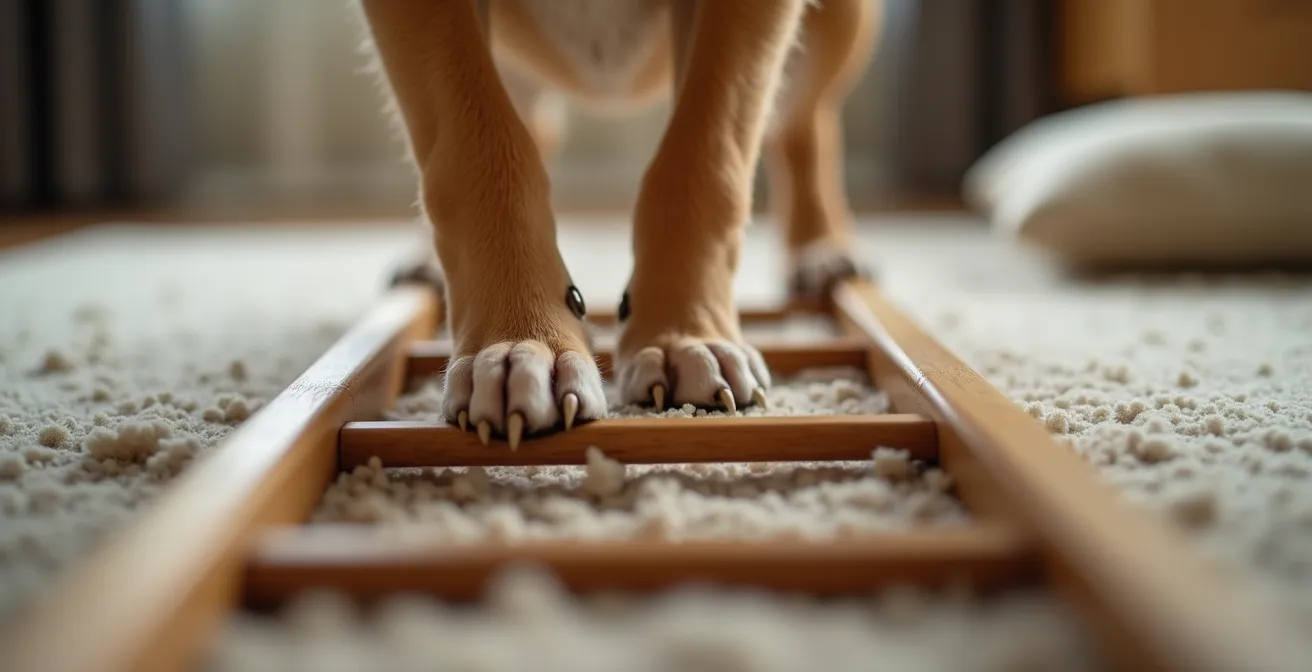
As you can see, you don’t need expensive equipment. A ladder laid flat, different textured mats, or cushions all encourage your dog to think about where they place their paws. This isn’t about the obstacle; it’s about the process of thinking and moving with intention. Each successful step is a tiny deposit in their confidence bank.
Your Pre-Agility Foundation Plan: Building Body Awareness
- Teach Nose Targeting: Start by teaching your dog to touch their nose to your hand, then to objects like a plastic lid or a target stick. This is your primary tool for guiding your dog without force.
- Introduce Spin and Bow: Use the nose target to lure your dog into a “spin” in both directions to stretch their sides. The “bow” position is a natural stretch that improves flexibility and can be captured and rewarded.
- Master Weaving and Backing Up: Practice figure-eight weaving around your legs to teach tight turns. Luring your dog to walk backward helps build rear-end awareness, a critical and often-neglected skill.
- Create Paw Placement Puzzles: Lay a ladder flat on the ground or place several small mats or boxes and reward your dog for placing their paws in or on them. This directly teaches them to be conscious of their footfalls.
- Integrate Gradually: Keep sessions short (1-5 minutes) and end on a high note. The goal is to build a positive association with learning and problem-solving, not to achieve perfection.
Growth Plates and Impact: When Is It Safe to Raise the Bar?
As a therapeutic instructor, my primary rule is “do no harm.” For a fearful dog owner, the thought of causing physical injury on top of emotional distress is a nightmare. This is why understanding your dog’s physical development is not just important—it’s a non-negotiable prerequisite to any activity involving impact. The most critical factor to consider is the status of your dog’s growth plates.
Growth plates are areas of soft, developing cartilage at the ends of a young dog’s long bones. They are weaker than solid bone and highly susceptible to injury. Repetitive impact from jumping or tight turns can damage these plates, potentially leading to deformities or premature arthritis. These plates do not close, or harden into solid bone, until a dog is physically mature. This is not a matter of opinion; it’s a biological fact.
The timeline for this closure varies significantly by breed size. According to veterinary guidelines, growth plates in small breeds may close as early as 6-10 months, while large and giant breeds may not be fully mature until 14-24 months. This is why a “one-size-fits-all” approach is dangerous. Raising the jump bar or encouraging high-impact maneuvers before these plates are confirmed closed by a veterinarian is gambling with your dog’s long-term soundness. For a fearful dog, a painful experience can erase months of confidence-building work. The rule is simple: keep jumps on the ground until your dog is well over a year old, and even later for larger breeds.
The 18-Month Rule: Why Jumping Is Ban for Puppies Under 1 Year?
The enthusiasm of a new puppy owner is a wonderful thing, but it must be tempered with patience and knowledge. When it comes to agility, the question isn’t “what can my puppy do?” but “what *should* my puppy do?” The “18-Month Rule” is a widely accepted guideline in the dog sports community that strongly advises against any high-impact activities, including jumping, for dogs under 12 to 18 months of age. As we’ve discussed, this is directly tied to the closure of their growth plates.
For a young dog, their body is still under construction. Forcing it to withstand the concussion of landing a jump is like asking a construction crew to work on a building with a shaky foundation. While an adult dog’s joints and ligaments are equipped to absorb shock, a puppy’s are not. This puts them at a much higher risk for acute injuries like sprains and fractures, as well as chronic issues later in life.
But this doesn’t mean you have to put all training on hold! The puppy period is a golden opportunity to build a “zero-impact” agility foundation. You can teach all the handling cues, body awareness, and obstacle familiarity without a single jump. This “pre-agility” curriculum focuses on building the dog’s brain and creating a positive association with the equipment and the game. A puppy who learns to love running through jump wings with no bar will be ecstatic when the bar finally appears, fully prepared mentally and physically.
Here are some safe and effective zero-impact agility exercises for puppies:
- Walk Through Jump Wings: Set up jump uprights without a bar and reward your puppy for walking or running through the middle.
- Ground-Level Hoops: Use a hoop resting on the ground and encourage your puppy to go through it.
- Cavaletti Poles on the Floor: Lay PVC pipes or broomsticks flat on the ground and have your puppy walk over them, which encourages them to lift their feet and be aware of placement.
- Wobble Board Exploration: Introduce very low, stable balance boards or even cushions to build confidence with moving surfaces.
- Tunnel Fun: A short, straight tunnel is often a favorite. Keep sessions short and use it as a high-value reward.
Front Cross vs. Rear Cross: How Your Body Language Steers the Dog?
Once the foundation is laid, agility becomes a dance. And in this dance, you are the leader. The dog is not guessing where to go next; they are reading a complex set of cues from your body. For a fearful dog, the clarity and predictability of this communication are everything. When your body language is consistent, the world becomes a safe, understandable place. When it’s messy, the world is confusing and scary. This is why mastering your own movement is more important than mastering the obstacles.
Handling maneuvers like the “Front Cross” (where you turn in front of your dog to change their path) and the “Rear Cross” (where you cross behind your dog) are just names for different ways of communicating direction. The choice isn’t about which is “better,” but which one communicates your intention most clearly to *your* dog in that specific moment. A successful cross is a silent sentence. Your shoulders dictate the path, your speed sets the pace, and your position relative to the obstacle tells the dog what to do next.
A fearful dog is an expert at reading body language. They notice the slightest hesitation in your step, the tension in your shoulders, or the frantic movement of your arms. These unintended signals are “noise” that drowns out your intended message. The key is to practice your movements *without the dog* first, until they are calm, deliberate, and quiet. As the team at Maximum Fun Dog Sports so aptly puts it:
Dogs respond to very small changes in cues, so make sure you are not taking extra steps in the wrong direction, flapping your arms, or shifting your shoulders on successive repetitions of a skill. Simple, clear, direct communication of what you want will build your dog’s confidence in your cues.
– Maximum Fun Dog Sports Training Team, Does Your Agility Dog Lack Confidence? Training Guide
Your goal is to become an honest and trustworthy dance partner. When your dog knows that your right shoulder always means “turn right,” they don’t have to worry about what’s coming. They can simply react, and that ability to react confidently is the bedrock of a strong partnership.
Running Contacts vs. Stopped Contacts: Which Strategy for Your Dog?
In agility, “contact obstacles” (like the A-frame, dog walk, and teeter-totter) have designated “contact zones” at the beginning and end, usually painted in yellow. The dog must touch these zones for a clean run. There are two main strategies for training this: “Running Contacts,” where the dog targets the zone at full speed, and “Stopped Contacts,” where the dog is trained to stop in a specific position (e.g., two paws on the obstacle, two on the ground) within the zone.
For competitive, high-drive dogs, running contacts are a way to shave seconds off their time. But for our therapeutic purpose with a fearful dog, the stopped contact is a gift of unparalleled value. A stopped contact is a built-in pause button. It’s a moment of intentional stillness in a world of motion. For a dog prone to anxiety or over-arousal, this stop provides a critical moment to take a breath, process information, and wait for the next cue. It transforms a potentially terrifying experience—like descending a steep ramp—into a predictable, controllable sequence: run, stop, wait, go.
This strategy gives the dog a clear “job” to do, and completing that job is highly rewarding. It replaces ambiguity with certainty. The dog learns, “My job is not to fly off this thing, but to get to the bottom and put my paws here. I know how to do that.” This builds an incredible sense of competence. The pause table, an obstacle that requires a five-second hold, is an excellent tool for teaching this concept of controlled stillness, as shown below.
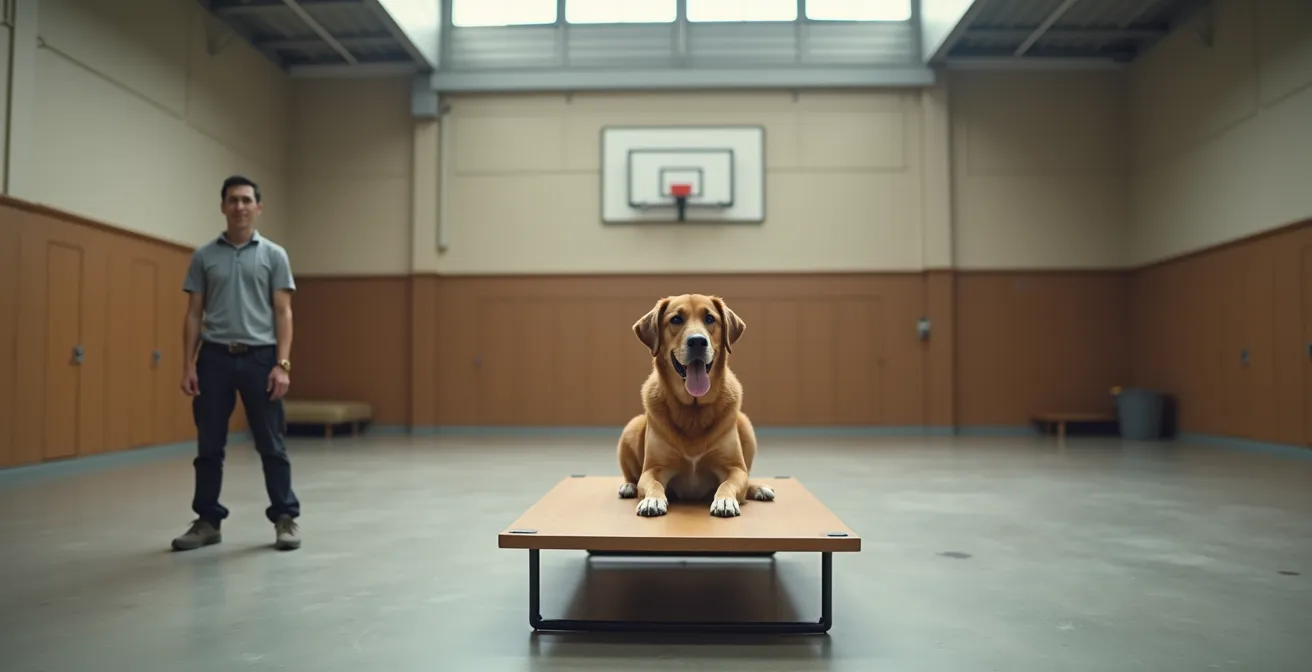
Building confidence on these moving or elevated surfaces requires breaking the task down into microscopic steps. You don’t start with a full teeter; you start with a wobble board, rewarding the dog for simply looking at it, then sniffing it, then touching it with one paw.
Case Study: The Teeter-Totter and Deconstruction
The teeter-totter, which moves and makes a noise, is often the most intimidating obstacle. To build confidence, you must deconstruct it. As experts in canine behavior suggest, you should start with low-movement items like a skateboard or a small wobble board. Reward any interest, then any paw contact, then any attempt to balance. The goal is to build a positive association with movement under their feet. Only when the dog is comfortable with these small movements do you move to a teeter. When it finally shifts and bangs for the first time, you’re ready with a “jackpot” of high-value treats to reward the dog for staying on, turning a scary moment into the best party ever.
The Warm-Up Routine to Prevent ACL Tears in Agility Dogs
A warm-up is not just for elite athletes; it’s a critical component of injury prevention and mental preparation for any dog engaging in physical activity. For an agility dog, especially a fearful one, the warm-up serves a dual purpose: it prepares the muscles, ligaments, and tendons for the explosive movements of agility, and it transitions the dog’s brain from a resting state to a focused, “ready-to-learn” state. The most common and devastating injury in agility is an ACL tear, and a proper warm-up is your best defense.
A good warm-up gradually increases the heart rate, warms the muscles, and lubricates the joints. It should not be strenuous. You’re not trying to tire your dog out; you’re gently waking up their body. A cold muscle is brittle and prone to tearing. A warm, pliable muscle can handle the stress of a tight turn or an awkward landing far more effectively.
For the anxious dog, the warm-up is also a vital ritual. It’s a predictable sequence that signals, “We are about to do our fun focus work together.” It allows them to acclimate to the environment, sniff the air, and connect with you before any performance pressure is applied. This ritual builds security and focus. The warm-up should include:
- A 5-Minute Calm Walk: This is the transition from car to work. It allows the dog to relieve themselves and get their blood flowing gently.
- Gentle Full-Body Movements: Incorporate play bows, gentle spins in both directions, and backing up. These movements activate the core and stretch the large muscle groups.
- Activation of the “Seeking System”: Tossing a few treats into short grass for your dog to “find it” engages their natural foraging instinct. This is a dopamine-releasing activity that promotes a positive emotional state.
- Focus and Engagement Games: Practice a few easy, known cues like “touch” or “watch me.” This gets their brain connected to yours and reinforces your role as the source of fun and safety.
- Sensory Exploration: Before starting your run, allow your dog to sniff a few of the obstacles without any pressure to perform. This satisfies their curiosity and reduces anxiety about the equipment.
The “Two-Leash” Rule for Transporting Flight-Risk Dogs
The confidence-building work of agility is irrelevant if your dog bolts from the car in the parking lot. For a dog with a high flight risk—common among fearful rescues—safety protocols are not optional. The “Two-Leash Rule” is a simple but potentially life-saving technique for transport and transitions. It means your dog is secured by two separate systems at all times when outside a fully fenced area. For example: a leash attached to a harness, AND a second leash attached to a martingale collar. Or, one leash and a secure connection to a waist belt on the handler. The key is redundancy. If one piece of equipment fails or a clip is fumbled, the backup is already in place.
This strict safety management does more than just prevent disaster; it contributes to the dog’s confidence. When the dog’s world is managed with such predictable security, they don’t have to be on high alert. They can begin to relax and trust that you, the handler, have things under control. This feeling of safety is the fertile ground in which confidence can grow.
This principle extends to the training itself. The goal of agility as therapy is to create a series of solvable problems. As the iHeartDogs training team notes, “A lack of confidence often comes from feeling they don’t have control over what’s happening.” Agility gives them that control in a micro-environment. A successful run through a tunnel or a confident completion of the dog walk provides a powerful lesson: “I was faced with a challenge, I performed an action, and I succeeded.” This success in one small area begins to generalize. The confidence gained from clearing a jump can translate into being a little less scared of the vacuum cleaner at home. We see this in action at rescues like the Colorado Springs Zoom Room, where huskies undergoing agility training showed marked improvement in their overall confidence and trust.
Key Takeaways
- Agility for fearful dogs is a communication tool, not a race. The goal is dialogue and understanding, not speed.
- The handler’s clear, calm, and consistent body language is the single most important factor in building a dog’s confidence.
- Safety is paramount. Respecting a dog’s physical development (like growth plates) and using safety protocols (like the two-leash rule) builds a foundation of trust.
Why Your Spaniel Paces: The Consequence of Unmet Working Instincts
While the title mentions Spaniels, the principle applies to countless breeds and mixes: many behaviors we label as “anxious,” like pacing, circling, or destructive chewing, are often the result of unmet working instincts. Breeds from herding, sporting, or terrier groups were developed for centuries to perform specific jobs. They are hardwired to think, problem-solve, and move with purpose. A modern home, no matter how loving, often fails to provide an appropriate outlet for this deep-seated genetic drive.
This is where agility shines as a therapeutic tool. It provides a “job” that satisfies these core canine instincts on multiple levels. The course presents a series of challenges that engage the seeking system (the drive to find the next obstacle), the need for problem-solving (how to navigate the weave poles or approach a jump), and the deep desire to work in partnership with a teammate—you. For a high-energy dog whose brain is “unemployed,” this structured work is incredibly calming and satisfying. It channels their mental and physical energy into a productive task, leaving them too tired and fulfilled to be anxious.
This approach is particularly effective for dogs that seem to lack focus or fidget constantly. Agility gives their busy brains a puzzle to solve. Instead of their energy being scattered and anxious, it becomes focused and directed. This is more than just exercise; it is mental enrichment of the highest order. The rising interest in canine sports, with a 12% increase in participation, shows that more owners are discovering the benefits of giving their dogs a job. For a fearful dog, this job becomes their anchor, proving to them that they are capable, competent, and a valuable member of a team.
Now that you understand the “why” behind using agility as a therapeutic tool, the next step is to begin. Don’t go out and buy a full course of obstacles. Start tonight, in your living room, with a handful of treats and the goal of teaching a simple nose target. That is the first sentence in your new conversation.
Frequently Asked Questions on Agility for Fearful Dogs
Can agility help my anxious dog who doesn’t know what will happen next?
Yes, absolutely. Anxious or nervous dogs often get stressed by uncertainty. The structured, repetitive nature of agility training provides a predictable routine that can be very comforting. The dog learns the sequence of the course, which helps them anticipate what comes next in a positive way, reducing their overall stress.
Is agility suitable for dogs with behavioral issues?
For many common behavioral issues stemming from boredom, anxiety, or lack of confidence, agility can be a fantastic outlet. It provides both physical exercise and mental stimulation, which can help tire out a dog and reduce problem behaviors. The regular routine and clear communication involved help establish a healthier, more confident mindset.
How does agility address unmet instincts?
Agility directly satisfies several core canine instincts. The drive to find the next obstacle taps into their natural “seeking” and hunting behaviors. Navigating complex sequences like weave poles engages their problem-solving abilities. Most importantly, it fulfills their instinct to work in partnership with a handler, strengthening the bond and giving them a sense of purpose.