In summary:
- Days 1-2 (Isolation): The new kitten must stay in a “safe room” to allow stress hormones (cortisol) to normalize.
- Days 2-4 (Scent Swapping): Introduce pets through smell alone by exchanging bedding and toys to build positive scent-memory.
- Days 4-6 (Visual Contact): Use barriers like baby gates for short, supervised visual meetings, focusing on rewarding calm behavior.
- Day 7+ (Supervised Interaction): Allow short, supervised time together in a neutral space, ready to intervene at the first sign of stress.
Bringing a new kitten into a home with existing pets is a moment filled with both excitement and anxiety. As a cat owner, your primary concern is likely how your resident cat or dog will react. You’ve probably heard vague advice like “let them sort it out” or “just separate them for a bit.” These approaches leave too much to chance and often pave the way for territorial aggression, fear, and long-term behavioral problems. The stress of a poorly managed introduction can manifest in everything from hissing and fighting to stress-induced illnesses like urinary tract infections.
The common mistake is treating this as a social meet-and-greet. It’s not. From a feline perspective, this is a high-stakes territorial negotiation. The key to success doesn’t lie in forcing friendship, but in carefully managing the sensory information your pets receive. A successful integration is a science, one that hinges on preventing negative first impressions from becoming permanently ingrained.
This is where my role as a feline behaviorist comes in. Forget what you think you know. We are going to approach this with a strict, methodical protocol. This 7-day plan is designed around one core principle: managing your pets’ stress hormones and controlling the narrative of their first encounter. We will focus on what I call scent-memory and cortisol management. This structured process systematically reduces the risk of rejection and builds a foundation for, if not friendship, then at least peaceful coexistence. This guide will walk you through each non-negotiable step to orchestrate a harmonious multi-pet household.
For those who prefer a visual overview, the following video summarizes some of the key principles of a successful cat introduction, complementing the detailed, step-by-step protocol in this guide.
To ensure a smooth and successful integration, it’s essential to follow a clear, sequential plan. The following sections are structured as a day-by-day guide, addressing the most critical challenges you’ll face at each stage of the introduction. This structured approach is the key to preventing conflict and fostering a peaceful environment.
Table of Contents: A Week-Long Plan for Multi-Pet Harmony
- Why Your Kitten Needs a Solitary Safe Room for the First 48 Hours?
- How to Swap Scents Between Pets Without Direct Contact?
- Visual Barriers or Baby Gates: Which to Choose for High-Prey Drive Dogs?
- The Feeding Mistake That Causes 80% of Early Feline Aggression
- When to Intervene: Rough Play vs. Predatory Drift Signs
- Where to Place the Litter Box to Avoid “Corner Trapping” Stress?
- Diffusers vs. Sprays: Which Pheromone Works for Multi-Cat Tension?
- Why Your Cat Scratches the Sofa Despite Having a Post?
Why Your Kitten Needs a Solitary Safe Room for the First 48 Hours?
The single most critical phase of any introduction is the first 48 hours, and the rule here is absolute: your new kitten must be completely isolated in a dedicated “safe room.” This is not a suggestion; it’s a biological necessity. When a kitten enters a new, unknown territory filled with the scents of other animals, its body is flooded with cortisol, the primary stress hormone. This puts the kitten in a state of high alert, making it impossible to form positive associations. The goal of the safe room is cortisol management, allowing these hormone levels to return to baseline so the kitten can start to feel secure.
This initial separation is the bedrock of a successful integration. Rushing this step is the most common and damaging mistake owners make. Research shows that structured introductions, which always begin with a period of separation, have a significantly higher success rate. One analysis found that following a gradual introduction protocol can increase the chances of a peaceful outcome by over 68%. The safe room provides a sanctuary where the kitten can decompress, eat, drink, and use the litter box without fear of being ambushed. It is here, in this controlled environment, that the entire territorial negotiation begins.
Your 48-Hour Safe Room Setup Checklist
- Choose a quiet room with a secure door and places for the kitten to hide, like a bathroom or spare bedroom. Ensure it is fully kitten-proofed.
- Equip the room with its own food, water, litter box, toys, and comfortable bedding. These resources must be separate from the resident pets’ items.
- Plug in a feline pheromone diffuser (like Feliway Classic) 24 hours before the kitten arrives to saturate the room with calming signals.
- Keep the door completely closed for the full 48 hours. No exceptions. This allows the kitten’s cortisol levels to normalize and prevents premature, stressful encounters.
- Monitor food intake and litter box usage from a distance to ensure the kitten is adjusting and not showing signs of medical distress.
Think of this room as the kitten’s embassy in a foreign land. It is a sovereign territory from which all future diplomatic missions—scent swapping, visual meetings, and finally, shared space—will be launched. Protecting this initial period of calm is your first and most important job as the mediator.
How to Swap Scents Between Pets Without Direct Contact?
Once your kitten’s initial stress levels have stabilized in the safe room, the next phase of the territorial negotiation begins. This phase is conducted entirely through smell. For cats and dogs, scent is the primary form of communication; it’s their version of exchanging detailed social media profiles. Your job is to be the messenger, ensuring the first “conversation” they have is a positive one. This process is about creating a positive scent-memory, where the smell of the other animal becomes associated with comfort and safety, not threat.
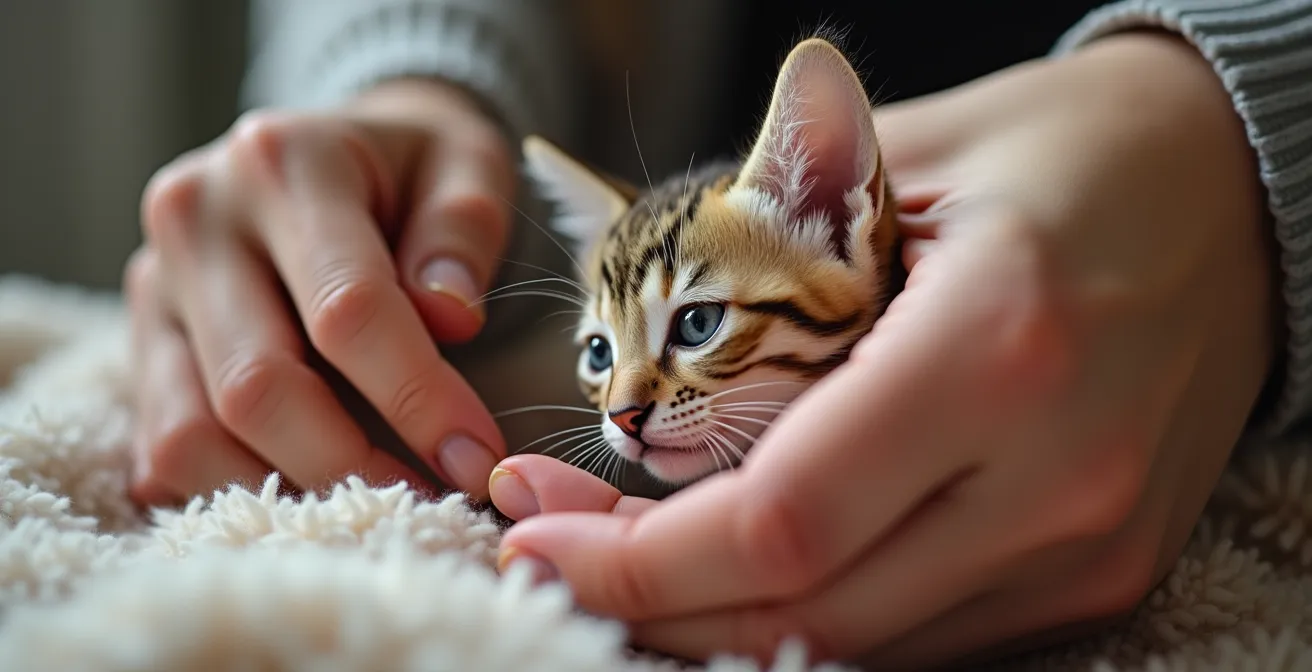
The technique is simple but must be done correctly. Take a soft cloth or sock and gently rub it on your kitten’s cheeks and head to collect their facial pheromones—their “happy” scents. Place this cloth in your resident pet’s area, perhaps near their food bowl but not in it. Do the reverse with another cloth for your resident pet and place it in the kitten’s safe room. This exchange allows them to investigate each other’s scent on their own terms, without the pressure of a face-to-face encounter. They are learning about each other long before they ever see each other.
For a clear visual on the correct technique, the image below demonstrates how to gently collect scent from a kitten’s cheek glands. This is the source of the most important social pheromones.
This method was used with great success in a documented case where a veterinary professional introduced a new cat, Miso, into a home with four resident cats. They used extensive scent swapping with bedding and toys. By creating a rich and positive tapestry of shared scents throughout the house before any physical meeting, they established a foundation of familiarity. This gradual scent introduction was credited with preventing any significant territorial aggression, leading to a peaceful coexistence within just a few weeks. The resident cats had already “met” Miso through scent long before they laid eyes on her.
Visual Barriers or Baby Gates: Which to Choose for High-Prey Drive Dogs?
After several days of successful scent swapping, your pets are aware of each other’s existence in a non-threatening way. Now, we can cautiously proceed to the visual introduction phase. The goal here is controlled exposure: “I can see you, but I can’t get to you.” This is where barriers come into play. However, not all barriers are created equal, and choosing the wrong one, especially with a high-prey drive dog, can be disastrous. A standard baby gate that allows a dog to fixate, whine, and potentially lunge can dramatically increase frustration and reinforce the kitten as a “prey” object.
Your choice of barrier must be tailored to the temperament of your resident pet, particularly if it’s a dog. For a calm, older dog, a standard pet gate might be sufficient. But for a dog with a high prey drive (like many terriers or sighthounds), you must prevent direct, exciting eye contact initially. The key is to manage the intensity of the stimulus. You can start with a door cracked only an inch, allowing scent to pass but offering only a sliver of a view. Another effective method is to use two baby gates stacked on top of each other, or a single gate with a blanket draped over the top half, gradually lowering the blanket over several sessions as the dog remains calm.
This controlled visual access is a critical part of the ongoing territorial negotiation. It allows the animals to observe each other’s body language from a safe distance, learning routines and behaviors without the risk of physical conflict. The following table, based on recommendations from cat behavior experts, can help you choose the right tool for your specific situation.
| Barrier Type | Best For | Pros | Cons |
|---|---|---|---|
| Pet Gate | Calm to moderate dogs | Visual contact, walk-through door, adjustable height | Can increase frustration in high-prey dogs |
| Screen Door | Most temperaments | Full height barrier, allows scent exchange | Installation required |
| Cracked Door (1 inch) | High-prey drive dogs | Minimal visual stimulus, prevents lunging | Limited interaction initially |
| Blanket-Draped Gate | Gradual introduction | Adjustable visual access | Requires monitoring |
As an analysis from cat behaviorist Jackson Galaxy’s team suggests, the right barrier is one that minimizes arousal and maximizes safety. The goal is boredom. You want the sight of the other animal to eventually become uninteresting, a normal part of the background. Only when both pets can see each other through the barrier without signs of agitation (hissing, growling, fixation) can you consider moving to the next step.
The Feeding Mistake That Causes 80% of Early Feline Aggression
One of the most common pieces of advice is to feed pets together to build a positive association. In theory, it makes sense: food is good, so seeing the other pet while eating should be good. In practice, this is where a staggering number of introductions go wrong, leading to what behaviorists call resource guarding. Placing two unfamiliar animals close together with a high-value resource like food is a recipe for conflict. It can create tension, aggression, and solidify the idea that the other animal is a competitor, a problem that can persist for life.
The correct way to use food as a tool is to feed the pets simultaneously, but on opposite sides of a closed door. The kitten eats in its safe room, and the resident pet eats just outside the door. They can smell each other and hear each other eating, associating that scent and sound with the positive experience of a meal, but without the threat of competition. As cat behavior expert Jackson Galaxy puts it, the subconscious message becomes:
Every time I get food, I smell you… you can’t be bad
– Jackson Galaxy, as quoted on Rover.com
This method masterfully builds a positive scent-memory. You should only gradually move the bowls closer to the door over several days. Once they are eating calmly right next to the closed door, you can transition to feeding them on opposite sides of a visual barrier, like a baby gate, but starting far apart again. Rushing this process is a critical error. The goal is to ensure that every mealtime interaction is calm and positive.
To avoid this common pitfall, follow this strict feeding protocol:
- Start with food bowls at least 10 feet apart, on opposite sides of the closed door to the safe room.
- Use their regular daily food. High-value treats or wet food can increase excitement and the potential for competition at this early stage.
- Only after 2-3 consecutive calm meals, move each bowl 1-2 feet closer to the door. If any hissing or growling occurs, move them back to the last successful distance.
- Do not rush to feeding with a visual barrier. Wait until they can eat comfortably just a foot apart with the door closed.
- Even after a full introduction, it’s wise to maintain separate “dining bubbles” to prevent any future resource guarding from developing.
Patience during this feeding ritual is paramount. It teaches the animals that the presence of the other predicts a good thing (food) but does not threaten their access to it. This is a foundational lesson in multi-pet diplomacy.
When to Intervene: Rough Play vs. Predatory Drift Signs
After days of careful, structured introductions, the moment will come when you allow your pets to share the same space under strict supervision. This is often where owners face a new anxiety: is that playing or fighting? Knowing when to let them interact and when to intervene is crucial. Misinterpreting the signs can either stifle a budding healthy relationship or allow a dangerous situation to escalate. The key is to learn the difference between reciprocal rough play and the silent, focused behavior known as predatory drift.
Healthy play between cats, even if it looks rough, has a distinct give-and-take quality. You will see role reversal, where one cat chases and then the other takes a turn. There will be frequent pauses, with one cat stopping to groom or look away, signaling “this is still a game.” Batting is usually done with “soft paws” (claws retracted), and while there might be some noise, it’s often more wrestling-style grunts than true screams of fear or pain. These interactions, while energetic, are building social bonds and establishing boundaries.
However, there are clear red flags that demand immediate, calm intervention. This is not play; it is conflict or worse, the switch from playmate to prey. The most dangerous sign is a sudden silence and intense focus from the aggressor. This is predatory drift, where the playful instinct shifts into a hunting sequence. You must intervene when you see:
- A fixed, unblinking stare from one animal to the other, often accompanied by a low, twitching tail.
- One-sided pursuit, where one animal is consistently the chaser and the other is consistently trying to flee and hide.
- The aggressor goes silent, losing the playful vocalizations as their focus narrows. This is a classic sign of the hunting instinct taking over.
- Hissing, spitting, or growling from the animal being pursued, along with flattened ears and a puffed-up tail.
- Any actual injury, no matter how small. All interactions must stop immediately.
If you see any of these signs, do not shout or panic, as this adds to the chaos. Instead, use a loud clap or a thrown object (not at the pets) to create a distraction, then calmly separate them. End the session and take a step back in your introduction protocol. This isn’t a failure; it’s data. It tells you that you’ve moved too fast and they need more time at the previous stage to build confidence and security.
Where to Place the Litter Box to Avoid “Corner Trapping” Stress?
In the complex world of feline territorial negotiation, the litter box is not just a toilet; it’s a point of extreme vulnerability. A cat using the litter box is in a compromised position, and if they feel unsafe, they will avoid it, leading to inappropriate elimination—one of the top reasons cats are surrendered to shelters. When introducing a new kitten, strategic litter box placement is crucial to prevent what I call “corner trapping” stress. This occurs when a resident pet ambushes or simply blocks the kitten’s access to or exit from the litter box, creating a highly stressful and negative association.
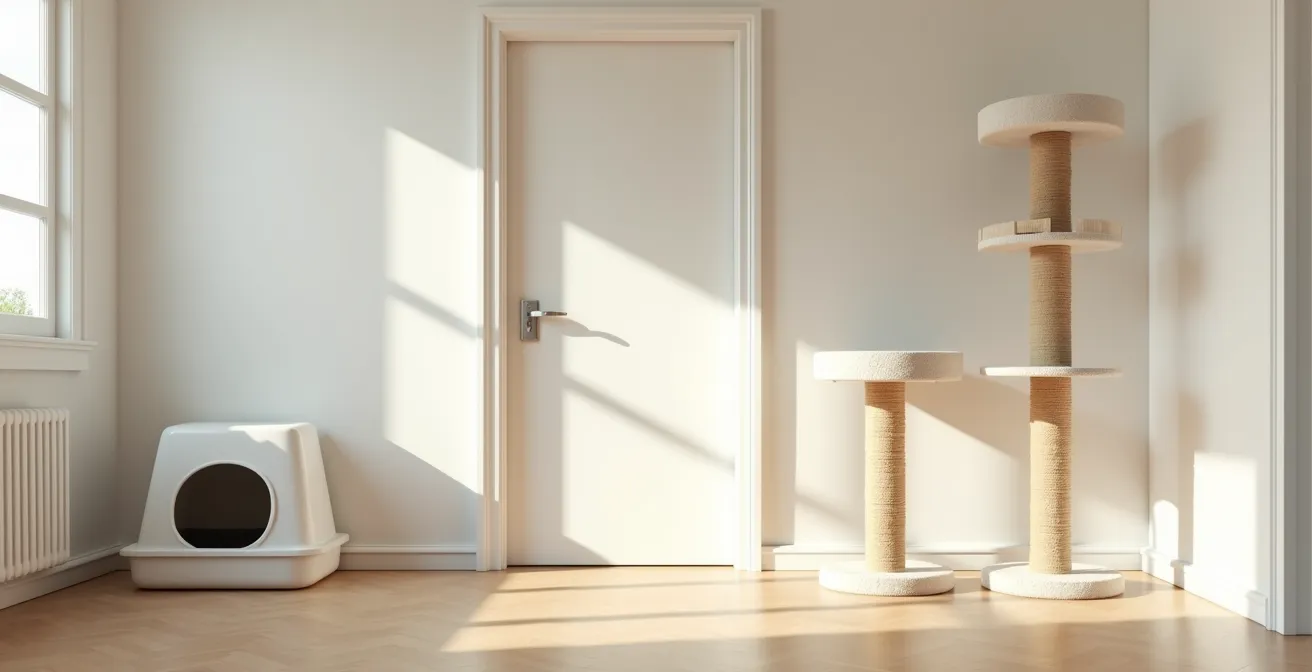
The golden rule of litter box placement in a multi-pet home is to ensure the user has a 360-degree view and multiple escape routes. A box tucked away in a small, dead-end laundry room or inside a cabinet might seem tidy to us, but to a cat, it’s a trap. The ideal location allows the cat to see the entrances to the room while they are in the box, so they cannot be surprised. This means avoiding both high-traffic hallways and cramped, hidden closets. The goal is a location that is both accessible and secure.
The image below illustrates an ideal setup. Notice how the litter box is in a corner but provides clear sightlines to the doorways. The nearby cat tree is not just for fun; it serves as a critical vertical escape route, allowing a cat to quickly ascend out of reach if they feel threatened.
To ensure litter box harmony, follow these essential guidelines:
- Follow the n+1 Rule: You should have at least one litter box per cat, plus one extra. For your new kitten and one resident pet, you need a minimum of three boxes.
- Disperse the Boxes: Place the boxes in different areas of the house. Lining them all up in one room allows a dominant pet to “guard” all of them at once.
- Ensure Sightlines: Position boxes so the cat can see the approach of other pets. Low-traffic corners of larger rooms are often better than small, enclosed spaces.
- Provide Vertical Escapes: Place cat trees, shelves, or sturdy furniture near litter box areas to give cats a way to escape upwards if they feel cornered.
By providing safe and strategically placed litter boxes, you remove a major potential source of conflict and stress. You are communicating to all pets that this essential resource is abundant and secure, a key step in successful territorial negotiation.
Key takeaways
- Isolation is Scientific: The initial 48-hour separation isn’t about punishment; it’s a biological necessity to lower stress hormones and prevent negative first impressions.
- Scent is a Language: Before they see each other, pets can learn about one another through scent. Managing this “first conversation” is your most powerful tool.
- Slow is Fast: Every step of this protocol is designed to prevent a setback. Rushing the process is the surest way to create long-term conflict. Patience now saves months of stress later.
Diffusers vs. Sprays: Which Pheromone Works for Multi-Cat Tension?
In the modern toolkit for feline behavior management, synthetic pheromones are an invaluable asset for cortisol management. These products mimic the natural pheromones that cats use to communicate feelings of safety, harmony, and territorial ownership. When used correctly during an introduction, they can significantly lower the ambient stress in your home and smooth the path to acceptance. However, many owners are confused by the different types available—primarily diffusers and sprays—and use them incorrectly. Choosing the right product for the right situation is key to their effectiveness.
Pheromone diffusers are designed for continuous, area-wide environmental management. A Feliway Classic diffuser, which mimics the feline facial pheromone, is perfect for the kitten’s safe room. It sends the constant message, “This place is safe and secure.” In the shared areas of the house where all pets will eventually interact, a Feliway MultiCat diffuser is more appropriate. It mimics the appeasing pheromone a mother cat releases to her kittens, sending a message of social harmony and helping to reduce tension and conflict between cats.
Pheromone sprays, on the other hand, are for targeted, short-term use. They are perfect for applying to the blankets or toys you are using for scent swapping, or for spraying in a carrier before a vet visit. Their effect is more localized and lasts only a few hours. The power of these tools is backed by science; research from institutions like Cornell University has shown that using pheromones can reduce signs of stress during introductions by up to 78%. The following table breaks down the best use for each product type during your 7-day introduction.
This comparative analysis, based on information from veterinary sources like Small Door Vet, helps clarify which product to use where.
| Product Type | Best Use Case | Coverage Area | Duration |
|---|---|---|---|
| Feliway Classic Diffuser | Kitten’s safe room – ‘this place is safe’ message | Up to 700 sq ft | 30 days continuous |
| Feliway MultiCat Diffuser | Shared living spaces – ‘we are harmonious’ message | Up to 700 sq ft | 30 days continuous |
| Pheromone Spray | Targeted application on bedding, carriers for scent swapping | Specific objects | 4-5 hours per application |
Think of pheromones as setting the background music for your introduction. A diffuser playing a “calm and safe” song in the safe room and a “harmony” tune in the living room creates an invisible support system, making all the other steps of the protocol more likely to succeed.
Why Your Cat Scratches the Sofa Despite Having a Post?
It’s a common and frustrating scenario: you’ve spent money on a beautiful scratching post, yet your resident cat insists on scratching the arm of the sofa, especially since the new kitten arrived. This isn’t an act of spite; it’s a desperate act of territorial negotiation. Scratching has two functions for a cat: nail maintenance and, more importantly, communication. A cat’s paws contain scent glands, and when they scratch a surface, they are leaving a powerful visual and olfactory message: “This is mine. I was here.”
When a new kitten is introduced, the resident cat’s sense of security is threatened. The entire territory is now “contaminated” with the scent of an intruder. In response, the cat will often ramp up its marking behavior to re-establish its claim. They target socially significant areas—like the sofa where the family’s scent is strongest—to “over-mark” and drown out the new kitten’s smell. They are essentially shouting their ownership from the rooftops. The fact that they are ignoring the new post is not about the post itself, but its location and social relevance.
Case Study: Territory Re-establishment Through Scratching
Behavioral observations in multi-cat homes consistently show that resident cats increase their scratching on prominent, shared furniture like sofas immediately following the introduction of a new cat. This behavior, known as “over-marking,” is a direct response to the territorial stress. The cat uses the scent glands in its paws to re-apply its own scent over the combined smells of the family and the new kitten, attempting to reclaim a socially important piece of territory during a period of uncertainty.
To solve this, you must think like a cat. The solution is not to punish the cat, but to make the “legal” scratching options more appealing than the “illegal” ones. This means providing the right type of posts in the right locations.
- Location is everything: Place new, sturdy scratching posts directly beside the furniture they are targeting. You are offering a better alternative right at the scene of the crime.
- Create a scratching buffet: Cats have preferences. Offer a variety of materials (sisal rope, carpet, cardboard, wood) and orientations (vertical posts, horizontal pads).
- Stability is key: Ensure all posts are tall enough for a full-body stretch and are completely stable. A wobbly post is an unsafe and undesirable post.
- Mark the territory borders: Place additional posts at the borders of their territory, such as in doorways between rooms, to give them appropriate places to leave their “signage.”
By understanding that the scratching is a symptom of territorial insecurity, you can provide the right tools to help your cat feel confident again. You are giving them the resources they need to successfully and appropriately renegotiate the boundaries of their world.
Committing to this structured, seven-day protocol is the single best investment you can make in the long-term peace of your multi-pet household. It requires patience and strict adherence, but it transforms a potentially chaotic event into a controlled, successful negotiation. Your next step is to prepare the safe room and begin this journey with the confidence that you are setting all of your pets up for a lifetime of harmonious coexistence.