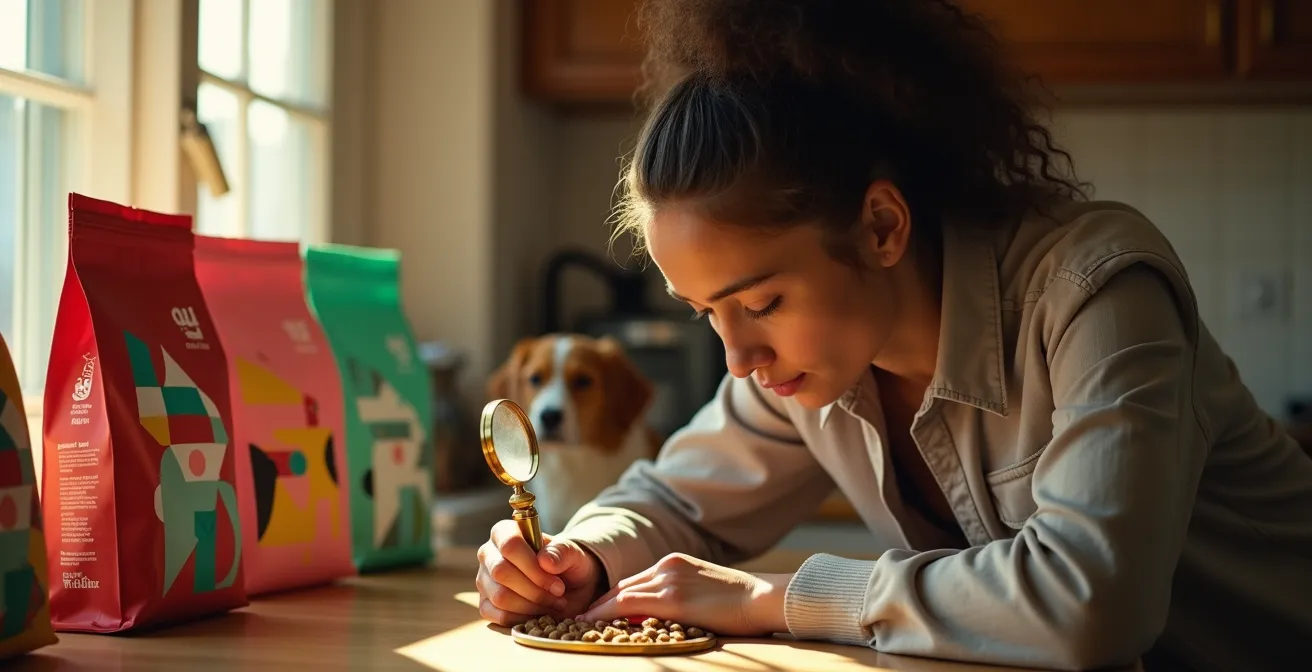
The ingredient list on your pet’s food bag is a marketing tool first and a nutritional guide second; true quality is found by analyzing nutrient density, not just ingredient rank.
- “Fresh chicken” is mostly water; concentrated “chicken meal” often provides more actual protein per gram.
- “Grain-free” foods frequently use “legume loading” (peas, lentils) which can hide low-quality fillers and is linked to heart conditions like DCM.
Recommendation: Stop reading the label like a menu. Start analyzing it like a forensic accountant by calculating nutrition on a dry matter basis and identifying split ingredients to understand what you are really paying for.
You stand in the pet food aisle, holding a bag of kibble that costs more per pound than your own groceries. The packaging is a masterpiece of marketing: rustic fonts, images of farm-fresh chicken, and bold claims like “Grain-Free” and “Ancestral Diet.” The first ingredient is “Deboned Chicken,” which you’ve been told is the gold standard. Yet, your pet is still itchy, overweight, or lethargic. This dissonance between premium price and mediocre results is a common frustration for conscientious pet owners.
The conventional wisdom is to check the first five ingredients and avoid grains or by-products. This advice is not just outdated; it’s a trap set by marketing departments. It fails to account for the physics of water weight, the chemistry of manufacturing, and the clever legal loopholes that allow a bag front-loaded with legumes to masquerade as a meat-rich diet. The pet food industry has perfected the art of making you feel good about what you’re buying, even if the nutritional reality is vastly different.
But what if the key wasn’t simply reading the ingredient list, but deconstructing it? This guide abandons the surface-level platitudes. Instead, it equips you with the skeptical mindset of a pet nutritionist. We will not be checking boxes; we will be forensic accountants of pet food. We will explore how processing methods alter nutrient value, why storage is a critical nutritional factor, and how to spot the “ingredient splitting” scams that artificially inflate the position of meat on the label. Forget the marketing promises; it’s time to learn the language of nutritional truth.
This article provides a systematic approach to demystify kibble labels. Each section tackles a common myth or deceptive practice, giving you the analytical tools to make a truly informed choice for your pet’s long-term health.
Table of Contents: Decoding Your Pet’s Kibble Bag
- Why “Chicken Meal” Can Be Superior to “Fresh Chicken” by Weight?
- How to Calculate Exact Calories for a Spayed Indoor Cat?
- Baked vs. Extruded Kibble: Which Retains More Vitamins?
- The Storage Mistake That Spoils Expensive Kibble in 2 Weeks
- When to Avoid Grain-Free Diets: The DCM Risk Explained
- Chicken or Fish: Which Is the Top Allergen for Itchy Cats?
- Peas, Pea Flour, Pea Protein: How “Grain-Free” Diets Hide Filler?
- Why Overweight Dogs Die 2 Years Earlier Than Lean Dogs?
Why “Chicken Meal” Can Be Superior to “Fresh Chicken” by Weight?
One of the most effective marketing tactics is listing “fresh chicken” or “deboned beef” as the first ingredient. It evokes images of a prime cut from the butcher. However, this is misleading due to a simple factor: water content. Fresh chicken is composed of roughly 70% water. Pet food ingredients are listed by pre-processing weight. When that fresh chicken is cooked and extruded to create a dry kibble, most of that water evaporates.
“Chicken meal,” on the other hand, is a dry, rendered product. It has already had its water and fat removed, leaving behind a concentrated protein and mineral source. High-quality chicken meal contains only about 10% moisture. This means that by final, post-processing weight, a food with chicken meal listed second or third may contain significantly more actual animal protein than a food with “fresh chicken” listed first. An analysis of industry standards shows that chicken meal can contain upwards of 65% protein, whereas fresh chicken contains only about 18%.
Therefore, seeing “chicken meal” on a label is not necessarily a red flag; in many cases, it’s a sign of a more protein-dense formula. The key is to distinguish high-quality “chicken meal” from generic “meat meal” or “by-product meal,” which can be of much lower quality. A reputable manufacturer will be transparent about the source of their meal, ensuring it’s made from clean muscle and skin, not undesirable parts.
How to Calculate Exact Calories for a Spayed Indoor Cat?
Relying solely on the feeding guidelines printed on a kibble bag is a primary contributor to the pet obesity epidemic. These charts are formulated for the “average” active, intact animal and often overestimate needs. For an indoor, spayed or neutered cat, this is a recipe for weight gain. Hormonal changes after the procedure can reduce a cat’s metabolic rate by up to 30%, while simultaneously increasing their appetite. This combination is a dangerous one.
To determine the correct portion, you must calculate your cat’s specific energy needs. The most accurate method involves a two-step calculation. First, find the Resting Energy Requirement (RER) using the formula: RER = 70 x (body weight in kg)^0.75. For a typical 4.5kg (10 lb) cat, this is about 220 calories per day.
Second, you adjust this RER with a multiplier based on lifestyle. For a spayed/neutered indoor cat, the multiplier is typically 1.0 to 1.2. So, our 4.5kg cat needs approximately 220-264 calories per day. You must then use the “calories per cup/kg” information on the bag and a digital kitchen scale to measure out this exact amount. A measuring cup is wildly inaccurate and should never be used for portion control. This precise approach allows you to adjust portions by small increments based on regular body condition scoring, rather than relying on a generic, and often incorrect, bag recommendation.
Your Action Plan: 4-Week Calorie Adjustment for a Spayed Cat
- Week 1: Calculate initial needs using the formula: RER = 70 x (body weight in kg)^0.75, then multiply by 1.2.
- Daily: Weigh all food portions with a digital scale. Do not use measuring cups.
- Weekly: Perform a Body Condition Score (BCS) assessment. You should be able to feel the ribs and see a waist tuck from above.
- Adjustment: If weight is increasing or BCS is above 5/9, reduce daily calories by 10%. If weight is decreasing too rapidly (over 2% of body weight per week), increase calories by 5%.
- Mindset: Ignore begging behavior. Post-spaying, it’s often driven by hormones, not true hunger.
Baked vs. Extruded Kibble: Which Retains More Vitamins?
Not all kibble is created equal, and the difference starts with the manufacturing process. The vast majority of dry pet food is made through extrusion. In this high-temperature, high-pressure process, a dough of ingredients is cooked rapidly and forced through a die, which cuts it into the familiar kibble shapes. This method is efficient and excellent at gelatinizing starches, making them more digestible. However, the intense heat can be devastating to delicate nutrients.
An alternative method is baking. Baked kibble is cooked more slowly, at lower temperatures and without the same intense pressure. This gentler process is significantly better at preserving heat-sensitive vitamins and the integrity of fats and oils. For example, essential vitamins like Thiamine (B1) can be almost entirely destroyed during extrusion, while baking retains a much higher percentage. Similarly, fats in baked kibble are less prone to damage, reducing the need for the heavy, sprayed-on coatings of fat and flavor enhancers that are required to make extruded kibble palatable.
This macro photograph highlights the structural differences. The baked kibble (left) is denser and more irregular, while the extruded piece (right) is light and porous, a result of the expansion during the high-pressure process.
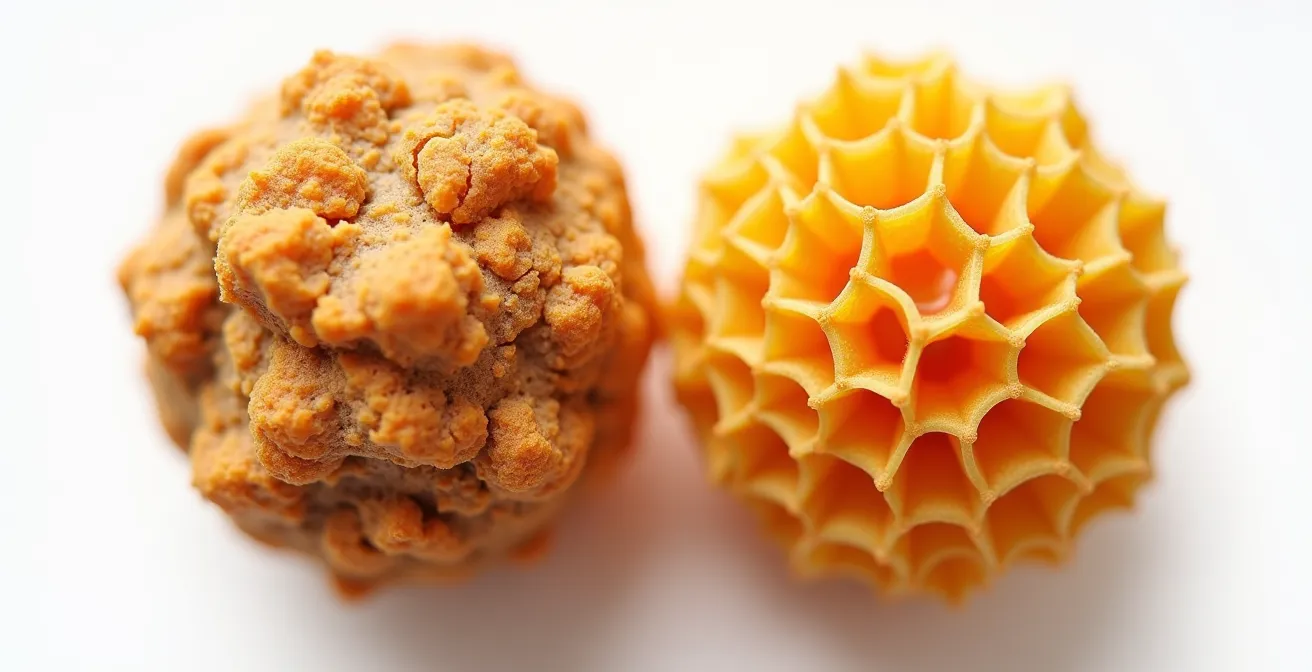
While extrusion offers superior starch digestibility, the trade-off in nutrient degradation is significant. When evaluating a food, considering the manufacturing process provides another layer of insight beyond the ingredient list. The table below outlines the key differences:
| Aspect | Extruded Kibble | Baked Kibble |
|---|---|---|
| Processing Temperature | 250-350°F (high pressure) | 200-250°F (atmospheric pressure) |
| Vitamin B1 (Thiamine) Loss | Up to 90% destroyed | 20-40% loss |
| Vitamin A Retention | Significant degradation | Better preserved |
| Texture | Light, airy, uniform (like cereal) | Dense, darker, irregular |
| Starch Gelatinization | Complete (more digestible) | Partial (less digestible) |
| Post-process Coating | Required for palatability | Less dependency on sprayed fats |
| Shelf Life After Opening | Coating prone to rancidity | More stable without heavy coating |
The Storage Mistake That Spoils Expensive Kibble in 2 Weeks
You’ve invested in a high-quality, expensive kibble. The worst thing you can do is dump it into a large, plastic container. This common practice, known as “decanting,” exposes the food to its two greatest enemies: oxygen and light. The fats and oils in kibble, especially the sprayed-on coatings on extruded products, are highly susceptible to oxidative rancidity. This is a chemical process where fats break down, creating a foul, paint-like smell and destroying essential nutrients.
Once a bag of kibble is opened, the clock starts ticking. When exposed to oxygen and heat, crucial nutrients degrade rapidly. Studies show that fat-soluble vitamins (A, D, E, and K) can degrade by 50% within just a couple of weeks of improper storage. This means the guaranteed analysis on the bag is no longer accurate, and your pet is not receiving the nutrition you paid for. The food becomes not just less nutritious, but potentially harmful, as rancid fats can cause gastrointestinal upset and other health issues.
The solution is counter-intuitive. The original bag is your friend. Pet food bags are specifically designed with multi-laminate layers that act as a superior fat and oxygen barrier. The best practice is to keep the kibble in its original packaging, roll the top down tightly to expel as much air as possible, and secure it with a clip. For an extra layer of protection, place the entire closed bag inside an airtight container. Furthermore, you should never “top up” a container with a new bag of food. This mixes older, potentially rancid crumbs with the fresh food, accelerating the spoilage of the entire batch.
When to Avoid Grain-Free Diets: The DCM Risk Explained
For years, “grain-free” was the ultimate marketing buzzword, equated with a healthier, more “ancestral” diet. However, this trend has been shadowed by a serious concern: a link to a potentially fatal heart condition called non-hereditary Dilated Cardiomyopathy (DCM). The U.S. Food and Drug Administration (FDA) launched an investigation after a spike in DCM cases in breeds not typically predisposed to the disease, with a common link being their diet.
The issue does not appear to be the absence of grain itself, but what manufacturers use to replace it. To provide the starch needed to bind kibble, most grain-free formulas rely heavily on legumes like peas, lentils, chickpeas, and various potatoes. The FDA’s investigation revealed a startling correlation: its analysis found that 93% of the diets associated with DCM cases contained peas or lentils. The leading theory is that these ingredients, especially in high quantities or when processed in certain ways, may interfere with the body’s ability to absorb or synthesize taurine, an amino acid critical for heart health.
Recent studies have reinforced this link, showing that dogs fed these “BEG” diets (Boutique brands, Exotic ingredients, Grain-free formulas) can exhibit measurable negative changes in heart function. The good news is that in many cases, the condition can be reversed or improved by switching back to a traditional, grain-inclusive diet formulated by a company with robust nutritional expertise and a history of feeding trials. Unless your pet has a medically diagnosed grain allergy (which is rare), there is no health benefit to choosing a grain-free diet, and there may be a significant risk.
Your Action Plan: Risk Assessment Checklist for Grain-Free Diets
- Breed Check: Is your dog’s breed predisposed to DCM (e.g., Golden Retrievers, Dobermans, Great Danes)?
- Ingredient Count: Count how many legume-based ingredients (peas, lentils, chickpeas, beans) are in the top 10 ingredients.
- Splitting Check: Look for multiple forms of the same legume (e.g., peas, pea protein, pea fiber). This is a red flag for “legume loading.”
- Manufacturer Vetting: Does the company employ full-time veterinary nutritionists and conduct AAFCO feeding trials?
- Taurine Consideration: If you must continue a grain-free diet for medical reasons, discuss taurine supplementation with your vet.
- Cardiac Screening: If feeding a BEG diet, schedule an annual cardiac screening with your veterinarian.
- Diet History: Keep a detailed log of all food brands, formulas, and feeding durations for your vet’s records.
Chicken or Fish: Which Is the Top Allergen for Itchy Cats?
When a cat develops itchy skin, chronic ear infections, or digestive upset, owners often jump to the conclusion that grains are to blame. This belief has been heavily fueled by grain-free marketing. However, the science of feline food allergies tells a very different story. True food allergies in cats are an adverse immune reaction to a specific protein, not carbohydrates.
The most common culprits are, ironically, the most common proteins found in cat food. Decades of veterinary dermatology studies consistently show that the top three food allergens for cats are beef, fish, and chicken. Together, an analysis from leading veterinary sources confirms that beef, fish, and chicken account for over 80% of all food allergies in the feline population. Allergies to ingredients like corn, wheat, or soy are significantly less common.
An allergy develops over time with repeated exposure. Because chicken and fish are so ubiquitous in cat foods, cats have more opportunity to become sensitized to them. Therefore, if your cat is chronically itchy, blaming the corn in their food while continuing to feed them a chicken-based diet is illogical. The proper diagnostic procedure is an elimination diet, conducted under veterinary supervision. This involves feeding a “novel protein” diet—one containing a protein source the cat has never been exposed to before, like rabbit, venison, or even kangaroo—for 8-12 weeks to see if symptoms resolve. Blaming grains without proper diagnostics often just delays finding the real cause of your cat’s discomfort.
Peas, Pea Flour, Pea Protein: How “Grain-Free” Diets Hide Filler?
This brings us to one of the most sophisticated deceptions on the pet food label: ingredient splitting. This is a legal and clever way for manufacturers to manipulate the ingredient list to make a food appear more meat-rich than it truly is. Because ingredients must be listed in descending order by pre-processing weight, companies have found a way to game the system.
Here’s how it works: imagine a formula that contains 30% chicken, 20% peas, 15% pea flour, and 10% pea protein. If the company listed “peas” as a single ingredient, it would total 45% (20+15+10), making it the first and most abundant ingredient, with chicken coming in second. This would look bad to a discerning customer. By “splitting” the pea into three different forms, each individual component weighs less than the chicken. The resulting label can now legally list chicken first, followed by peas, pea flour, and pea protein. It gives the illusion that chicken is the primary ingredient, when in reality, the food is predominantly pea-based.
This practice is rampant in the “grain-free” market. As one leading industry watchdog explains, it’s a tactic designed to mislead:
Ingredient splitting is the creative practice of dividing a more abundant (inferior) ingredient into smaller portions of similar items. It’s a sneaky way to artificially boost a more desirable item (like meat) to a higher spot on the ingredients list… while lowering the ranking of a less desirable item.
– Dog Food Advisor, on ingredient splitting tactics
To spot this, you must train your eye to look for ingredient clusters. If you see multiple variations of the same source—especially legumes (peas, lentils) or potatoes (potatoes, potato starch, potato protein)—clustered in the top 10 ingredients, you are almost certainly looking at a product using ingredient splitting to mask its true composition.
Key Takeaways
- “Fresh Chicken” on a label is mostly water; concentrated “Chicken Meal” often provides more protein by dry weight.
- Grain-free diets are not inherently healthier and are linked to heart disease (DCM) due to high legume content used as fillers.
- The most common food allergens for pets are the most common proteins (beef, chicken, fish), not grains.
Why Overweight Dogs Die 2 Years Earlier Than Lean Dogs?
The final, and perhaps most critical, aspect of pet nutrition analysis is understanding the consequence of getting it wrong: obesity. We often view a chubby pet as “well-loved,” but from a medical standpoint, it’s a state of chronic disease. The link between obesity and lifespan is not an estimate; it’s a scientifically proven fact. The landmark 14-year Purina study on Labrador Retrievers found that lean-fed dogs lived a median of 1.8 years longer than their overweight counterparts.
Why is the impact so dramatic? Because excess fat tissue is not inert. It acts as an active endocrine organ, secreting a constant stream of inflammatory hormones called adipokines. This creates a state of chronic, low-grade inflammation throughout the body. This inflammation is a direct contributor to a host of diseases that shorten a dog’s life and reduce its quality. It accelerates the onset of osteoarthritis (from both inflammation and the sheer mechanical load on joints), leads to insulin resistance and diabetes, strains the cardiovascular system, and even increases the risk of certain types of cancer.
Assessing your dog’s condition is not about the number on a scale, but about their physical shape. Veterinarians use a 9-point Body Condition Score (BCS), which you can easily learn to perform at home:
- Rib Check: You should be able to easily feel the ribs with a slight fat covering, like the back of your hand. If you can’t find them, the dog is overweight.
- Waist Check: Looking from above, you should see a clear, hourglass-shaped waist behind the ribs.
- Tummy Tuck: Looking from the side, the abdomen should tuck up from the ribcage towards the hind legs.
An ideal score is a 4 or 5 out of 9. A score of 6-7 is overweight, and 8-9 is obese. Viewing obesity as a medical condition, not a cosmetic issue, is the final step in becoming a responsible guardian of your pet’s health. It is the culmination of all other label-reading skills: choosing a nutrient-dense food, calculating correct portions, and avoiding marketing gimmicks that lead to excess calories and poor health.
Start today by critically examining the food you’re providing. Use these analytical tools to move beyond the marketing and make choices based on nutritional science, not clever packaging. Your pet’s health and longevity depend on it.