In summary:
- Rehabilitating a traumatized cat requires a systematic approach, moving beyond single tips like the “slow blink.”
- Start by creating an “environmental blueprint” for safety with vertical spaces and clear escape routes to reduce perceived threats.
- Rule out or manage underlying pain from conditions like arthritis or chronic itch, as it is a primary driver of defensive aggression.
- Use “neutral bridges” like the spoon-feeding technique to build positive associations with your presence without forcing contact.
- Leverage pheromones and, when necessary, veterinary-prescribed medication as tools to support your behavioral and environmental changes.
The silence from a cat who is always hiding, punctuated only by a hiss if you get too close, is a sound of helplessness for any owner. You’ve read the articles. You’ve tried offering the “slow blink,” the universal sign of feline trust, only to be met with a fixed, wide-eyed stare. This feeling of being unable to comfort your own pet is deeply frustrating and can make you question if you’re doing something wrong. The common advice—be patient, give them space, use treats—feels vague and insufficient when faced with such profound fear.
But what if the key to rehabilitation isn’t just one magic gesture? What if healing a traumatized cat is less about what you *do* to them and more about how you architect their entire world? The truth is that a cat’s sense of security is built upon a foundation of environmental predictability and control. Before they can trust you, they must first trust their surroundings. This requires a shift in perspective, from trying to “fix” the cat to systematically deconstructing the threats in their environment from their point of view.
This guide offers a new framework: an environmental and behavioral blueprint for safety. We will move beyond the platitudes and give you a concrete, step-by-step process rooted in cat psychology. We will explore how to create physical and sensory safety, how to differentiate between fear and physical pain, and when to bring in professional veterinary support. By the end, you won’t just have a list of tips; you will have a comprehensive strategy to rebuild the world for your cat, one safe space at a time.
This article provides a structured approach to understanding and healing your cat’s trauma. Below is a summary of the key pillars we will cover to help you restore your cat’s confidence and your shared bond.
Summary: A Blueprint to Rehab a Traumatized Cat
- Why High Shelves Help Anxious Cats Feel Secure?
- Diffusers vs. Sprays: Which Pheromone Works for Multi-Cat Tension?
- Is It Trauma or Arthritis? The Link Between Pain and Hissing
- The Spoon-Feeding Technique to bond with Feral Kittens
- When to Ask the Vet for Fluoxetine for Your Anxious Cat?
- Dead Ends: How to Arrange Furniture to Prevent Ambushes?
- Anxiety and Aggression: How Chronic Itch Changes Behavior?
- Why One Cat Tree Is Not Enough for Two Cats?
Why High Shelves Help Anxious Cats Feel Secure?
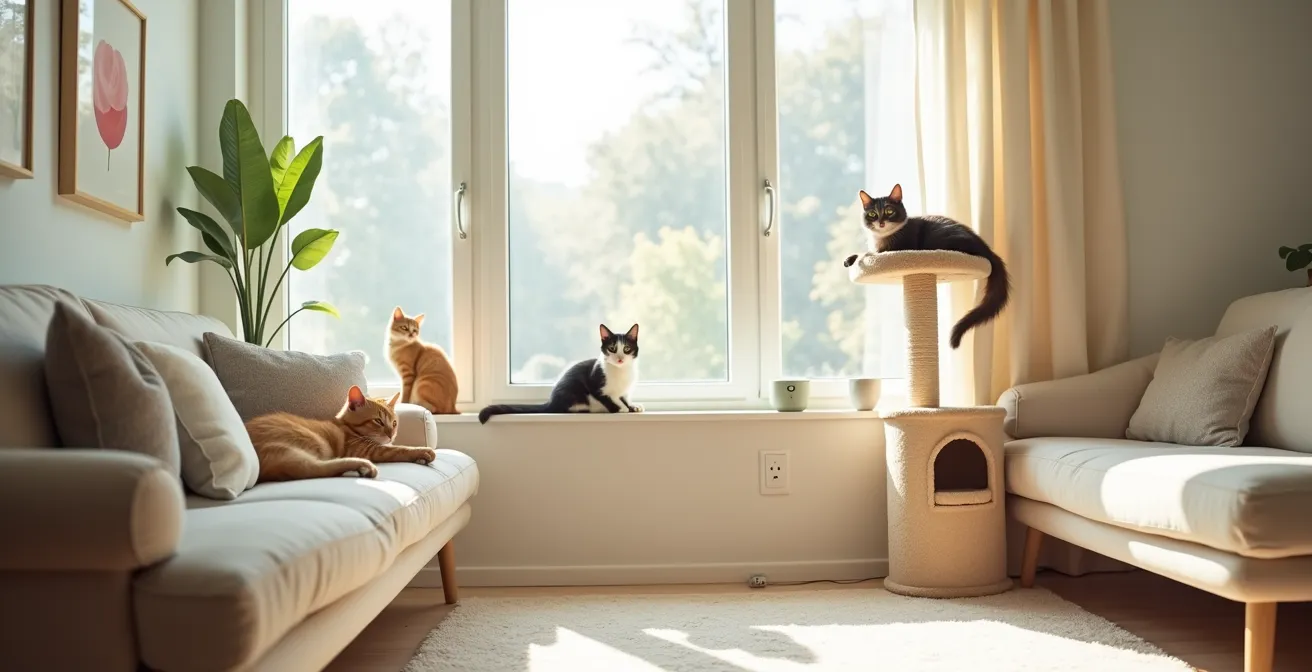
For a traumatized cat, the world is a landscape of potential threats. Their instinct in the face of fear is to find a position that offers the best vantage point while remaining inaccessible. This is where vertical space becomes a non-negotiable element of their rehabilitation. A cat’s security is directly linked to their ability to observe their territory from a safe, elevated perch. Ground level is vulnerable; it’s where dogs, children, and even other cats can easily approach. Height provides an immediate tactical advantage and a profound psychological relief.
The principle is simple: a cat who can see a threat coming without being seen has control. This is why you’ll often find a fearful cat on top of a refrigerator or a high bookcase. They are not being antisocial; they are managing their anxiety by using environmental architecture. By intentionally providing this vertical territory, you give them a powerful tool for self-soothing. As research shows that vertical spaces provide a fundamental sense of security, integrating them into your home is one of the most effective first steps in building an environment of trust. These “superhighways” allow a cat to navigate a room without ever touching the floor, effectively removing them from the plane of perceived danger.
Creating this vertical world doesn’t have to mean clutter. Well-placed wall shelves, sturdy cat trees, and clear tops of bookcases can be woven into your decor. The key is to create pathways that lead to these safe zones. A single high shelf is good, but a series of shelves that allow your cat to ascend and descend from multiple points is even better. This is the first and most crucial step in building your cat’s environmental blueprint for safety.
Diffusers vs. Sprays: Which Pheromone Works for Multi-Cat Tension?
Once you begin to address a cat’s physical security, the next layer to consider is their sensory safety, particularly their sense of smell. A traumatized cat is hyper-vigilant, and their olfactory world can either be a source of stress or a beacon of calm. Synthetic feline facial pheromones are designed to mimic the natural chemicals cats leave when they rub their face on objects to mark them as “safe” and “familiar.” Introducing these signals can fundamentally change a cat’s perception of their environment from threatening to secure.
The choice between a diffuser and a spray depends on your strategic goal. Diffusers are the workhorses of ambient calming. They release pheromones continuously, creating a baseline level of security throughout a large area (typically 650-700 sq ft). This makes them ideal for general anxiety or tension in multi-cat households, where the goal is to lower the overall stress level. In fact, a study found that 84% of multi-cat households using diffusers alongside behavior management saw significant improvement in social harmony.
Sprays, on the other hand, are for targeted, short-term interventions. Their effect is concentrated but lasts only 4-5 hours. This makes them perfect for “event-based” calming, such as spraying a carrier before a vet visit or a new cat bed to make it more inviting. For managing multi-cat tension, a layered approach is often most effective, using a diffuser for background peace and a spray for specific hotspots of conflict.
The following table, based on data from recent analysis of pheromone application methods, helps clarify the best use for each.
| Method | Coverage | Duration | Best Use Case |
|---|---|---|---|
| Diffuser | 650-700 sq ft | 30-60 days | Baseline ambient calming |
| Spray | Targeted area | 4-5 hours | Event-based calming |
| Layering Both | Full home + specific zones | Continuous + as needed | Multi-cat tension management |
Is It Trauma or Arthritis? The Link Between Pain and Hissing
One of the most critical mistakes in rehabilitating a “traumatized” cat is assuming the problem is purely psychological. A cat’s hiss is a defensive warning, and often, they are defending themselves against anticipated pain. Undiagnosed physical discomfort, especially from chronic conditions like arthritis, is a major, often-missed contributor to behaviors labeled as aggression or fear. A cat who suddenly hisses when you try to pet them might not be rejecting your affection; they might be protecting a sore back or a stiff joint.
Cats are masters at hiding pain, a survival instinct left over from their wild ancestors where showing weakness made them a target. Therefore, owners must become expert detectives, looking for subtle clues. A reluctance to jump onto a once-favorite perch, hesitation before using the litter box (especially high-sided ones), or a decrease in grooming leading to matted fur are all potential red flags. These are not signs of “getting old” or being “lazy”; they are often direct communications about physical discomfort. The pain-behavior axis is a fundamental concept: when pain goes up, the threshold for aggressive or fearful behavior goes down.
The Diagnostic Pain Medication Trial Approach
Veterinary behaviorists have a powerful tool for untangling pain from trauma. As outlined in expert resources on healing emotionally traumatized pets, a diagnostic trial involves administering pain medication to a cat exhibiting aggression for 2-3 weeks. If the hissing, swatting, or hiding significantly decreases during this period, it provides strong evidence that pain was a primary driver of the behavior. This approach offers a clear path forward, allowing for a treatment plan that addresses both the physical source of the pain and the learned behavioral responses to it.
Your Action Plan: Auditing for Hidden Pain
- Identify Contact Points: Note all situations where your cat hesitates or reacts negatively. This includes being petted, jumping up or down, or using the litter box. These are your potential pain indicators.
- Collect Data: For one week, keep a “pain diary.” Log specific instances of reluctance (e.g., “avoided the cat tree today,” “didn’t curl up to sleep”). Also note changes in grooming, appetite, or movement speed.
- Establish a Baseline: Compare your log to your cat’s “normal” behavior from a year ago. Is there a clear pattern of decline or a new preference for soft surfaces over hard ones? This contrast is crucial.
- Pinpoint the Key Change: Review your log and identify the single most concerning change. Is it the new grumpiness, or the fact they no longer greet you at the door? This emotional data point is as important as the physical ones.
- Formulate Your Plan: Schedule a veterinary visit. Present your detailed log not as a vague concern, but as concrete evidence. This transforms you from a worried owner into a proactive partner in your cat’s diagnosis.
The Spoon-Feeding Technique to bond with Feral Kittens
To a fearful cat, your hand is not a source of comfort; it’s a potential threat. It’s large, moves unpredictably, and is associated with being grabbed or restrained. Rebuilding trust requires creating positive associations with your presence without triggering this fear. This is where the concept of a “neutral bridge” comes in—an object that can deliver something positive (like food) from a safe distance, slowly closing the gap between fear and trust.
The spoon-feeding technique is a perfect example of this principle in action. It is especially effective for feral or semi-feral kittens who have no positive human experiences. You start by offering a small amount of high-value wet food (think tuna or a meat-based baby food) on the tip of a long-handled wooden spoon. The wood is key initially, as it’s a neutral material that doesn’t carry your scent as strongly as metal. You simply hold the spoon out and wait, letting the kitten choose to approach.

This process systematically desensitizes the kitten to your presence. The spoon becomes a reliable predictor of good things. Over time, as the kitten’s confidence grows, you can gradually shorten the distance and even transition to a metal spoon, which carries your scent more, transferring the positive association from the food to you.
The Sensory Graduation Bonding Protocol
This isn’t just theory; it’s a proven protocol. The socialization guide from Austin Pets Alive! documents this method of “sensory graduation.” Their program systematically moves from a long-handled wooden spoon (neutral smell, safe distance), to a metal spoon (carries human scent), and finally to hand-feeding. This structured approach, which allows the kitten to control the pace of interaction, successfully socialized 75% of feral kittens within 3-4 weeks. The spoon acts as a critical bridge, transferring the positive association with food to the scent and presence of a human hand.
When to Ask the Vet for Fluoxetine for Your Anxious Cat?
Sometimes, even with a perfect environmental blueprint and the most patient behavioral work, a cat’s anxiety remains debilitating. Their fear is so deeply ingrained that their brain chemistry prevents them from learning new, safer associations. In these cases, psychotropic medication like Fluoxetine (the feline equivalent of Prozac) is not a last resort, but a vital tool that enables behavioral therapy to work.
The decision to medicate a pet is a significant one, and it’s normal for owners to have reservations. In fact, research indicates that while 74% of cat owners are comfortable using pheromones, that number drops to 50% for long-term prescription medication. However, it’s crucial to reframe the role of this medication. It doesn’t “drug” the cat or change their personality. Instead, it works by lowering the baseline level of anxiety just enough for the cat’s brain to be receptive to learning. It opens a window of opportunity for your environmental and behavioral modifications to finally take root.
So, when is it time to have this conversation with your veterinarian? The key is to move from subjective feelings to objective measurement. A Quality of Life Assessment allows you to track specific behaviors over time. If your cat is consistently hitting red-flag metrics—such as hiding for more than half the day or having multiple litter box incidents per week—it’s a strong indicator that their anxiety is severe and unmanageable without medical support. This data gives you and your vet a clear, shared language to decide on the best course of action.
Use the following scale to get an objective measure of your cat’s quality of life. If you find yourself in the “severe” category on multiple points, it’s time to book a vet appointment.
- Hiding Time: Calculate the percentage of the day your cat spends hiding. Over 50% indicates severe anxiety.
- Litter Box Issues: Count the number of out-of-box incidents per week. More than 3 is a significant stress signal.
- Play Engagement: Measure how much time your cat engages in interactive play. Less than 10 minutes daily suggests withdrawal.
- Eating Patterns: Track skipped meals. Missing more than two meals in a week is a concern.
- Aggressive Incidents: Note every instance of hissing, swatting, or biting. More than 5 incidents per week warrants intervention.
- Grooming Behavior: Look for either over-grooming (bald spots) or a complete cessation of grooming (matted fur).
- Sleep Disturbances: Document pacing at night, frequent waking, or an inability to settle into a deep sleep.
Dead Ends: How to Arrange Furniture to Prevent Ambushes?
A traumatized cat’s map of your home is not based on rooms, but on routes and risks. A long, narrow hallway isn’t a passageway; it’s a trap. A corner behind a sofa isn’t a cozy nook; it’s a dead end where they can be cornered. Preventing ambushes—whether from another pet or a perceived human threat—is a cornerstone of creating an environmental blueprint for safety. This involves actively auditing your home for these “dead ends” and redesigning the layout to create flow and escape options.
The key is to think in terms of circular pathways. Instead of arranging furniture flat against the walls, which creates long, intimidating “bowling alleys,” try pulling pieces out slightly. An armchair angled away from a wall or a sofa positioned to create a path behind it can transform a dead end into a thoroughfare. The goal is to ensure that from any point in a room, the cat can see at least two ways out. This simple change can dramatically reduce the hyper-vigilance that leads to “surprise” attacks and defensive aggression.
Prospect and Refuge: A Design for Feline Confidence
Architectural principles of “prospect and refuge” are incredibly effective in reducing cat anxiety. The concept is simple: cats need “prospect” (clear sight lines to see what’s coming) and “refuge” (secure places to hide and feel unseen). A case study of 20 homes implementing these principles showed that simple environmental modifications led to a 60% reduction in stress behaviors. This involved creating circular pathways, adding cat trees at the ends of hallways to provide vertical escape routes, and ensuring every room had multiple exits. The cats in these redesigned homes showed measurable increases in confidence and decreased their hiding time within just two weeks.
You can perform your own audit to identify and eliminate these stress points. Get down on your hands and knees to see your home from your cat’s eye level. Where are the blind corners? Where could they be trapped? This perspective shift is essential for deconstructing environmental threats.
Follow this checklist to perform a home escape route audit:
- Walk through your home at your cat’s eye level by crouching down.
- Identify all dead-end corridors and corners where a cat could feel trapped.
- Mark any spots where furniture placement could pin a cat in.
- Ensure there are at least two exit paths from every main room.
- Strategically position cat trees at hallway junctions to offer a vertical escape route.
- Arrange furniture to encourage circular movement patterns rather than straight lines.
- Remove any clutter or items that block these crucial escape routes.
Anxiety and Aggression: How Chronic Itch Changes Behavior?
The link between physical pain and behavioral problems is a recurring theme in feline psychology, and it extends beyond joint pain. Chronic itch, often caused by allergies or skin conditions, is a relentless, maddening source of discomfort that can profoundly alter a cat’s behavior. A cat that is constantly itchy is living in a state of chronic stress and frustration. This persistent irritation lowers their tolerance for everything and everyone, making them more likely to lash out.
This is not just a theory; it’s physiology. The constant stress from itching keeps the body flooded with stress hormones like cortisol, which in turn can exacerbate inflammation, creating a vicious cycle of itch and anxiety. Powerful studies demonstrate that up to 90% of cats with allergic dermatitis showed a significant reduction in stress-related behaviors (like over-grooming or aggression) once their underlying inflammation was medically controlled. The behavioral problem was, in fact, a medical one.
The aggression that stems from chronic itch can manifest in several ways, and understanding the type of aggression is key to addressing it. An itchy cat isn’t just “grumpy”; their behavior is a direct symptom of their physical state. Addressing the root medical cause—the allergy or skin condition—is the only way to resolve the behavioral fallout.
This table helps differentiate the types of aggression commonly seen in cats suffering from chronic itch:
| Aggression Type | Trigger | Behavior | Treatment Focus |
|---|---|---|---|
| Redirected | Frustration from itch | Attacks nearby pets/people | Address underlying allergy |
| Pain-Based | Touch on sore spot | Hisses when touched | Pain management first |
| Irritability | Chronic discomfort | General grumpiness | Anti-inflammatory approach |
Key takeaways
- Think Like an Architect, Not Just an Owner: Your cat’s sense of safety is built on their environment. Prioritize vertical spaces, escape routes, and the elimination of dead ends.
- Pain is a Behavior, Not a Feeling: Hissing, hiding, and aggression are often symptoms of undiagnosed physical pain. Always rule out medical causes like arthritis or allergies before focusing solely on psychological trauma.
- Resources are Territory: In a multi-cat home, conflict is often about competition for resources. Providing multiple, strategically placed cat trees, food bowls, and litter boxes is not a luxury; it’s a necessity for peace.
Why One Cat Tree Is Not Enough for Two Cats?
In a multi-cat household, the “one of everything” rule is a recipe for conflict. The final piece of our environmental blueprint is understanding that cats do not share valuable resources well, especially when there’s underlying tension. A single cat tree, no matter how elaborate, is not a shared asset; it’s a point of contention. It becomes the “king of the hill,” a resource to be guarded, leading to stare-downs, ambushes, and fights.
For two cats, you need at least two cat trees, and ideally more resource stations than there are cats. This principle of resource abundance is fundamental to reducing competition and stress. It’s not just about the number of trees but also their strategic placement. Placing two trees side-by-side simply creates a larger battleground. Instead, they should be in different rooms or at opposite ends of a large room, each offering a unique and valuable view—one overlooking a window with birds, the other monitoring the main household traffic.
This strategy allows cats to “time-share” the home without direct confrontation. One cat can claim the living room tree in the morning, while the other observes from the bedroom tree, and they can swap without ever needing to interact or compete. By providing multiple, high-value perches, you dilute the importance of any single one, effectively de-escalating potential conflicts over territory. It’s a proactive approach to peace, designing the environment to prevent disputes before they even start.
Use this guide for strategic placement to maximize harmony:
- Place trees in separate rooms to give each cat their own domain.
- If in the same room, position them at opposite ends to create distance.
- Ensure each tree has a view of a different window or point of interest.
- Vary the heights and features (e.g., one with a hammock, one with a cubby) to appeal to different preferences.
- Use furniture or screens to create sight barriers between the trees, preventing tense stare-downs.
- If one cat “claims” a tree, periodically use treats and play to entice them to a different one, preventing permanent ownership.
Start today by auditing your cat’s environment for hidden stressors and creating just one new, safe, high perch. This single change is the first and most powerful step in rebuilding the blueprint of safety your cat desperately needs to begin healing.