
A reliable recall isn’t about being “alpha,” it’s about being the best economic option available to your dog at any given moment.
- Your dry kibble is a low-value currency that is worthless in the highly competitive “market” of a dog park.
- Environmental rewards (like sniffing and chasing) are powerful, non-monetary payments that you must learn to control and dispense strategically.
Recommendation: Stop bribing and start investing. Build a tiered payment system that makes coming back to you the most profitable decision your dog can make.
You stand in the park, a crumpled bag of kibble in your pocket. Your dog, fifty yards away, has just spotted a squirrel. You call their name. Nothing. You call again, louder, shaking the bag. The dog glances at you, performs a quick cost-benefit analysis, and decides the squirrel is a far better investment. You are left feeling frustrated, ignored, and powerless. The common advice is to “be more exciting” or “use better treats,” but these are just tactics without a strategy.
The problem isn’t your dog’s disobedience; it’s your economic model. You’re offering minimum wage for a task that requires a CEO’s salary. Dog training, especially for a critical skill like recall, is a micro-economy. Your treats are currency, the environment is a competitive market full of tempting offers, and your dog is a rational consumer always seeking the best deal. To succeed, you must stop thinking like a pet owner and start acting like an economic reinforcement strategist.
This means understanding the principles of value, scarcity, market competition, and return on investment. It’s about building a robust reinforcement economy where your “currency” holds its value, even during a market crash (the appearance of a rabbit). This guide will deconstruct this economy, giving you the strategic tools to manage your assets, out-compete distractions, and build a recall so reliable it becomes the most valuable life insurance policy you can have for your dog.
To master this economic approach, we will explore the core components of your new training strategy. This article breaks down the essential concepts, from managing your treat budget and understanding payment schedules to leveraging the environment itself as a form of capital.
Summary: Liver vs. Kibble: A Strategic Guide to Reinforcement Economics
- Pea-Sized Rewards: How to Feed 50 Treats Without Overfeeding?
- When to Empty the Hand: Marking a Breakthrough Moment
- Pre-Mack Principle: Using “Go Sniff” as the Ultimate Treat
- Variable Ratio Schedule: How to Turn Your Dog into a Gambler?
- Chew Time: Why Crunchy Treats Slow Down Training Flow?
- Kibble vs. Hot Dogs: What to Use in High-Distraction Environments?
- Performance Kibble: When Does a Dog Actually Need 30% Protein?
- Why “Recall” Is the Only Command That Truly Saves Lives?
Pea-Sized Rewards: How to Feed 50 Treats Without Overfeeding?
Every successful economy operates within a budget. In dog training, this is a hard caloric limit. Overspending not only leads to health problems but also to economic inflation where treats lose their value. The goal is to maximize reinforcement opportunities without exceeding your budgetary constraints. The core principle is that veterinary guidelines confirm that treats should make up no more than 10% of daily calories. This is your “reinforcement budget.”
The strategist’s job is to acquire the highest number of “transactional units” (treats) within this budget. This means choosing rewards with a high value-to-calorie ratio. A single cube of cheese might have the same caloric cost as ten pieces of freeze-dried liver. By choosing the liver, you have increased your capacity for reinforcement tenfold. The key is to think in terms of reinforcement opportunities per day, not just the value of a single treat. Cutting treats into pea-sized portions is not about being cheap; it’s a strategic move to increase the volume of transactions you can make, allowing you to pay your dog for more behaviors throughout a session.
To implement this, you must analyze the cost and benefit of each asset in your portfolio. High-calorie, high-value treats like cheese should be reserved for jackpot moments, while low-calorie, high-value options like freeze-dried liver become your daily transactional currency. This ensures you have enough “cash on hand” for a high rate of reinforcement without bankrupting your dog’s daily caloric intake.
When to Empty the Hand: Marking a Breakthrough Moment
A “jackpot” is not a random act of generosity; it’s a calculated economic bonus paid for exceptional performance. In our reinforcement economy, a jackpot serves to create powerful ‘cognitive anchoring.’ It’s the moment you tell your dog, “That specific choice you just made—disengaging from that other dog to look at me—was so incredibly valuable that it merits a massive, unexpected payout.” This creates a durable memory, increasing the probability that the dog will repeat this high-value choice in the future.
There are two primary forms of jackpot payouts, each serving a different economic purpose. A stream jackpot, where you deliver 5-10 treats in rapid succession, is used to maintain and extend high focus. It’s the equivalent of a performance bonus that keeps a star employee engaged in a critical project. A scatter jackpot, where treats are tossed on the ground, is a tool for economic reset. It’s used when a dog’s arousal is too high (over-excited by the “market”). The act of sniffing and searching for the scattered treats is a naturally calming activity that lowers arousal, allowing the training session to continue productively.
The key to a successful jackpot is timing. The reward must mark the precise moment the dog makes the desired choice, such as choosing you over a major distraction. It is the payment for a successful “hostile takeover,” where your dog’s attention is acquired from a competitor. Using jackpots sparingly and strategically for these breakthrough moments prevents value inflation and ensures they retain their immense power.
Pre-Mack Principle: Using “Go Sniff” as the Ultimate Treat
The most sophisticated economic strategists understand that currency isn’t limited to tangible goods. The environment itself is a marketplace of experiences your dog wants to purchase: the right to sniff a particular tree, greet another dog, or chase a leaf. The Premack Principle states that a more probable behavior (sniffing the ground) can be used to reinforce a less probable behavior (coming when called). As a strategist, your role is to become the gatekeeper to these environmental assets. You control access to the market.
This reframes the entire training dynamic. Instead of seeing the environment as a source of distractions you must compete with, you see it as a vault of high-value, non-monetary rewards you control. The dog wants to sniff the fire hydrant? Great. That now has a price: one sit-stay. The dog wants to go say hello to a familiar dog? The price is a focused heel for ten paces. As professional service dog programs have found, handlers become ‘gatekeepers’ who grant permission to engage with the environment only after compliance with commands.
By controlling access, you make yourself the source of all good things, both from your pocket and from the world at large. This is the ultimate power move in your reinforcement economy. A “go sniff” command becomes a more powerful reward than a piece of liver because it’s exactly what the dog values most in that specific moment. You are not just paying your dog; you are giving them the purchasing power to buy what they truly want.

This image perfectly captures the transaction. The trainer, acting as the gatekeeper, releases the dog to engage with a high-value environmental reward (sniffing wildflowers) as payment for a prior behavior. The connection and focus are maintained because the trainer is the one who facilitates this desired experience.
Variable Ratio Schedule: How to Turn Your Dog into a Gambler?
Once a behavior is well-established, paying for it every single time becomes economically inefficient. It leads to expectancy and a decline in performance if a payment is missed. The strategic pivot is to move from a fixed ratio schedule (payment for every action) to a variable ratio schedule. This is the principle that powers the gambling industry: the slot machine. You don’t get a payout every time you pull the lever, but the possibility of a win on the *next* pull keeps you playing. This turns your dog from a salaried employee into an enthusiastic gambler.
This schedule of reinforcement is incredibly powerful because it builds persistence and resistance to extinction. The dog learns that not every “come” will result in a hot dog, but a big one could happen at any time, so it’s always worth taking the chance. However, there’s a critical prerequisite: you cannot introduce gambling until the behavior is fluent. Moving to a variable schedule too soon will extinguish the behavior. As a rule, research shows that behaviors must reach a 90-95% fluency rate on a continuous schedule before you can begin to vary the reinforcement.
The transition must be gradual. Start by rewarding three out of four repetitions, then two out of three, then vary it unpredictably. The unpredictability is key. It creates a surge of dopamine in the brain, the same neurochemical reaction associated with addictive behaviors. You are, in effect, getting your dog happily addicted to obeying your commands. This is the secret to maintaining strong, reliable behaviors over the long term without having to pay out for every single repetition.
Chew Time: Why Crunchy Treats Slow Down Training Flow?
In economics, transaction speed is a critical metric of efficiency. The same applies to your reinforcement economy. The goal of a training session is to maximize the number of successful repetitions in a given time. The type of treat you use has a direct impact on this “reps per minute” (RPM) rate. A crunchy biscuit, while perhaps enjoyed by the dog, is an economic disaster in a fast-paced training scenario. It can take a dog 10 seconds or more to crunch and swallow it. In that time, you could have completed five or six more repetitions.
A successful strategist optimizes for flow. This means using “liquid assets”—treats that are small, soft, and can be consumed almost instantly. This is where the difference between treat types becomes stark. For example, soft treats enable a reinforcement rate of 60+ RPM, whereas a crunchy biscuit drops that rate to a sluggish 6 RPM. Freeze-dried liver or small pieces of hot dog offer a middle ground, providing high value with a consumption time of only 1-2 seconds.
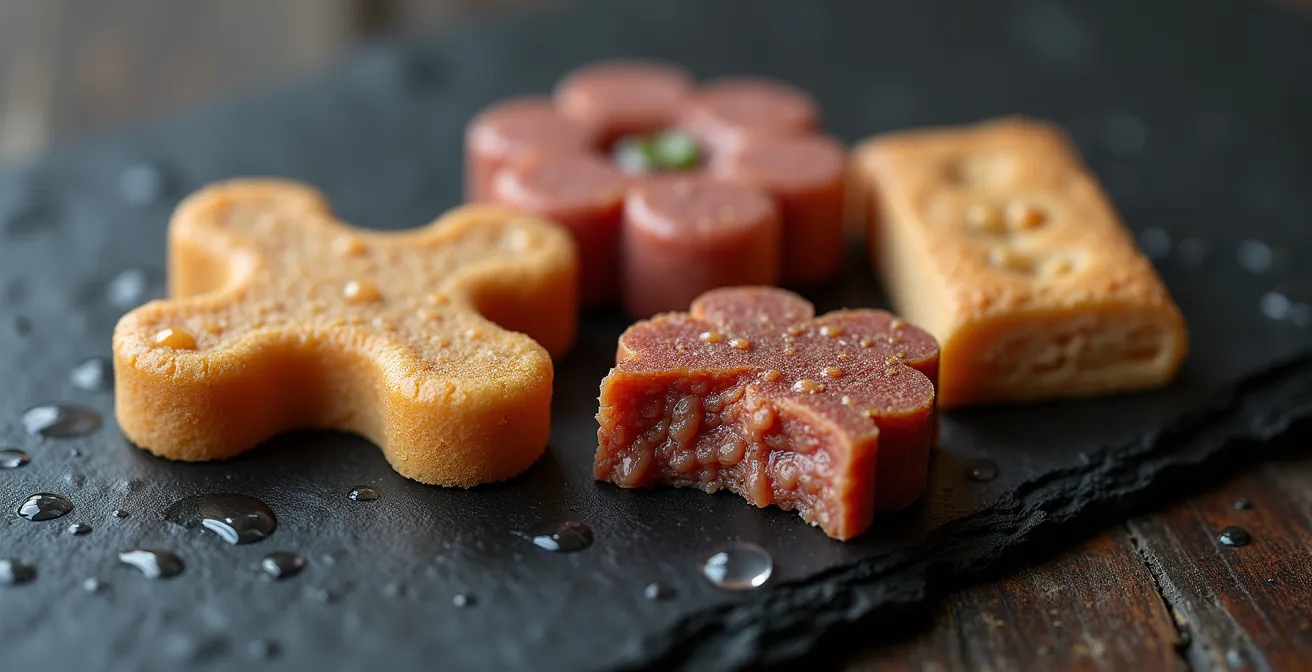
The textural difference is everything. The soft, moist treat on the left can be swallowed instantly, allowing for a high rate of reinforcement. The porous freeze-dried liver in the middle is also fast. The hard, crunchy biscuit on the right, however, requires significant “processing time,” effectively halting the training session while it’s being consumed. Choosing the right texture is choosing training efficiency.
This doesn’t mean crunchy treats have no place. They are simply ill-suited for rapid-fire training. Their best use is as a “final bonus”—a longer-lasting reward to signal the end of a productive work session, similar to a relaxing company dinner after a successful quarter. Understanding this difference is key to designing efficient and effective training protocols.
Kibble vs. Hot Dogs: What to Use in High-Distraction Environments?
Not all work is created equal, and not all payments should be either. Asking your dog to “sit” in a quiet living room is a low-skill, low-effort job. Asking for the same “sit” at the chaotic entrance to a dog park is a high-stakes, high-pressure task. A core failure of many training plans is offering the same pay (a piece of kibble) for both jobs. This is economic nonsense. An effective strategist must become an expert at situational value-matching, adjusting the payment to reflect the difficulty of the task and the level of market competition (distractions).
This requires you to grade your environments and your rewards on a corresponding scale. Your regular kibble is Level 1 currency, suitable only for Level 1 environments. As the difficulty and distraction level increases, so must the value of your currency. Hot dogs, cheese, or liver paste are your Level 5+ currencies, reserved for the most challenging economic conditions.
The following table provides a basic framework for this “Distraction-to-Reward” matrix. It is a foundational tool for any reinforcement strategist.
| Environment Level | Distraction Examples | Recommended Reward | Value Level |
|---|---|---|---|
| Level 1 (Home) | Quiet room, no distractions | Regular kibble | Low |
| Level 3 (Yard) | Birds, familiar smells | Training treats | Medium |
| Level 5 (Park) | Dogs, people, wildlife | Hot dogs, cheese | High |
| Level 7 (Dog park entrance) | Maximum excitement | Liver paste tube | Nuclear |
Furthermore, to prevent the devaluation of your high-value currency, you must maintain its novelty. This can be achieved with a “Special Ops Pouch” strategy. Prepare a mix of ultra-high-value treats (rotisserie chicken, salmon, sardines) that is used exclusively in the most difficult environments. Your dog never gets these treats at home. Their appearance signals that an incredibly high-paying job opportunity is available, making them more likely to engage with you even when the distraction market is booming.
Performance Kibble: When Does a Dog Actually Need 30% Protein?
The reinforcement economy doesn’t exist in a vacuum. The physical and mental state of your “employee”—your dog—directly impacts their performance. A poorly nourished dog is like a poorly maintained machine: prone to breakdown, lack of focus, and reduced productivity. Investing in high-quality nutrition is not an expense; it is an investment in your primary asset, and it provides a measurable return.
While most pet dogs do not require the 30% protein found in elite performance kibble, dogs undergoing intensive training or “work” (including the cognitive work of navigating distracting environments) have higher needs. It’s not just about protein. Research on working dogs shows that diets with balanced omega-3 fatty acids, particularly DHA, significantly improve cognitive function and trainability. In economic terms, proper nutrition reduces the “cost of acquisition” for new behaviors. In fact, some studies report that handlers see as many as 30% fewer repetitions needed for new behaviors when dogs receive adequate brain-supporting nutrients.
This means your dog’s daily food is part of your overall reinforcement strategy. A diet rich in brain-supporting nutrients makes your dog a more capable, focused, and less anxious partner. It ensures they are mentally and physically ready to “clock in” for training sessions and perform at their peak. You are not just filling a bowl; you are funding the biological infrastructure required for high performance.
Your Action Plan: Performance Diet Optimization
- Assess activity level: Working dogs and canine athletes may need 25-30% protein, while most pets thrive on 18-25%.
- Check fat content: Look for 15-20% from high-quality sources for cognitive support and sustained energy.
- Verify DHA/EPA presence: Ensure the food includes brain-boosting omega-3s from sources like fish oil or algae.
- Time carbohydrates: For intensive activities, feed a carb-containing meal 2-3 hours before training for available energy.
- Monitor body condition score weekly to ensure ideal weight, adjusting portions based on activity, not just the bag’s suggestion.
Key Takeaways
- The value of a treat is always relative; what works at home is likely worthless in the park.
- You have a strict 10% daily caloric budget for treats; spend it wisely on high-value, low-calorie options.
- The environment is not your enemy; it’s a vault of powerful rewards that you must learn to control and use as payment.
Why “Recall” Is the Only Command That Truly Saves Lives?
In the grand economic scheme of dog ownership, the recall command is your ultimate insurance policy. It’s the one behavior that can prevent catastrophic loss—from your dog running into traffic, engaging with an aggressive animal, or getting lost. All other commands are about convenience and management; recall is about life and death. As such, its economic value is nearly infinite, and it must be protected at all costs.
The single greatest threat to this asset is the “poisoned cue.” This is an economic term for a currency that has become associated with a negative outcome, rendering it worthless. This happens when owners primarily use recall to end fun (e.g., leaving the dog park) or only use it in panicked, high-stress emergencies.
The ‘poisoned cue’ phenomenon occurs when owners primarily use recall to end fun activities or only in emergency situations with panicked tone, inadvertently teaching dogs that coming when called predicts negative outcomes.
– Karen Pryor, Clicker Training Research
To protect this vital asset, you must ensure that 90% of your recalls are followed by a positive or neutral outcome. Call your dog, reward them lavishly, and then release them to continue playing. This builds a massive “trust fund” of positive associations. The recall doesn’t mean the fun ends; it means a high-value payment is about to occur. The 1% of the time you need it for a true emergency, your dog will respond without hesitation because you have made a career of making “come” the most profitable word they know.
By shifting your perspective from a simple pet owner to a savvy economic reinforcement strategist, you change the game entirely. You now have a framework to analyze any training problem, a system for valuing assets, and a strategy for out-competing the most tempting distractions. Your next step is to conduct an audit of your current reinforcement economy and begin implementing these principles today.