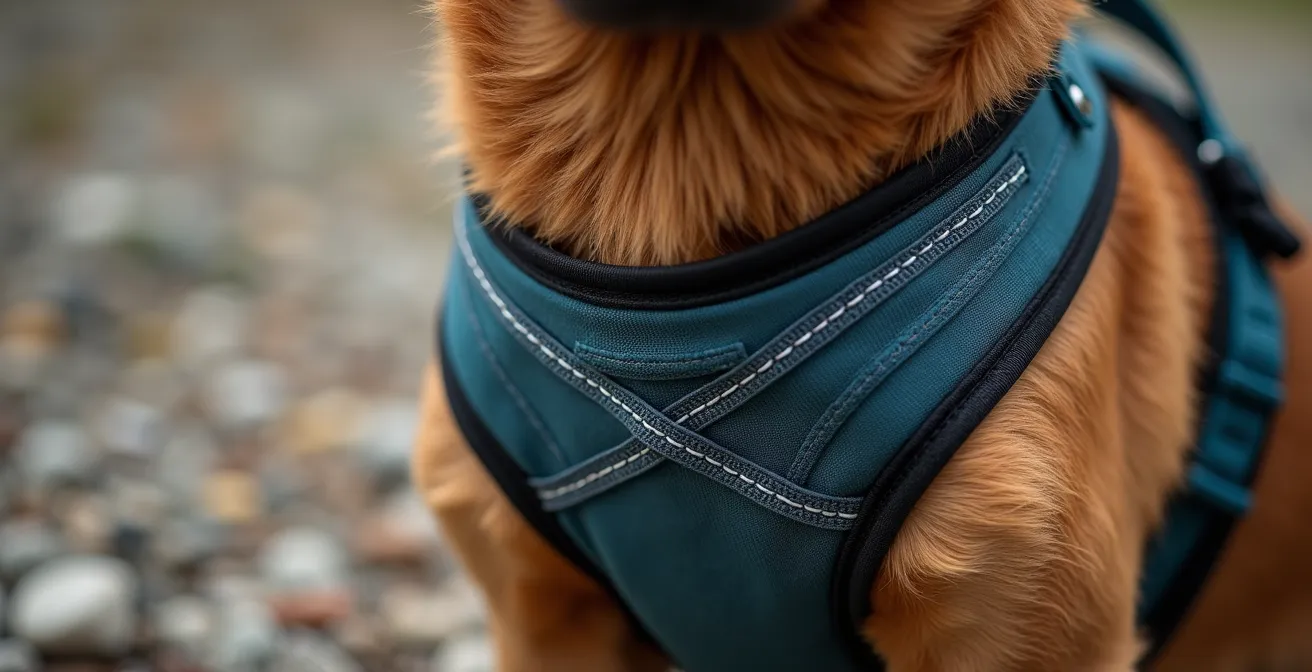
The standard walking harness you use is likely choking your dog and wasting their natural pulling power.
- Pulling force is a vector; the harness’s attachment point dictates whether it lifts the dog, restricts the airway, or drives them forward efficiently.
- A proper sports harness must free the shoulders for full gait extension, not just prevent rubbing, to enable maximum power transfer.
Recommendation: Select a sport-specific model (like a half-harness or X-back) that directs pulling force from the chest and rib cage, transforming your dog’s instinct to pull into safe, effective performance.
For many active dog owners, a walk can feel like a contest of wills. Your dog surges forward, you pull back, and the standard walking harness—often marketed as a humane alternative to a collar—tightens around their chest and throat. You may think you’re simply managing a behavioral issue, but you’re actually fighting a battle against physics. Most walking harnesses are designed with a single goal: to stop or redirect pulling. They work by creating discomfort or applying pressure in a way that makes pulling inefficient. But what if the goal isn’t to stop the pull, but to harness it?
For an owner wanting to start canicross, bikejor, or skijoring, this changes everything. The instinct to pull is not a problem to be solved; it’s an asset to be cultivated. The equipment’s job shifts from opposition to optimization. This is where the profound difference between a walking harness and a pulling harness becomes clear. It’s not just about a better fit; it’s about understanding the biomechanics of a canine athlete. The wrong equipment doesn’t just hinder performance; it can restrict breathing, alter natural gait, and lead to injury for both you and your dog.
But what if the key wasn’t just a different shape, but a completely different understanding of force, pressure, and movement? This guide moves beyond the simple “stop pulling” debate. We will decode the physics behind pulling sports equipment, explaining how to choose a harness that ensures your dog’s airway remains clear, their shoulders move freely, and every ounce of their power is transferred into forward motion. We’ll explore how attachment points create different force vectors, why leash elasticity is critical, and how to match a harness to your dog’s specific anatomy for a safe, powerful, and exhilarating partnership.
For those who prefer a visual format, the following video offers a great overview of how to approach choosing the right harness for your dog, complementing the detailed technical advice in this guide.
To help you navigate these crucial equipment decisions, this article breaks down the essential components of a high-performance pulling setup. From ensuring a friction-free fit to understanding the nutritional needs of a canine athlete, each section provides the expert knowledge you need to get started safely and effectively.
Summary: Decoding the Physics of a Performance Dog Harness
- Rib Cage Clearance: How to Ensure the Harness Doesn’t Rub?
- High Attachment vs. Low Attachment: Which Setup for Your Sport?
- Padding vs. Breathability: Preventing Overheating in Harnesses
- Which Harness Style Suits a Compact Staffy vs. a Husky?
- Shock Absorption: Why the Leash Matters as Much as the Harness?
- X-Back vs. Half-Harness: Which Fit Allows Full Range of Motion?
- Performance Kibble: When Does a Dog Actually Need 30% Protein?
- How to Start Urban Mushing (Canicross/Bikejor) with One Dog?
Rib Cage Clearance: How to Ensure the Harness Doesn’t Rub?
The most common mistake when fitting a harness is focusing only on tightness. For a pulling harness, the true measure of a good fit is freedom of movement. A harness that is too restrictive around the rib cage and behind the front legs won’t just cause chafing; it physically impedes your dog’s gait mechanics. As the dog extends its front legs forward and back, the shoulders and surrounding muscles need to move without obstruction. If a strap sits too close to the “armpit,” it will rub with every stride, causing painful sores and forcing the dog to shorten its stride, reducing power and efficiency.
A properly fitted pulling harness should sit snugly around the neck and chest to distribute pressure, but allow you to easily slide two fingers between the straps and the dog’s body, especially around the back of the rib cage. The Y-shape at the front is critical: it must sit on the sternum (breastbone), leaving the shoulder points completely free to rotate. This design ensures that pulling pressure is directed to the dog’s strong chest and core, away from the delicate throat area. A recent university study on harness biomechanics confirmed this, finding that harnesses with a clear, straight-front design allowed for maximum shoulder and elbow extension, while more restrictive designs significantly limited range of motion.
When you put the harness on, check for clearance not only when the dog is standing still, but also when you gently pull their front leg forward, mimicking a running motion. The harness material should not bunch up or tighten in the armpit area. This dynamic check ensures the harness works with your dog’s body in motion, not against it. This is the difference between a simple restraint and true performance equipment.
Ultimately, a fit that prioritizes clearance is a fit that prioritizes both comfort and performance.
High Attachment vs. Low Attachment: Which Setup for Your Sport?
The location of the leash attachment point on a harness is not an arbitrary design choice; it is the single most important factor determining the force vector of your dog’s pull. This vector dictates how the pulling force is distributed across the dog’s body and, consequently, how efficiently that power is transferred to you. A standard walking harness often has a high attachment point between the shoulder blades. When a dog pulls, this creates a downward force on their front end, which can slightly lift their hind legs, disrupt their balance, and press the harness into their throat—exactly what you want to avoid in a pulling sport.
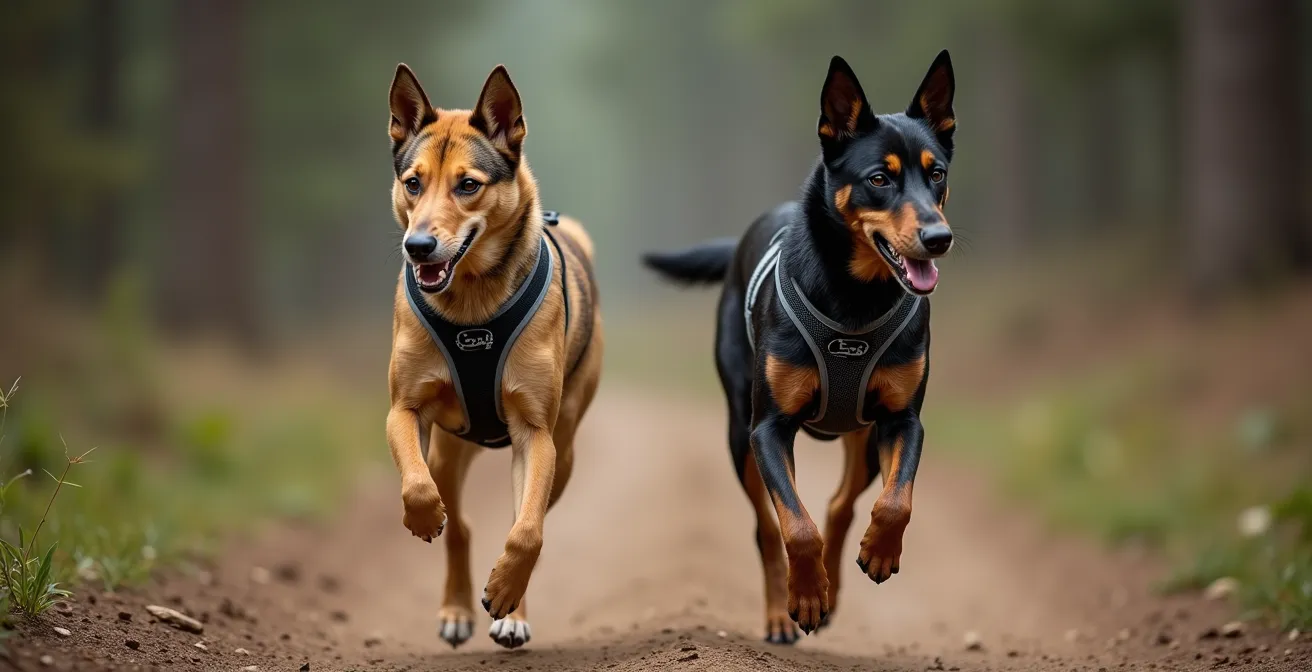
For sports like canicross, bikejor, and skijoring, the goal is to create a horizontal force vector that propels the dog and rider forward. This is achieved with a low attachment point, typically located at the base of the dog’s tail. This setup allows the dog to lean into the harness, using their powerful chest, shoulders, and core to drive forward without any upward or downward pressure on their spine or airway. The pull is straight and efficient, maximizing power transfer. Some modern “half-harness” designs have a mid-back attachment point, offering a compromise that works well for dogs running with taller humans, as it helps maintain an optimal line angle.
Choosing the right setup depends on your sport and your relative heights. For canicross, where the runner is upright, a harness with a low attachment point at the tail base is ideal to prevent pressure on the spine. For skijoring, where the pull angle is naturally lower, a mid-back attachment can provide more balanced force distribution. The key is to ensure the line from the harness to your running belt creates a smooth, relatively straight line that encourages forward motion, not downward pressure.
Understanding these force dynamics is the first step toward building a truly effective pulling team.
Padding vs. Breathability: Preventing Overheating in Harnesses
When selecting a pulling harness, it’s tempting to choose the one with the most padding, assuming more cushion equals more comfort. However, in an endurance sport, padding can become a liability. Thick, non-breathable padding traps heat and moisture against the dog’s body, increasing the risk of overheating, especially during intense activity or in warmer climates. The best performance harnesses strike a delicate balance between strategic cushioning and maximum breathability. They are not built like a plush armchair, but like a high-tech running shoe.
This philosophy is about placing padding only where it’s needed most. As the Non-stop Dogwear Technical Team explains, this is a core principle of modern design:
The most advanced harnesses use padding only on key pressure zones (sternum, spine) and use minimalist, open-weave webbing elsewhere to maximize surface area for heat dissipation.
– Non-stop Dogwear Technical Team, Canicross Harness Equipment Guide
This approach identifies the pressure zones—the sternum and along the spine where force is concentrated—and protects them with closed-cell foam that doesn’t absorb water. The rest of the harness uses lightweight, open-weave mesh or webbing. This minimalist design allows air to circulate freely over the dog’s body, facilitating natural cooling. The material choice is therefore highly dependent on your typical running environment, a factor highlighted by a comparative analysis of harness materials.
| Climate | Material Type | Padding Strategy | Breathability Score |
|---|---|---|---|
| Hot/Dry | Mesh webbing | Minimal (sternum only) | 9/10 |
| Cold/Wet | Closed-cell foam | Full coverage | 4/10 |
| Temperate | Open-cell foam | Strategic zones | 7/10 |
As the table shows, a harness made of mesh webbing with minimal padding is ideal for hot climates, prioritizing breathability above all else. Conversely, a harness for cold, wet conditions might use more extensive closed-cell foam padding, which provides insulation and won’t get heavy with water. For most users in temperate climates, a harness with strategic padding offers the best of both worlds.
Ultimately, keeping your canine athlete cool is just as important as keeping them comfortable.
Which Harness Style Suits a Compact Staffy vs. a Husky?
There is no “one-size-fits-all” in performance dog equipment, because there is no one-size-fits-all dog. Body conformation—a dog’s overall structure, shape, and proportions—plays a massive role in determining the ideal harness style. Two dogs of the same weight can have vastly different needs based on their build. Consider a compact, deep-chested Staffordshire Bull Terrier versus a lean, long-backed Siberian Husky. A harness that fits the Staffy perfectly would likely restrict the Husky’s movement, and vice-versa.
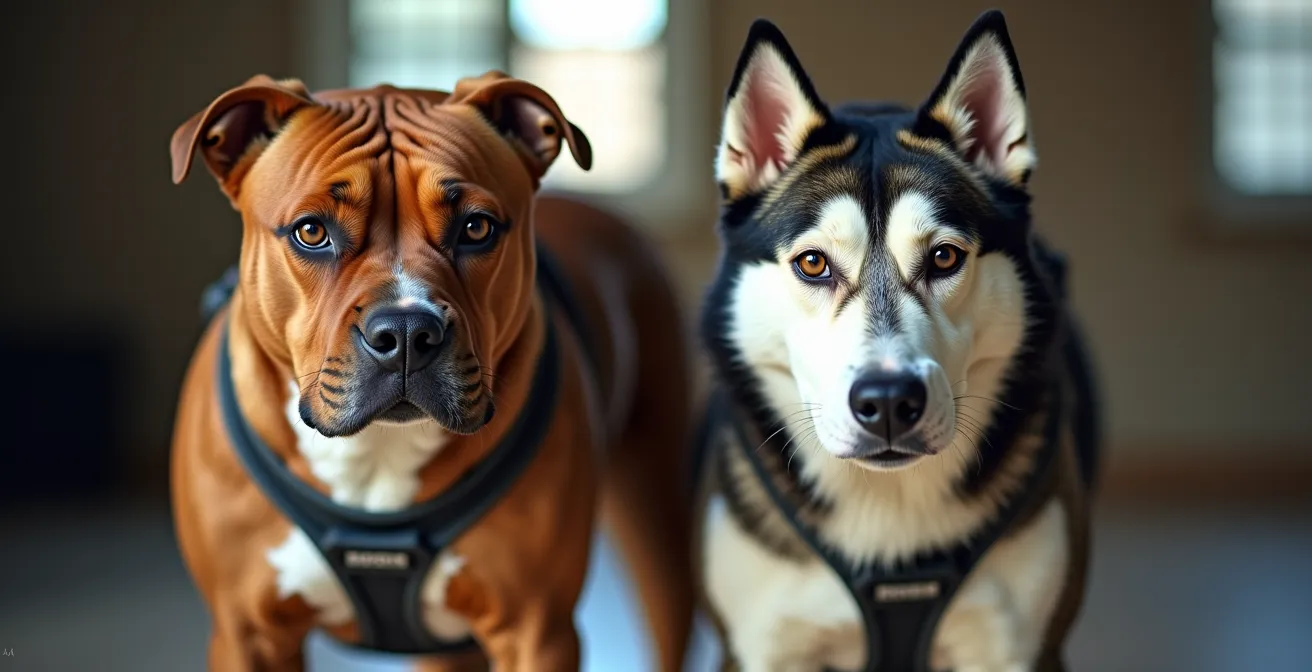
The key differences lie in chest depth, neck thickness, and back length. A deep-chested breed like a Staffy, Boxer, or Weimaraner needs a harness with a longer sternum piece and a wider Y-opening at the neck to avoid chafing and accommodate their prominent breastbone. The straps must be angled to wrap around a broad rib cage without sitting too close to the front legs. In contrast, a narrow-chested breed like a Husky, Greyhound, or Saluki requires a harness with a shorter, more compact fit. A harness designed for a deep chest would be too loose and shift around on their slender frame, creating friction and inefficient power transfer.
Long-backed dogs also present a unique challenge. On these breeds, some shorter harness styles can put upward pressure on the lumbar region, so longer models like the X-back or specific long-distance harnesses are often a better choice as they distribute force over the entire length of the back. When choosing a harness, look beyond the weight chart and consider your dog’s specific body type. Measure their neck, chest, and back length, and compare those measurements to the manufacturer’s sizing guide and breed recommendations. The right geometry will feel like a second skin, allowing for unrestricted, powerful movement.
A personalized fit is the cornerstone of safe and effective performance.
Shock Absorption: Why the Leash Matters as Much as the Harness?
You can have the most perfectly fitted, biomechanically-sound harness in the world, but if it’s connected to a static leash, you are missing a critical piece of the performance puzzle. In pulling sports, the connection between dog and human is not constant. The dog may surge, slow for a corner, or change pace unexpectedly. A static line transfers every bit of that kinetic energy directly to both bodies as a jarring force. This is where a bungee leash becomes non-negotiable. It acts as a shock absorption system, protecting both you and your dog from injury and creating a smoother, more efficient partnership.
A canicross or bikejor bungee line has an elasticated section that stretches to absorb sudden changes in tension. This dramatically reduces the peak forces felt during acceleration or deceleration. As one analysis of bungee line elasticity found, professional teams using these lines report a significant reduction in jerk force, with the elastic section absorbing up to 40% of the impact. This not only prevents strain on the dog’s back and your own, but it also helps maintain momentum. Instead of a sudden stop-start motion, the bungee creates a fluid “give and take,” allowing you to maintain a more consistent rhythm.
However, not all bungees are created equal. The ideal stiffness and length depend on your dog’s weight and pulling style. A small dog that surges needs a soft, progressive bungee, while a large, powerful dog that pulls steadily requires a stiffer line for more direct power transfer. Choosing the right one is key to a comfortable run.
Your Bungee Selection Checklist: Match the Leash to Your Dog
- Assess Pulling Style: For dogs under 40lbs that surge, select a soft progressive bungee with 30-40% stretch capacity.
- Match to Steady Pullers: For 40-60lb dogs that pull steadily, choose a medium stiffness bungee with 20-30% stretch.
- Equip a Power Puller: For dogs over 60lbs that pull constantly, use a stiff bungee with 15-20% stretch for direct power transfer.
- Test for Resonance: Run for 50 meters and check for uncomfortable bouncing patterns; if the rhythm is off, the stiffness is likely wrong.
- Adjust for Your Sport: Use a 2-meter line for canicross and a longer 2.8-meter line for bikejor or skijor to ensure safe distance from wheels or skis.
This dynamic connection transforms a series of jerks into a smooth and powerful collaboration.
X-Back vs. Half-Harness: Which Fit Allows Full Range of Motion?
Within the world of pulling sports, two dominant harness designs emerge: the traditional X-Back and the more modern Half-Harness (or short harness). While both are vast improvements over walking harnesses, they are engineered for different purposes and pull angles, directly impacting your dog’s range of motion. The choice between them comes down to the specific biomechanics of your chosen sport. Any harness that crosses over the shoulder blades or sits too high on the sides can impede the natural gait, and as biomechanical research reveals, this can lead to an 8-10° reduction in shoulder extension, robbing your dog of power and efficiency with every stride.
The X-Back harness is the classic sled dog design. It features straps that cross over the back in an “X” shape and distribute pulling force across the entire length of the dog’s body. As one expert on the Dog Trick Academy forum explains, its design is highly specialized:
An X-Back is optimized for a very low point of pull (traditional sledding), where it uses the dog’s entire body. A Half-Harness is a modern adaptation for higher points of pull (canicross, bikejor).
– Dog Trick Academy Forum Expert, Canicross Harness Discussion Thread
The Half-Harness, like the Non-stop Freemotion or Howling Dog Alaska Second Skin, ends mid-back and is designed specifically for sports with a higher point of pull, like canicross. Its open design leaves the back and hindquarters completely free, allowing for unrestricted galloping and turning. This style is generally more versatile and better suited for single-dog mushing activities where agility is key. For most recreational runners and bikers, the half-harness provides the optimal combination of power transfer and freedom of movement, ensuring the dog’s shoulders and hips can move through their full, natural range.
Choosing the right silhouette is about matching the tool to the task for optimal athletic performance.
Performance Kibble: When Does a Dog Actually Need 30% Protein?
Just as a human marathon runner eats differently than a casual jogger, a canine athlete has specific nutritional needs that go far beyond a standard adult maintenance diet. When your dog is consistently pulling in a harness, they are burning significantly more calories and putting greater stress on their muscles. This is where performance kibble, characterized by high protein and high fat content, becomes essential for energy, endurance, and recovery. For a dog engaged in moderate to heavy work like canicross, a standard diet is simply not enough to fuel performance and repair muscle tissue.
So, when does a dog actually need that 30% protein level? The answer lies in their workload. A pet dog on daily walks thrives on a diet with around 18-25% protein. However, for a canine athlete, the demands are much higher. According to optimal performance studies, athletic dogs thrive on a diet ratio of roughly 30% protein, 50% fat, and 20% carbohydrates. Fat is the primary energy source for endurance exercise, providing more than twice the calories per gram as protein or carbs. Protein is the crucial building block for muscle repair and recovery. Without adequate protein, a hard-working dog can suffer from muscle breakdown and a condition known as sports anemia.
Timing is also critical. Veterinary research confirms that providing a small, protein-rich meal within 30-60 minutes post-exercise significantly enhances muscle recovery and replenishes glycogen stores. This “recovery window” is a key part of an athletic dog’s nutritional strategy. It’s also important to feed their main meal at least three hours before a run to allow for proper digestion. Upgrading to a performance diet isn’t about spoiling your dog; it’s about providing the high-octane fuel and essential repair materials their body needs to perform safely and recover quickly.
Proper nutrition is the invisible foundation of your dog’s strength and endurance.
Key Takeaways
- A pulling harness is performance equipment, not a restraint. Its goal is to optimize safe power transfer, not stop pulling.
- The harness attachment point determines the force vector. For canicross, a low attachment point near the tail creates an efficient horizontal pull.
- A proper fit must guarantee total freedom for the shoulder blades to rotate, which is more important than simply being snug.
How to Start Urban Mushing (Canicross/Bikejor) with One Dog?
With the right equipment and training, you can transform your daily run or bike ride into an exhilarating team sport. Urban mushing—a term for canicross (running), bikejor (biking), and scootering with your dog—is an incredible way to bond with your pet and provide them with a physically and mentally stimulating job. Getting started is less intimidating than it seems and revolves around three pillars: the right gear, foundational training, and a gradual introduction to the sport. As you now know, the gear is paramount: a properly fitted pulling harness for the dog, a bungee line, and a canicross belt for you (or a bike antenna for bikejor).
Once you have the gear, the training begins—not with pulling, but with commands. Your dog needs to learn a few basic directional cues to navigate an urban environment safely. The most important are “Gee” (right), “Haw” (left), “On by” (ignore distraction), and “Easy” (slow down). Practice these on regular walks before ever clipping into the bungee line. Start in a quiet park or trail, rewarding them enthusiastically when they respond correctly. The goal is to build a reliable communication system before adding speed and power.
Finally, the introduction to pulling should be gradual and positive. Start with short, 100-meter “sprints” where you encourage your dog to pull, praising them lavishly. Keep the sessions short and fun to build their enthusiasm. As they begin to understand the game, you can slowly increase the distance. It is crucial to wait until your dog is physically mature—typically between 12 and 24 months, depending on the breed—before starting any serious pulling activity, to ensure their growth plates have closed. By building a strong foundation of gear, commands, and confidence, you can safely unlock a new level of partnership with your canine athlete.
Your journey into canine sports starts with the right first step: choosing equipment that respects your dog’s anatomy and amplifies their power. Assess your needs, select the right harness, and start building your athletic partnership today.
Frequently Asked Questions About Urban Mushing
When should I start canicross training with my dog?
Dogs should not begin canicross until growth plates have closed, typically 12-24 months depending on breed size, with smaller dogs maturing faster.
What safety equipment is essential for urban bikejor?
A bike antenna is non-negotiable – it prevents the towline from fouling the front wheel, which can instantly launch riders over handlebars.
How do I teach directional commands for urban navigation?
Start with voice cues during regular walks – use ‘gee’ for right, ‘haw’ for left, ‘easy’ for slowing down, especially important for navigating curbs and intersections.