
Treating only your pet is a tactical error because 95% of the flea population—the eggs, larvae, and pupae—resides in your home environment, not on your animal.
- Flea pupae can remain dormant for months, causing re-infestations weeks after you thought the problem was solved.
- Effective control requires a multi-pronged attack: treating the pet, stopping egg development with an Insect Growth Regulator (IGR), and systematically eliminating environmental stages.
Recommendation: Shift from one-off treatments to a continuous, strategic campaign that targets every stage of the flea lifecycle both on your pet and in your home.
There are few things more disheartening for a pet owner than the sight of a tiny black speck moving through their dog’s fur, especially after diligently applying a trusted flea treatment. You’ve followed the instructions, spent the money, and yet the problem persists. This frustrating cycle leads many to believe the products have failed or that they are facing a “super flea” resistant to all control. The common advice is to simply treat the pet, assuming that will resolve the issue at its source. You might have even been told to just “be patient” and wait for the treatment to work.
But what if the entire premise of “treating the pet” is a strategic blunder? The core of the problem isn’t the single adult flea you see; it’s the vast, unseen army hiding in your home. The truth is, the adult fleas on your pet represent a mere fraction of the total infestation. The real battle is being waged in your carpets, your furniture, and the cracks in your floorboards, where the other 95% of the flea population—the eggs, larvae, and pupae—are developing. This isn’t just a pest problem; it’s a war that requires a comprehensive strategy of lifecycle disruption.
This guide abandons the failed “pet-only” approach. Instead, it provides a complete strategic battle plan. We will dissect the flea’s lifecycle to expose its weaknesses, deploy the right weapons at the right time, and transform your home from a flea nursery into a hostile environment. It’s time to move beyond simple treatments and execute a campaign that will eradicate the infestation for good.
This article provides a series of strategic briefings designed to give you the intelligence needed to win the war against fleas. Each section tackles a critical component of the infestation, from understanding the enemy’s resilience to deploying the correct countermeasures safely and effectively.
Summary: A Strategist’s Guide to Eradicating Fleas
- The Pupa Stage: Why Fleas Return 2 Weeks After Treatment?
- Permethrin Danger: Why Dog Spot-Ons Can Kill Cats?
- Collars vs. Chews: Which Is Better for Swimming Dogs?
- Vacuuming Strategy: How to Remove 50% of Larvae from Carpets?
- Why You Must Treat for Fleas Even in December?
- Steroids vs. Apoquel: How to Stop the Scratching Cycle Quickly?
- Coop Boots: How to Prevent Tracking Bacteria into Your House?
- Why One Flea Bite Can Cause 3 Weeks of Itching?
The Pupa Stage: Why Fleas Return 2 Weeks After Treatment?
The primary reason for apparent treatment failure is a profound misunderstanding of the flea lifecycle, specifically its most resilient stage: the pupa. When you treat your pet, you effectively kill the adult fleas currently feeding on it. However, you do not touch the pupae, which are encased in a protective silk-like cocoon. This cocoon is incredibly durable, shielding the developing flea from insecticides and environmental changes. The result is a “pupal window,” a period of 2-4 weeks after your initial treatment when these new adult fleas begin to emerge, creating the illusion that your efforts have failed.
This delayed emergence is a brilliant survival mechanism. The developing fleas wait for signs of a host, such as vibrations from movement, warmth, and the carbon dioxide you and your pets exhale. This explains why infestations can suddenly appear in a vacant home when a family returns from vacation. The pupae have been waiting patiently. In fact, under unfavorable conditions, pupae can remain dormant for up to 12 months, making them a formidable, long-term threat. This is why it often takes 2-3 months of consistent, strategic effort to fully break the lifecycle and eliminate an infestation.
Action Plan: The “Pupa Bomb” Strategy
- Vibrations: Vacuum thoroughly and frequently. The vibrations and warmth are a key trigger that stimulates pupae to hatch, exposing the new adults to the insecticides in the environment and on your pet.
- Environmental Control: Immediately after vacuuming, apply a household flea treatment containing an Insect Growth Regulator (IGR). IGRs prevent eggs and larvae from maturing, breaking the cycle.
- Host Triggers: Keep your treated pets in the affected areas. Their body heat and exhaled CO2 act as irresistible signals, luring newly emerged fleas out of their cocoons and to their doom.
- Sustained Assault: Continue daily vacuuming for at least two weeks to catch all newly hatched adults before they have a chance to lay more eggs.
- Follow-Up Strike: Reapply environmental treatments exactly as directed by the manufacturer, without exceeding the recommended frequency, to maintain a hostile environment for any late-emerging fleas.
Mastering this pupal window is the difference between a frustrating, months-long battle and a decisive victory. Your goal is not just to kill fleas but to force the next generation to emerge on your terms, into an environment they cannot survive.
Permethrin Danger: Why Dog Spot-Ons Can Kill Cats?
In a multi-pet household, a critical aspect of your flea control strategy is safety. Many over-the-counter flea treatments for dogs contain permethrin, a synthetic insecticide that is highly effective against fleas and ticks on canines. However, this same chemical is extremely toxic to cats. Cats lack the specific liver enzyme (glucuronidase) required to metabolize permethrin safely, leading to a rapid and severe neurological crisis known as permethrin toxicosis.
Exposure can occur in several ways. The most common is the accidental application of a dog product to a cat, but toxicity can also result from a cat grooming a recently treated dog or even just sharing bedding. The symptoms are severe and escalate quickly: they include muscle tremors, twitching, seizures, drooling, and hyperthermia. This is a life-threatening emergency that requires immediate veterinary intervention. Without aggressive treatment, the condition can be fatal. This is why it is absolutely non-negotiable to use only cat-specific flea products on felines and to be acutely aware of the products used on any dogs in the same home.

If you suspect your cat has been exposed to a permethrin-based product, you must act immediately. According to guidance from International Cat Care, a 10-minute emergency protocol can make a significant difference. You must immediately separate the cat from the source, and a critical first step is to wash the cat with warm water and a gentle dish soap. While washing, you or another person should be calling your veterinarian or a pet poison helpline. This is not a “wait and see” situation; every second counts. The goal is to decontaminate the cat and seek professional medical help as quickly as possible. When selecting products, always read the label and, if in doubt, consult your veterinarian to choose a product that is safe for every member of your animal family.
Ultimately, a successful flea eradication campaign cannot come at the cost of one of your pets. Product selection must be as strategic as its application.
Collars vs. Chews: Which Is Better for Swimming Dogs?
Choosing the right flea prevention for your pet is a key strategic decision, and lifestyle is a major factor. For owners of dogs who love the water—be it a lake, a river, or the backyard pool—the water resistance of a product is paramount. The two leading categories of long-lasting prevention, flea collars and oral chewables, have vastly different performance profiles when exposed to water. Making the wrong choice can leave your pet unprotected and your entire eradication strategy vulnerable.
Flea collars work by releasing active ingredients that spread over the dog’s skin and coat. While many are labeled “water-resistant,” this does not mean they are waterproof. Frequent swimming or bathing can wash away the active ingredients, reducing the collar’s efficacy and shortening its duration of protection. They may be suitable for a dog that gets caught in the rain or has an occasional bath, but not for a dedicated swimmer. In contrast, oral chewables work systemically. The active ingredient, typically from the isoxazoline class, circulates in the pet’s bloodstream. Since the protection is internal, it is completely unaffected by swimming, bathing, or grooming.
This table breaks down the key differences for water-loving dogs, based on data from veterinary parasitology resources.
| Treatment Type | Water Resistance | Efficacy After Swimming | Best For |
|---|---|---|---|
| Oral Chews (Isoxazolines) | 100% – Internal action | No reduction | Dogs that swim frequently |
| Water-Resistant Collars | Moderate | 15-30% reduction after repeated exposure | Occasional swimmers |
| Topical Spot-Ons | Variable | Significant reduction if bathed within 48 hours | Dogs that rarely swim |
For a dog that swims regularly, an oral chewable offers the most reliable and consistent protection. It ensures that the primary line of defense—treating the host—is never compromised, regardless of how much time your dog spends in the water. This maintains the integrity of your entire flea control program.
Vacuuming Strategy: How to Remove 50% of Larvae from Carpets?
The vacuum cleaner is the single most powerful weapon in your environmental flea control arsenal. To use it effectively, you must stop thinking of vacuuming as a cleaning chore and start treating it as a strategic military operation. The reason is simple: you are fighting an unseen enemy. According to veterinary data showing the distribution of fleas in a home, adult fleas are only 5% of the problem. The real targets are the eggs (50%) and larvae (35%) hidden deep within your carpets, furniture, and flooring.
Flea larvae are particularly vulnerable to vacuuming. These tiny, maggot-like creatures are not passive; they actively avoid light by burrowing deep into carpet fibers, under furniture, and along baseboards. They feed on “flea dirt” (the dried blood excreted by adult fleas) that falls from the host animal. A standard vacuum pass is insufficient. The key is the beater bar—the rotating brush on your vacuum head. The aggressive agitation of the beater bar is what physically dislodges the larvae and their food source from the carpet fibers, pulling them into the vacuum. Studies have shown that a powerful, well-maintained vacuum with a beater bar can remove up to 50% of flea larvae with each pass.
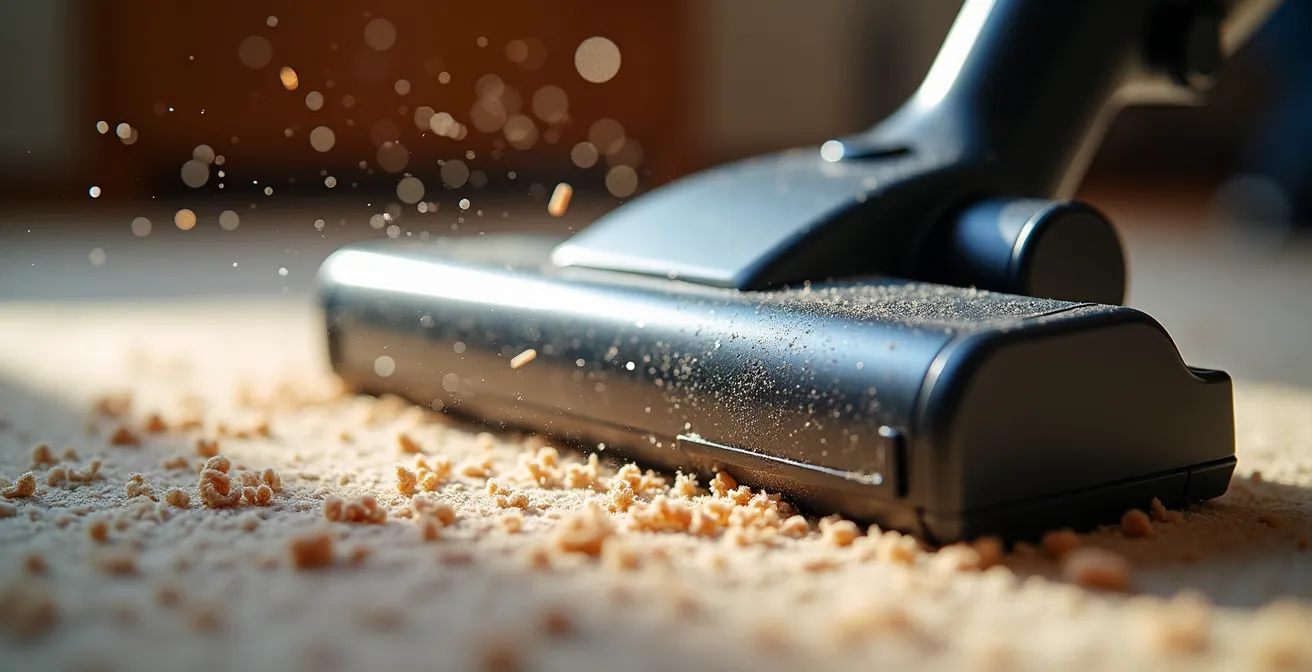
Your vacuuming strategy must be relentless and targeted. Focus on “priority zones” where flea life stages congregate: pet sleeping areas, along all baseboards, under furniture, and deep within couch cushions. The vibrations also serve a dual purpose: they trigger the heavily protected pupae to hatch, forcing the new adult fleas to emerge into an environment where they are vulnerable. After every session, the vacuum bag or canister must be sealed in a plastic bag and disposed of in an outdoor trash can immediately. Failure to do so turns your vacuum into a mobile flea incubator, undermining your entire effort.
By understanding the behavior of flea larvae and deploying your vacuum with strategic intent, you actively destroy the next generation of fleas before they ever have a chance to jump on your pet.
Why You Must Treat for Fleas Even in December?
A common and dangerous misconception is that flea infestations are a seasonal problem, disappearing with the first frost. This leads many pet owners to suspend their flea prevention measures during the winter months, creating a critical vulnerability in their defenses. While fleas cannot survive freezing temperatures outdoors, this is irrelevant in the context of a modern home. Central heating and insulation create a perfect, year-round “indoor summer” for fleas to thrive.
Indeed, entomological research confirms fleas thrive at 70-86°F (21-30°C) with 70% humidity, conditions that are consistently maintained inside our homes regardless of the weather outside. A single flea brought inside on a pet, or even on a person’s clothing, can quickly establish a thriving infestation in the dead of winter. The entire lifecycle—from egg to adult—will happily proceed in the protected environment of your carpets and furniture. Suspending treatment is like leaving the front door unlocked; it invites an invasion.
Case Study: The Winter Infestation from a Hidden Source
Even homes without pets are not immune. A family experiencing a winter flea problem, despite having no pets, discovered the source was a family of raccoons that had taken up residence in their chimney. These wildlife carriers can be a cryptic source of fleas, introducing them into the living spaces of a home through attics, crawl spaces, or chimneys. This highlights that the threat is ever-present and not solely dependent on your own pets, making year-round vigilance an essential part of a successful long-term strategy.
As veterinary expert Dr. Katy Nelson states, “Modern homes with central heating create a perpetual ‘indoor summer’ for fleas.” The only effective strategy is continuous, year-round prevention for every pet in the household. This creates an unbroken shield of protection, ensuring that any flea that enters your home cannot establish a foothold, no matter the season.
Steroids vs. Apoquel: How to Stop the Scratching Cycle Quickly?
While your long-term strategy focuses on eradicating the flea population, you also have a critical short-term mission: providing immediate relief to your suffering pet. For an animal with Flea Allergy Dermatitis (FAD), the intense itching (pruritus) is debilitating. Breaking this “itch-scratch” cycle is essential for their comfort and to prevent secondary skin infections. Your veterinarian has several powerful tools for this, with corticosteroids and newer targeted therapies like Apoquel being two primary options.
Corticosteroids (like prednisone) are potent anti-inflammatory drugs that work by suppressing the entire immune system. They are highly effective and work quickly to reduce itching, but this broad suppression comes with potential side effects, especially with long-term use. They are best used as a short-term intervention to break a severe flare-up. Apoquel (oclacitinib), on the other hand, is a more targeted medication. It specifically inhibits Janus kinase (JAK) enzymes, which are involved in the signaling pathway that leads to itch and inflammation. This targeted action provides rapid relief, often within hours, but with a better long-term safety profile than steroids because it doesn’t cause broad immune suppression.
This timeline offers a strategic comparison of the most common veterinary options for rapid itch relief.
| Treatment | Onset of Action | Duration | Safety Profile |
|---|---|---|---|
| Steroids | 4-24 hours | 24-72 hours | Short-term use only, systemic suppression |
| Apoquel (Oclacitinib) | 4-8 hours | 12-24 hours (daily dosing) | Targeted JAK inhibition, better long-term safety |
| Cytopoint (Injection) | 24-48 hours | 4-8 weeks | Monoclonal antibody, minimal side effects |
It’s also crucial to note that abruptly stopping steroid treatment can trigger a severe “rebound” itch. This is why these medical interventions must always be paired with a relentless, year-round flea control strategy. The ultimate goal is to make these emergency itch-relief drugs unnecessary by preventing the flea bites that trigger the allergy in the first place.
Coop Boots: How to Prevent Tracking Bacteria into Your House?
While the section title mentions “Coop Boots” and bacteria, in the context of a flea infestation, the more immediate threat we track indoors isn’t bacteria—it’s the flea eggs themselves. A core part of a comprehensive extermination strategy is establishing a defensive perimeter to prevent re-infestation from outside sources. Humans and pets are the primary transport vehicles for bringing flea eggs into the clean sanctuary of your home.
The science behind this is simple but critical. According to pest control research, a single female flea can lay 40-50 eggs per day. Unlike the eggs of other parasites, flea eggs are not sticky. They are laid on the host (your pet) but immediately fall off into the surrounding environment. This means that if your pet picks up a flea on a walk, flea eggs are being scattered like tiny salt grains wherever your pet goes—including on your porch, in your car, and eventually, all over your house. The same applies to humans; eggs can fall onto our shoes or clothing and be unknowingly carried inside.
To combat this, you must establish a “Decontamination Zone” at every entry point to your home. This isn’t about complex equipment; it’s a protocol. A washable rubber mat at the door serves as the first line of defense. A dedicated shoe removal area prevents outdoor footwear from going past the entryway. For pets, a paw-cleaning station with microfiber towels and water can physically remove eggs and debris before they are tracked further into the home. For pets with longer coats, a quick wipe-down of their underbelly and legs adds another layer of security. This protocol turns a passive entryway into an active checkpoint, significantly reducing the number of new enemy combatants being introduced into the battleground.
By controlling what comes in, you make the job of eliminating what’s already inside far more manageable. It is a simple but highly effective tactic in the long-term war against fleas.
Key Takeaways
- The “pupal window” is why fleas reappear 2-4 weeks after treatment; dormant pupae are immune to insecticides.
- Environmental control is non-negotiable, as 95% of the flea population (eggs, larvae, pupae) lives in your home, not on your pet.
- Year-round flea prevention is essential because modern homes create a perfect, perpetual breeding ground for fleas, even in winter.
Why One Flea Bite Can Cause 3 Weeks of Itching?
For many pets, a flea bite is a minor annoyance. But for a significant portion of the pet population, a single bite can trigger a severe and prolonged allergic reaction known as Flea Allergy Dermatitis (FAD). This condition is the most common dermatological disease in dogs and cats. Understanding FAD is crucial because it explains why the goal of your strategy must be total eradication, not just “control.” For an allergic pet, there is no acceptable number of fleas.
The intense, prolonged itching is caused by a hypersensitive immune response to specific proteins in flea saliva. As veterinary dermatologist Dr. Mitzi D. Clark explains, “In FAD, the pet’s immune system has been ‘trained’ to massively overreact to even minute amounts of proteins in flea saliva.” When the flea bites, it injects saliva that acts as an anticoagulant. In an allergic pet, the immune system identifies this saliva as a major threat and launches a massive inflammatory cascade. This response doesn’t stop when the flea is gone; it can last for weeks, causing intense pruritus, redness, hair loss (especially on the lower back, base of the tail, and thighs), and self-trauma from constant scratching and chewing. These wounds can then lead to painful secondary bacterial infections.
Certain breeds are genetically more prone to developing this hypersensitivity. According to veterinary dermatology studies, breeds like West Highland White Terriers, Golden Retrievers, and Shih Tzus show a higher susceptibility to FAD. However, any dog or cat can develop the allergy. The condition often worsens with age as the pet’s immune system becomes more sensitized over time with repeated exposure to flea bites. This is why a dog that was previously untroubled by fleas may suddenly develop a severe allergy.
The fight against fleas for an FAD pet is not about reducing numbers; it’s a strategic campaign for total prevention. The only way to stop the suffering is to ensure the pet is never bitten in the first place, which requires a flawless and continuous execution of your pet treatment and environmental control strategy.