
A dog’s snap is rarely a surprise; it’s the final sentence in a long story we failed to read.
- Common behaviors like yawning, sniffing, or even a certain type of tail wag are often misread signs of high stress, not happiness or distraction.
- Subtle signals like “whale eye” and lip licking are polite requests for space that, when chronically ignored, force a dog to escalate its communication.
Recommendation: Shift your focus from simply “training” a dog to truly “understanding” them by learning to interpret the context, sequence, and combination of their body language.
It’s a moment that shatters an owner’s world. One second, your “nice” dog is tolerating a situation; the next, there’s a flash of teeth, a growl, or a snap that seems to come from nowhere. The shock and confusion are profound. You’re left wondering, “Why did they do that? There was no warning.” This is a common and heartbreaking misconception. The truth is, there were almost certainly warnings. They just weren’t loud, obvious, or in a language we easily understand.
Most advice focuses on a simple checklist of behaviors: yawning, lip licking, avoiding eye contact. While correct, this approach is like memorizing a few words from a dictionary and expecting to be fluent. It misses the grammar, the syntax, and the poetry of canine communication. The real key to understanding your dog and preventing that “sudden” snap lies not in spotting a single signal, but in becoming a visual interpreter. It’s about learning to see the subtle conversation your dog is having with the world, moment by moment.
This is where we move beyond lists and into the art of observation. The “whale eye”—that glimpse of the white of the eye—is not just an isolated event; it’s a punctuation mark in a sentence of discomfort. When we learn to read the whole sentence, we can respond to our dog’s polite whispers before they feel the need to shout. This guide will teach you to see the patterns, understand the context, and recognize the buildup of emotional stacking, transforming you from a worried owner into a confident, observant interpreter of your dog’s true feelings.
To become a fluent interpreter of your dog’s language, it’s essential to break down their signals into understandable components. This article is structured to guide you through the nuances of canine body language, from the most commonly misunderstood signals to the subtle cues that reveal their true emotional state.
Summary: Decoding the Silent Language of Your Dog
- Stiff vs. Loose: Why a Wagging Tail Doesn’t Always Mean Friendliness?
- Sniffing and Scratching: Is Your Dog Distracted or Stressed?
- Meta-Signals: How Dogs Say “Just Kidding” During Rough Play?
- Raised Hackles: Is It Aggression or Just Arousal?
- Lip Licking and Looking Away: How Dogs Ask for Space?
- 100 People vs. 1 Positive Encounter: The Socialization Myth
- Front Cross vs. Rear Cross: How Your Body Language Steers the Dog?
- Why “Alpha Theory” Is Obsolete in Modern Dog Training?
Stiff vs. Loose: Why a Wagging Tail Doesn’t Always Mean Friendliness?
The myth of the universally friendly wagging tail is one of the most dangerous in canine communication. While a loose, swishy wag can indeed signal a happy, relaxed dog, a tail’s message is all about context and mechanics. A dog’s tail is an emotional barometer, and its position, speed, and tension are far more telling than the wag itself. A high, stiff, rapidly vibrating tail often signals high arousal, overstimulation, or even a warning. This is the “warning wag” that so many people misinterpret right before a snap.
To truly understand, you must look at the whole dog. Is the body stiff and tense, or loose and wiggly? Are the ears forward and alert, or relaxed? Is the mouth closed and tight, or open and soft? A stiff body with a high, fast wag is a world away from a relaxed body with a “helicopter” tail. The former is a dog on high alert, potentially seconds from feeling overwhelmed. The latter is a sign of genuine, uncomplicated joy.
Learning to differentiate these signals is critical for safe interactions. Observing the tail in conjunction with the rest of the body language provides a much clearer picture of the dog’s internal state. Here are some key variations to watch for:
- Tucked or low, fast-wagging tail: The dog is scared or unsure. It’s crucial to give them space immediately.
- Tail at spine level with loose wag: The dog is likely relaxed and comfortable, indicating a potentially safe interaction.
- Tail raised above spine with short, rapid movements: This shows high arousal or excitement. The situation should be monitored closely.
- Tail straight up and stiff: The dog is alert and could be on the verge of aggression. Avoid a direct approach.
- Circular wagging motion: This is often a sign of genuine happiness and friendliness, making a positive interaction likely.
Ultimately, the tail is just one word in a complex sentence. Ignoring the rest of the sentence is how friendly greetings turn into frightening incidents. By paying attention to the full picture, you can accurately read your dog’s intentions and ensure everyone stays safe and comfortable.
Sniffing and Scratching: Is Your Dog Distracted or Stressed?
You’re in a training session or walking past a stranger, and your dog suddenly becomes intensely interested in sniffing a patch of grass or stops to scratch an imaginary itch. Is it distraction? Rudeness? Or is it something else entirely? These are often “displacement behaviors”—normal activities performed out of context as a way to diffuse internal conflict or stress. When a dog is uncertain, anxious, or overwhelmed, they may default to these self-soothing behaviors. It’s the canine equivalent of a human nervously checking their phone or fiddling with their hair in an awkward social situation.
Recognizing displacement behaviors is key to understanding your dog’s emotional threshold. These actions are a direct window into their stress levels. In fact, some studies show that more than 70% of dogs display anxiety-related behaviors, many of which manifest as these seemingly random actions. When you see your dog suddenly yawn, intensely sniff the ground, or scratch when the context doesn’t fit, they are communicating discomfort. They’re telling you, “This situation is making me a bit uncomfortable, and I need to do something familiar to cope.”
This is a valuable, early piece of information. Ignoring these signals allows the “emotional stacking” to continue, pushing the dog closer to a more overt reaction like a growl or snap. Acknowledging them allows you to intervene, create distance, or change the environment to help your dog feel safe again.
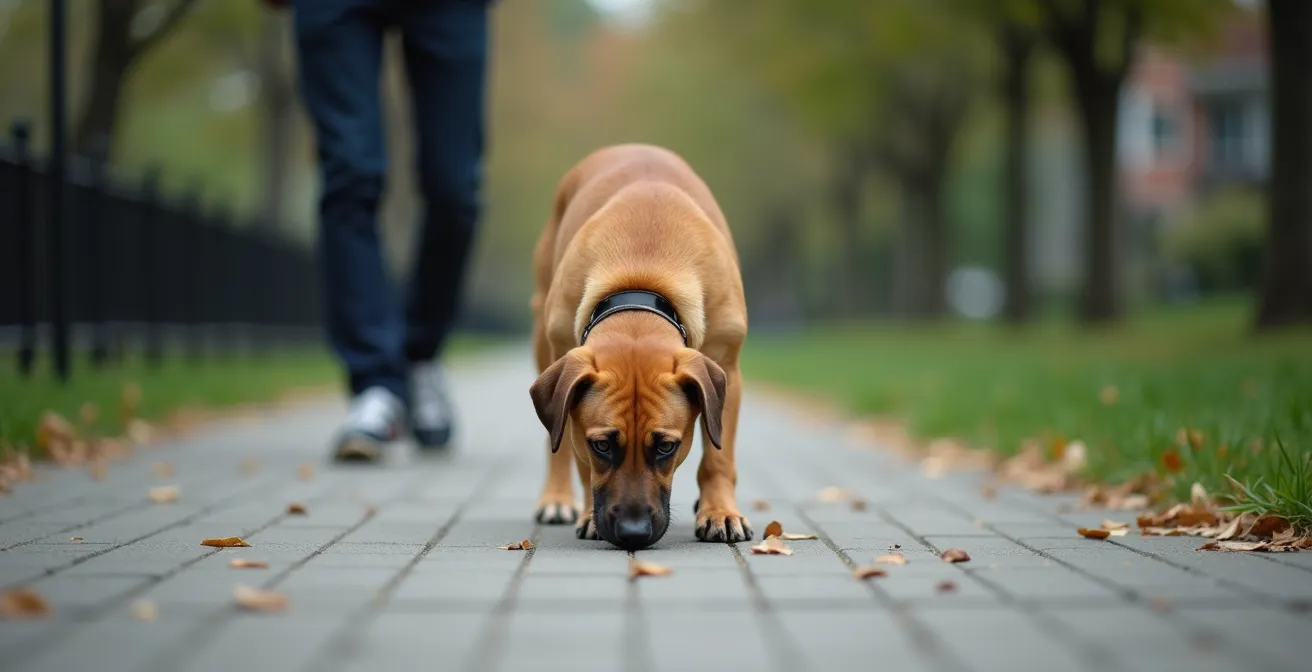
As this image illustrates, the dog is using an everyday behavior—sniffing—as a strategy to avoid a stressful interaction. The key is the context. To help differentiate, consider this breakdown of genuine actions versus stress signals.
| Behavior | Genuine Action | Displacement/Stress Signal |
|---|---|---|
| Sniffing | Exploratory, relaxed body, moving naturally | Sudden, frantic, occurs after trigger event |
| Scratching | Focused on specific spot, relief after | Random, no actual itch, during tense situations |
| Yawning | When tired, before sleep, stretching | During training, when stressed, repeatedly |
By learning to spot these subtle communicative acts, you can respond to your dog’s discomfort long before it escalates, building trust and strengthening your bond.
Meta-Signals: How Dogs Say “Just Kidding” During Rough Play?
Rough-and-tumble play between dogs can look alarming to the uninitiated. There’s growling, biting, and body slamming that can seem like a real fight. So, how do dogs differentiate a playful bout from a genuine conflict? They use “meta-signals”—a special class of communication that frames the following behavior as “play.” These signals are the social glue of healthy canine interaction, essentially telling the other dog, “Everything I do after this is just for fun, I don’t mean it.”
The most famous meta-signal is the play bow: front end down, rear end in the air, with a wiggly, expectant demeanor. As the Best Friends Animal Society notes, “A play bow before a growl frames the growl as part of a game.” It’s a clear, almost universal invitation. But the play bow is just one tool in their toolkit. Healthy play is characterized by a range of signals that maintain a light and fun atmosphere, ensuring both partners are comfortable and want to continue.
These signals include bouncy, inefficient movements, where dogs seem to move with deliberate clumsiness to show non-threatening intent. Another is self-handicapping, where a larger or stronger dog will lie down or “play dead” to allow a smaller partner to “win.” Brief pauses and freezes are also crucial, acting as a consent check to see if the other dog is still enjoying the game. A dog that continually ignores these pauses or pins a playmate who is trying to disengage is not playing fairly.
Recognizing these signals helps you determine if a play session is healthy or escalating toward a real conflict. Look for these key indicators of good-natured fun:
- Play bow: The classic front-end-down, rear-end-up invitation to play.
- Bouncy, inefficient movements: Exaggerated, clumsy motions signal playful intent.
- Self-handicapping: A stronger dog lies down to match a smaller playmate’s level, showing they mean no harm.
- Pause and freeze: Brief stops in the action to check if the play partner wants to continue.
- Soft eyes and relaxed mouth: An open-mouth “smile” during play indicates comfort and enjoyment.
When you see these meta-signals being exchanged, you’re witnessing a sophisticated social negotiation. It’s a testament to the complexity of canine communication and a beautiful thing to watch when both dogs are speaking the same language of play.
Raised Hackles: Is It Aggression or Just Arousal?
Few signals are as visually dramatic or as misunderstood as raised hackles, a phenomenon known as piloerection. When the hair along a dog’s spine stands on end, many owners immediately jump to the conclusion of aggression. While raised hackles can certainly accompany aggressive displays, interpreting them as solely a sign of aggression is a mistake. Piloerection is not a voluntary action; it’s an automatic response to a surge of adrenaline. This means it is an honest, unfiltered signal of a dog’s internal state.
The key thing to understand is that piloerection signals arousal, not necessarily aggression. Arousal can mean many things: fear, excitement, surprise, insecurity, or intense interest. Think of it as the canine equivalent of goosebumps in humans. You might get them when you’re scared, but also when you’re deeply moved by music or feeling a sudden chill. The presence of raised hackles simply tells you that the dog’s nervous system is on high alert. The *reason* for that alert is revealed by the rest of their body language.
A dog displaying aggressively will often have raised hackles, but they will also show other concurrent signals. As described in analyses of canine body language, an aggressive dog will try to look large, standing tall with its head raised above its shoulders and its body tense. Its weight might be centered or leaning forward. A wrinkled muzzle and a hard, fixed stare are also common companions to aggressive piloerection. In contrast, a fearful dog might have raised hackles but will also be cowering, have a tucked tail, and be trying to look smaller. An intensely excited dog chasing a squirrel might have its hackles up purely from the thrill of the chase. Piloerection is a 100% involuntary response controlled by the autonomic nervous system, making it one of the most truthful signals a dog can offer.
Instead of panicking when you see raised hackles, take it as a cue to slow down and become a better observer. Ask yourself: what else is the dog’s body saying? What is happening in the environment? The hackles are the headline; the rest of the body provides the story.
Lip Licking and Looking Away: How Dogs Ask for Space?
In the quiet language of dogs, some of the most important messages are also the most subtle. Lip licking and looking away (or a full head turn) are prime examples. Often dismissed or completely missed by owners, these are not random tics. They are active, intentional calming signals—polite requests for de-escalation and space. When a dog is approached by a stranger, hugged too tightly, or stared at, a quick, darting lick of the lips or a deliberate turn of the head is their way of saying, “I’m not comfortable with this,” or “You’re a bit too close, and I mean no harm.”
This is where the concept of “polite requests” versus “loud demands” becomes critical. The lip lick and head turn are the polite requests. They are the dog’s first and most civil attempts to resolve a socially awkward or stressful situation. In a visual analysis of a dog bite incident, it was noted that the dog gave clear warnings, including ‘whale eye’ and lip licking, for a long duration before escalating. The dog was consistently looking away, trying to appease and ask for space. As veterinarian Dr. Elizabeth Racine warns, “Ignoring polite requests for space forces dogs to escalate to more obvious signals like growling or snapping.” The growl is the loud demand that happens only after the polite requests have been repeatedly ignored.
The tragedy is that many owners punish the growl, effectively silencing the last warning signal their dog has left. A far better approach is to learn to recognize and honor the initial, quieter requests. When you see your dog offer a head turn or a lip lick, you are being given a gift: the chance to de-escalate a situation long before it becomes a problem. Simply turning your body sideways, taking a step back, or redirecting the interaction can validate your dog’s communication and build immense trust.
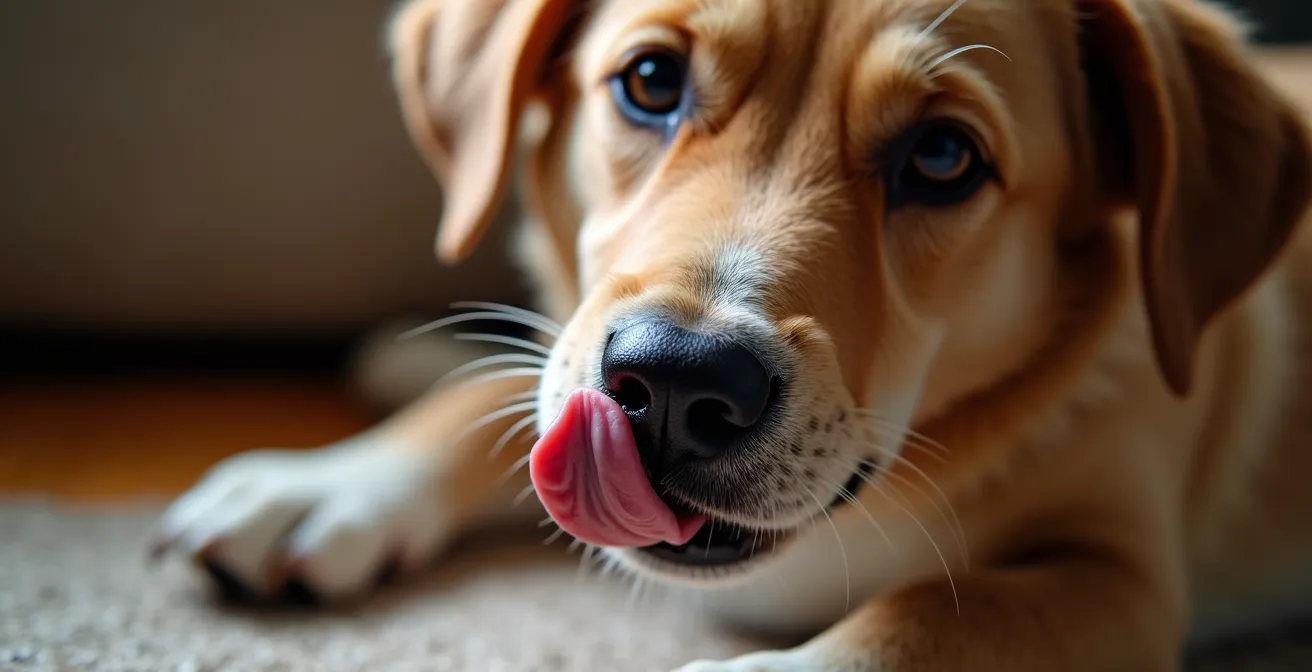
It is important, however, to interpret these signals in context, as a lip lick can also mean anticipation of food. The appearance and situation are key differentiators.
| Type of Lick | Appearance | Context | Meaning |
|---|---|---|---|
| Stress Lick | Quick, darting tongue flick | During training, meeting strangers | I’m uncomfortable |
| Food Anticipation | Slow, deliberate lip lick | Near meal time, seeing treats | I’m hungry/excited |
| Post-Meal | Full tongue cleaning motion | After eating or drinking | Normal grooming |
When you start seeing and responding to these subtle cues, you enter into a true two-way conversation with your dog, one built on mutual respect and understanding.
100 People vs. 1 Positive Encounter: The Socialization Myth
The term “socialization” is widely known but deeply misunderstood. Many new puppy owners interpret it as a numbers game: expose the puppy to as many people, dogs, and places as possible before the window closes. They drag their pup to bustling parks and parties, believing they are creating a bomb-proof adult dog. In reality, this approach can often do more harm than good. True socialization is not about the quantity of exposure; it is about the quality of the experience. One single scary encounter can do more damage than a hundred neutral ones can fix.
The goal of socialization is to build confidence, not to overwhelm. It’s about teaching a puppy that the world is a safe and predictable place, and that new things are not to be feared. This crucial learning happens during a sensitive developmental period. For puppies, the critical socialization period occurs between approximately 3-16 weeks of age. Experiences during this time have a profound and lasting impact on their future behavior. Forcing a timid puppy into the arms of 100 strangers is not socialization; it’s a process called “flooding,” and it can create fear and anxiety that lasts a lifetime.
A much better approach is to focus on creating positive, controlled associations. This means letting the puppy set the pace, never forcing interactions, and advocating for their space. A successful socialization outing might be simply sitting on a park bench and rewarding the puppy with a high-value treat every time a person or dog walks by at a distance, without any direct interaction. The puppy learns that new things predict good things (treats!) and that they don’t have to engage if they’re not ready. It’s about one positive encounter, not one hundred overwhelming ones.
Your Action Plan: Consent-Based Socialization
- Observe their body language: Watch for whale eye, lip licking, and attempts to disengage as signals that your puppy is becoming overwhelmed.
- Empower your puppy: Allow the puppy to approach new experiences and people at their own pace. Never force an interaction or allow strangers to loom over them.
- Build positive associations: Use games like “Look at That” (LAT) to build neutrality and positive feelings toward triggers from a safe distance.
- Prioritize parallel activities: Arrange structured parallel walks with calm, known dogs instead of chaotic, face-to-face greetings at a dog park.
- Curate their friends: Schedule short, heavily supervised one-on-one playdates with well-mannered, calm, and known adult dogs who can teach good social skills.
By shifting the focus from quantity to quality, you give your puppy the tools to grow into a confident, resilient, and truly well-socialized adult dog.
Front Cross vs. Rear Cross: How Your Body Language Steers the Dog?
In the world of dog agility, handlers use precise body movements like “front crosses” and “rear crosses” to direct their dogs through a complex obstacle course at high speed. It’s a beautiful dance where a subtle shift in shoulder position or a slight turn of the hips can send the dog over a jump or into a tunnel. While most of us aren’t competitive agility handlers, the principle is universal: our body language constantly steers our dogs’ emotional and physical direction. Our posture, speed, and even the direction of our gaze are powerful signals that our dogs are constantly reading.
Many owners inadvertently create stress for their dogs through their own body language. A direct, head-on approach, for example, is considered rude and confrontational in the canine world. Reaching over a dog’s head to pet them can be intimidating. Even prolonged, direct eye contact can be perceived as a threat. We do these things with loving intentions, but from the dog’s perspective, our body language can be unintentionally pressuring and stressful, causing them to show the very calming signals we’ve been discussing, like lip licking or looking away.
Learning to use our bodies in a more “dog-friendly” way can dramatically reduce our pets’ daily stress levels. As experts in canine behavior suggest, when approaching an unfamiliar or timid dog, one should do so in a curved fashion. This “arc” approach is a polite, non-confrontational signal. To further show goodwill, turning your body sideways to the dog and avoiding direct eye contact can make you appear much less threatening. These are simple adjustments, but they can completely change the tone of an interaction, inviting the dog to approach you willingly rather than feeling cornered.
Just like an agility handler guides their partner, we can guide our dogs toward feelings of safety and confidence simply by being more conscious of our own physical cues. It’s a silent conversation, and becoming more fluent in it benefits everyone.
Key Takeaways
- A wagging tail is not a universal sign of friendliness; the tension in the body and the height and speed of the wag are more revealing.
- Subtle, out-of-context behaviors like sniffing, scratching, or yawning are often “displacement behaviors” used to cope with stress, not signs of distraction.
- Quality socialization is about creating positive experiences at the dog’s pace, not about maximizing the quantity of exposure to new people and dogs.
Why “Alpha Theory” Is Obsolete in Modern Dog Training?
The journey into understanding canine communication inevitably leads to a critical re-evaluation of outdated training methods. The concept of the “alpha” or “pack leader,” which encourages owners to dominate their dogs to establish status, is perhaps the most damaging myth in the history of dog training. This theory, based on flawed observations of captive, unrelated wolves, has been thoroughly debunked by modern animal behaviorists. Yet, its legacy persists in confrontational techniques that create fear, not respect.
Methods like “alpha rolls” (forcing a dog onto its back), scruff shakes, and prolonged, intimidating stares do not establish leadership. They establish a relationship built on conflict and fear. These actions are profoundly threatening to a dog and are the direct cause of the very stress signals this article has taught you to recognize. When you physically dominate a dog, you are guaranteed to see whale eye, appeasement licks, and a tense, frozen body. You are forcing the dog into a state of defensive survival.
This is the ultimate tragedy of the alpha theory. In an attempt to “correct” behavior, it actively generates the fear and anxiety that often lead to aggression. As renowned animal behaviorist Patricia B. McConnell, Ph.D., states in her work, “Confrontational techniques like ‘alpha rolls,’ scruff shakes, and hard stares are the direct cause of defensive whale eye, appeasement licks, and fear-based aggression.” You are not teaching the dog to respect you; you are teaching the dog that you are unpredictable and dangerous, forcing them to escalate their signals to protect themselves.
The modern, effective, and humane approach is one of partnership, not dictatorship. It involves building trust, honoring your dog’s communication, and managing the environment to set them up for success. By abandoning the “alpha” mindset and embracing the role of a benevolent guide and interpreter, you can build a bond with your dog that is based on true mutual respect and understanding, making those “loud demands” of growls and snaps truly obsolete.