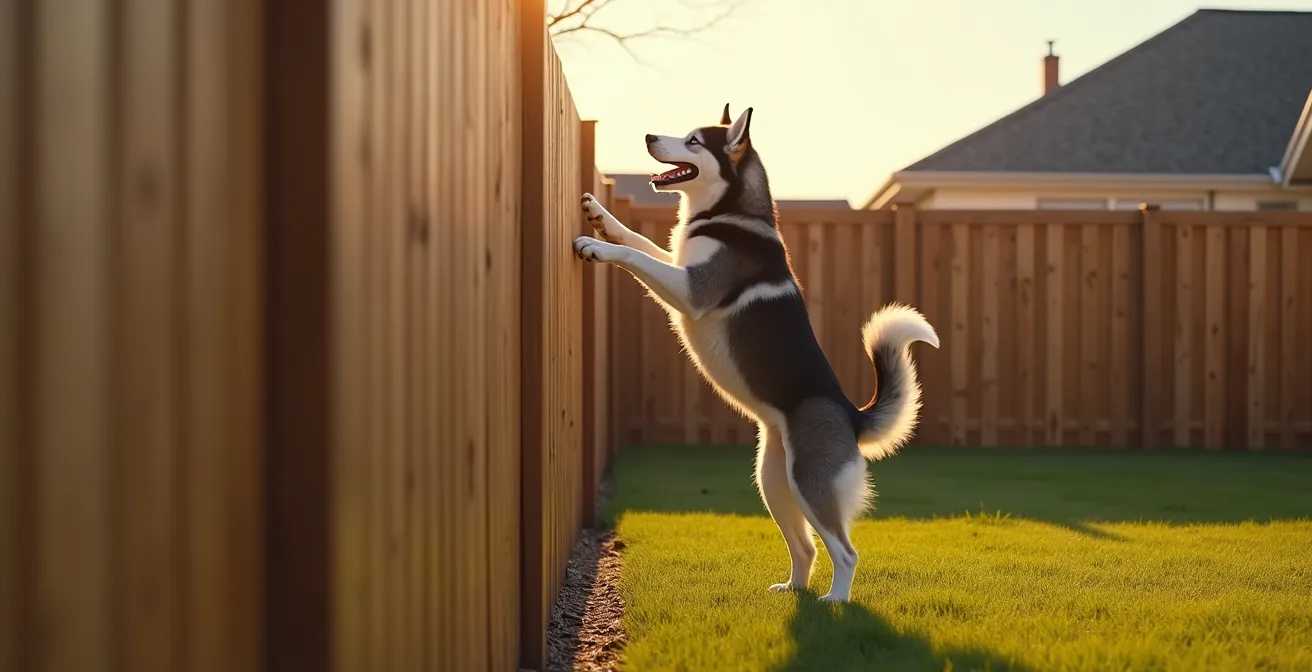
Most owners believe a higher fence or a stronger lock is the solution to a Husky’s escape attempts. The truth is, these are merely symptoms of a deeper issue. A Husky doesn’t just want out; it wants a job. This guide reframes containment from a question of physical restraint to one of purposeful engagement, revealing that the key to keeping your Husky safe is to satisfy its ancient, innate drive to work, not just to build a better prison.
The sight of an empty yard where your Husky should be is a heart-stopping moment every owner dreads. You’ve checked the gate, walked the fence line, and still, they’re gone. Siberian Huskies are infamous escape artists, a reputation earned through a formidable combination of intelligence, athleticism, and an insatiable wanderlust. Many owners respond by raising fences, burying wire, and adding locks, essentially escalating an arms race with a dog that was bred for thousands of years to think for itself and cover vast distances.
Common advice focuses on managing the symptoms: they have a high prey drive, they dig, they jump. While true, these are just manifestations of a much deeper, more fundamental need. This isn’t a “bad” dog that needs to be controlled; it’s a working dog trapped in a suburban lifestyle. The constant escape attempts are not acts of defiance but a desperate search for purpose—a job to do, a challenge to conquer, a territory to explore. They aren’t trying to run away from you; they are running towards a need that isn’t being met.
But what if the entire approach to containment is flawed? If the real solution isn’t about building a more secure fortress, but about changing what’s inside it? This guide moves beyond simple restraint. We will explore a containment philosophy centered on honoring the Husky’s spirit. We will delve into why a simple walk is not enough, how their independent mindset requires a different training approach, and how channeling their energy into purposeful engagement is the most effective security measure you can implement. We’ll provide the tools to make your yard a sanctuary of fulfillment, not a beautifully decorated cage.
This article breaks down the essential pillars of understanding and managing your Husky’s innate drives to ensure their safety. Explore the sections below to build a comprehensive strategy that addresses everything from their unique biology to their psychological needs.
Summary: Why Are Huskies Such Notorious Escape Artists and How Can You Secure Your Yard?
- Cats and Huskies: Can They Ever Safely Coexist?
- Why You Should Never Shave a Husky, Even in Summer
- Mental vs. Physical: Why a 5km Walk Isn’t Enough for a Husky
- Why Huskies Don’t Care About Pleasing You (And How to Train Them Anyway)
- The “Husky Talk”: Dealing with Howling in Close Quarters
- The No-Slip Collar: Preventing Escape for Heads Smaller Than Necks
- Why 15 Minutes of Brain Work Tires a Husky More Than an Hour of Running
- How to Start Urban Mushing (Canicross/Bikejor) with One Dog
Cats and Huskies: Can They Ever Safely Coexist?
The high prey drive of a Husky is not a behavioral flaw; it’s a feature. Bred to survive in harsh environments, their instinct to chase small, fast-moving animals is deeply ingrained. This presents a significant challenge for households with cats. While coexistence is possible, it demands vigilant management and a realistic understanding that the prey drive can never be entirely “trained out.” Success depends on managing the environment to prevent the chase instinct from ever being triggered. Simply hoping they’ll become friends is a dangerous gamble.
Successful integration is a slow, meticulous process. It involves creating separate safe zones using pet gates and vertical spaces like cat trees, allowing the cat to observe and retreat without feeling cornered. Initial introductions should be done with the Husky securely leashed, rewarding calm behavior in the cat’s presence. The goal is to reclassify the cat from “prey” to “boring part of the pack.” Even in successful cases, unsupervised interaction should be permanently off the table. A sudden dash from a cat can trigger that ancient instinct in a split second, with tragic consequences.
Case Study: Multi-Husky Household Successfully Integrates Cats
One owner with four sled-racing Huskies reported success integrating two cats into their home. The strategy relied heavily on environmental management. They created cat-only zones using pet gates and installed numerous cat trees to provide vertical escape routes. Through weeks of carefully controlled, positive-reinforcement-based introductions, the Huskies learned to view the cats as neutral members of the pack. The key, according to the owner, was consistency and never allowing a chase to begin, effectively managing the dogs’ innate drive rather than trying to erase it.
Ultimately, a Husky’s prey drive is a primary motivator for escape. A squirrel, a stray cat, or a rabbit on the other side of the fence is not just a curiosity—it’s a call to action. Securing your yard is as much about managing these external triggers as it is about containing the dog itself.
Why You Should Never Shave a Husky, Even in Summer
When summer temperatures rise, many well-intentioned owners think shaving their Husky will provide relief. This is one of the most dangerous myths and a fundamental misunderstanding of their unique biology. A Husky’s double coat is a sophisticated, all-weather insulation system. The dense, soft undercoat traps air to keep them warm in winter, while the longer, coarse guard hairs protect them from harmful UV rays, insect bites, and heat. Shaving this coat destroys their natural ability to regulate body temperature, making them more susceptible to overheating and sunburn.
The double coat works through a process of convection. The guard hairs create a layer of air between the skin and the hot environment, which is then cooled by the dog’s movement. Removing this layer is like taking the insulation out of a thermos; it can no longer keep the contents cool. Furthermore, shaving can cause permanent damage to the coat. The guard hairs and undercoat grow at different rates, and the texture may never return to its original protective state, often growing back patchy and less effective.

True cooling comes from proper grooming, not removal. The key is to help the dog “blow” its winter undercoat. Thorough brushing with an undercoat rake removes the dense, shedding fur, allowing air to circulate freely through the guard hairs. Instead of shaving, focus on providing effective cooling alternatives:
- Brush thoroughly during shedding season to remove the trapped undercoat.
- Create cooling stations with ample shade and access to wading pools.
- Use cooling mats and specialized vests designed for double-coated breeds.
- Offer frozen treats and “pupsicles” for internal cooling.
- Schedule professional deshedding treatments, which remove loose fur without cutting the protective guard hairs.
Respecting their natural biology is a cornerstone of responsible ownership. A dog that is physically uncomfortable is more likely to be stressed and seek escape, making proper coat care an indirect but important part of your containment strategy.
Mental vs. Physical: Why a 5km Walk Isn’t Enough for a Husky
A common misconception is that a tired Husky is a good Husky. While true, owners often misunderstand what truly tires them. A 5km leashed walk around the neighborhood barely scratches the surface of their needs. Huskies were bred to pull sleds for hundreds of miles, making decisions and navigating terrain. A monotonous walk on a flat sidewalk provides physical exercise but offers almost zero purposeful engagement or mental fatigue. This lack of mental stimulation is the primary driver behind boredom-induced behaviors like destructive chewing, howling, and, most notably, escaping.
An unfulfilled mind will seek its own challenges. For a Husky, that might mean figuring out how to unlatch a gate, scale a fence, or dig an escape tunnel. Their intelligence becomes a liability when not given a proper outlet. The solution is to shift the focus from a high quantity of physical exercise to a high quality of mental work. Activities that force them to think, problem-solve, and use their senses are far more effective at draining their energy. In fact, research on canine mental stimulation shows that 15 minutes of scent work can be more tiring for a Husky than a 30-minute run. Even the timing of exercise can have a profound impact, as it sets the tone for the entire day.
Case Study: The Morning Walk That Stopped Escape Attempts
The owner of a notorious escape artist Husky was at their wit’s end. The dog would find a way out of the yard almost daily, despite being taken for a long walk every evening. On a whim, they made one simple change: they added a 30-minute walk in the morning before leaving for work. The result was transformative. The escape attempts stopped completely. The morning walk provided just enough mental and physical stimulation to satisfy the dog’s initial burst of energy for the day, removing the bored, anxious drive to escape while the owner was away.
Incorporating brain games, puzzle toys, and short training sessions into their daily routine is not an optional extra; it is as essential as food and water. This is the “job” they crave. A mentally satisfied Husky is a dog that sees its home and yard as a place of engagement and reward, not a place to escape from.
Why Huskies Don’t Care About Pleasing You (And How to Train Them Anyway)
If you’re used to breeds like Golden Retrievers or Labradors, training a Husky can be a frustrating experience. They often seem stubborn, aloof, and utterly uninterested in making you happy. This isn’t because they are unintelligent; it’s because they were bred for a completely different purpose. They are not people-pleasers. Their genetics favor independent thought and problem-solving, traits essential for a sled dog navigating a blizzard hundreds of miles from its musher. A dog that waited for a command in that situation would not survive.
This independent nature is a core part of the breed’s identity. As Gina DiNardo, Vice President of the American Kennel Club, explains, “Huskies are a very independent, headstrong breed that has been bred to think on their own out in the tundra.” They operate on a “what’s in it for me?” basis. If a command doesn’t serve their immediate interests, they are likely to ignore it. This means traditional, repetitive training methods based on a desire to please are destined to fail. The key to training them is not to demand obedience but to build a cooperative partnership based on motivation.

To train a Husky effectively, you must become more interesting than the environment. This involves using high-value rewards (not just dry kibble), keeping training sessions short and engaging to combat boredom, and framing tasks as a fun game rather than a chore. You need to convince them that working with you is the most rewarding option available. Instead of trying to force a “sit,” you create a situation where sitting earns them something they truly desire. This approach respects their intelligence and independent spirit, turning training from a battle of wills into a collaborative effort.
Huskies are a very independent, headstrong breed that has been bred to think on their own out in the tundra.
– Gina DiNardo, Vice President of American Kennel Club
Understanding this mindset is crucial for containment. A Husky that sees you as a source of fun, challenge, and reward is a Husky that is less likely to seek those things elsewhere. The bond you build through this motivational training becomes one of the strongest fences you can have.
The “Husky Talk”: Dealing with Howling in Close Quarters
The iconic Husky howl is a form of communication, a way of connecting with their pack, and an expression of their emotions. While beautiful in the wild, it can be a significant source of stress for owners in apartments or suburban neighborhoods. Howling is often triggered by loneliness, boredom, or environmental cues like sirens. Just like escaping, it’s rarely done out of spite; it’s a symptom of an underlying need. In fact, behavioral research indicates that excessive howling due to boredom often stems from the same unfulfilled needs that lead to escape attempts. It’s a vocal cry for more engagement.
Managing howling requires a multi-faceted approach that combines environmental management, training, and enrichment. The first step is to identify the triggers. Does it happen when you leave? When a specific sound occurs? Keeping a log can reveal patterns. For separation-related howling, the goal is to desensitize them to your departure cues and provide engaging activities (like a frozen puzzle toy) to occupy them. For boredom-related howling, the solution is the same as for preventing escapes: increase their level of purposeful engagement and mental fatigue.
Living in close quarters with a vocal breed also requires practical sound management. Implementing strategies to dampen noise can keep the peace with your neighbors while you work on the underlying behavioral issues. Consider these practical steps:
- Install heavy curtains and place rugs on hard floors to absorb and dampen sound transmission.
- Train “speak” and “quiet” commands to gain some vocal control, turning it into a managed behavior.
- Proactively provide pre-written notes to neighbors, briefly explaining the breed’s vocal nature and assuring them you are actively managing it.
- Identify and manage howling triggers through careful observation of the context.
- Create a buffer of white noise using fans, air purifiers, or dedicated sound machines to mask external trigger sounds like sirens.
A howling Husky is communicating a need. By addressing the root cause—be it boredom, loneliness, or anxiety—you not only solve the noise issue but also create a more content and secure dog that is less motivated to find its own entertainment on the other side of the fence.
The No-Slip Collar: Preventing Escape for Heads Smaller Than Necks
A Husky’s physical anatomy presents a unique containment challenge. Many have heads that are narrower than their thick, powerful necks. This means they can easily back out of a standard flat collar, no matter how tightly it’s fitted. An owner can be left holding an empty leash while their dog makes a gleeful dash into traffic. This is one of the most common and dangerous forms of escape, and it requires specialized equipment to prevent.
The industry-standard solution for this problem is the Martingale collar. Unlike a standard collar, a Martingale has a smaller loop of fabric with a D-ring for the leash. When the dog pulls or tries to back out, this loop tightens just enough to prevent the collar from slipping over their head, but not enough to choke them. It provides a secure, humane way to prevent a slip-out escape. It’s crucial that the collar is fitted correctly: when fully tightened, the two metal slides on the control loop should not touch.
However, for a master escape artist, even a Martingale may not be foolproof. Any single point of failure—a broken clip, a worn-out collar—can lead to disaster. For maximum security, especially in high-risk situations like walking near a busy road or during initial introductions to new environments, professional trainers recommend a backup system. The most reliable method is a two-point-of-contact system. As outlined in expert training guides on managing high-drive dogs, this involves using a leash with two clips. One clip attaches to the Martingale collar, and the second attaches to a separate, well-fitted harness. This creates redundancy. If one piece of equipment fails or the dog manages to slip out of one, the other remains connected, giving you a crucial failsafe.
Investing in the right equipment is non-negotiable. It’s the first line of physical defense against an escape. A standard collar is an invitation for a Husky to test its limits. A properly fitted Martingale, ideally paired with a harness as a backup, is a fundamental piece of safety equipment for this breed.
Key Takeaways
- A Husky’s escape attempts are driven by an unfulfilled innate drive to work, not defiance.
- Mental fatigue through purposeful engagement is more effective for containment than purely physical exercise.
- Training requires a cooperative partnership built on motivation, as Huskies are not natural people-pleasers.
- Physical security (fences, collars) must be combined with a fulfilling environment to truly prevent escapes.
Why 15 Minutes of Brain Work Tires a Husky More Than an Hour of Running
The concept that mental exercise is more exhausting than physical exercise is the cornerstone of modern Husky management. While their bodies are built for endurance, their minds crave complex problems. Providing this stimulation is the most direct way to create a content dog with little desire to roam. The foundation of a secure yard is a dog that is too mentally satisfied to bother testing its boundaries. This means building a routine that consistently challenges their brain.
This “brain work” can take many forms. Obedience training, learning new tricks, puzzle toys, and scent work games all force the dog to focus, process information, and make decisions. This cognitive effort burns a surprising amount of energy. While physical security is essential, no fence can contain a brilliant, bored mind indefinitely. Experts recommend that a minimum fence height of 6 feet with no paw holds is necessary for Huskies, and it should be regularly checked for signs of digging. However, this physical barrier must be paired with a robust mental enrichment plan.
Creating a structured enrichment schedule ensures that your Husky’s mental needs are consistently met, not just when you have extra time. Varying the activities prevents boredom with the routine itself and keeps them engaged. A dog that knows a fun challenge is coming is less likely to create its own destructive challenge.
Your Action Plan: Weekly Brain Game Schedule for Huskies
- Scent Work Monday: Start the week by engaging their most powerful sense. Hide high-value treats around a room or the yard and encourage them to “find it.” This simple game is incredibly taxing and satisfying.
- Puzzle Toy Tuesday: Invest in a variety of food-dispensing puzzle toys. Instead of feeding them from a bowl, make them work for their meal. This mimics foraging and problem-solving.
- New Trick Wednesday: Dedicate 10-15 minutes to teaching a new, complex command or a fun trick. The process of learning is a powerful mental workout.
- Choice Thursday: Empower your dog by offering them a choice. Hold out two different toys or offer two different activities (e.g., a short walk vs. a puzzle game) and let them choose. This builds confidence and engagement.
- Agility Friday: Set up a simple obstacle course in your yard using household items like chairs to weave through or blankets to crawl under. This combines physical movement with mental focus as they follow your directions.
This proactive approach to mental stimulation transforms your role from a prison guard to an activity director. You are providing the job your Husky was born to do, making the yard a place of opportunity, not confinement.
How to Start Urban Mushing (Canicross/Bikejor) with One Dog
After addressing the mental needs and securing the physical environment, what’s next? For many owners, the ultimate expression of purposeful engagement is to lean into what the Husky was bred for: pulling. Urban mushing sports like canicross (running with the dog pulling you) and bikejoring (biking with the dog pulling) are fantastic ways to satisfy this innate drive in a safe, controlled manner. These activities create a profound partnership and provide an intense physical and mental workout that a simple walk could never match.
Getting started requires the right equipment to ensure the safety of both you and your dog. Using a standard walking harness or collar for pulling is extremely dangerous and can cause injury. Mushing-specific gear is designed to distribute the pulling force correctly and absorb shock. Before you begin, always check pavement temperature. A good guideline is the five-second rule: if the pavement is too hot for you to comfortably hold the back of your hand on it for five seconds, it is too hot for your dog’s paws.
Here is the essential gear you will need to get started:
- Pulling Harness: A specific X-back or H-back harness designed for mushing that allows free shoulder movement and distributes weight across the chest and back, not the neck.
- Bungee Line: A leash with a built-in bungee section is critical. It absorbs the shock from sudden stops or changes in speed, protecting both your back and your dog’s.
- Human Waist Belt: A wide, padded belt for canicross or a bike attachment for bikejoring allows you to be hands-free and keeps the pulling force centered on your core, not your arms.
- Proper Footwear: For canicross, you’ll need running shoes with excellent traction.
- Water and Bowl: Always carry water for both you and your dog, as pulling is strenuous work.
Starting urban mushing is more than just an exercise; it’s a profound shift in your relationship. It is the ultimate acknowledgment of your dog’s heritage. By giving your Husky the job it was born to do, you provide the highest form of fulfillment, creating a dog so satisfied with its life with you that the world beyond the fence loses its allure.
To truly keep your Husky safe and happy, shift your perspective from containment to partnership. By understanding and providing for their deep-seated psychological needs, you are not just building a secure yard; you are building an unbreakable bond and a life so fulfilling that there is no reason to escape.