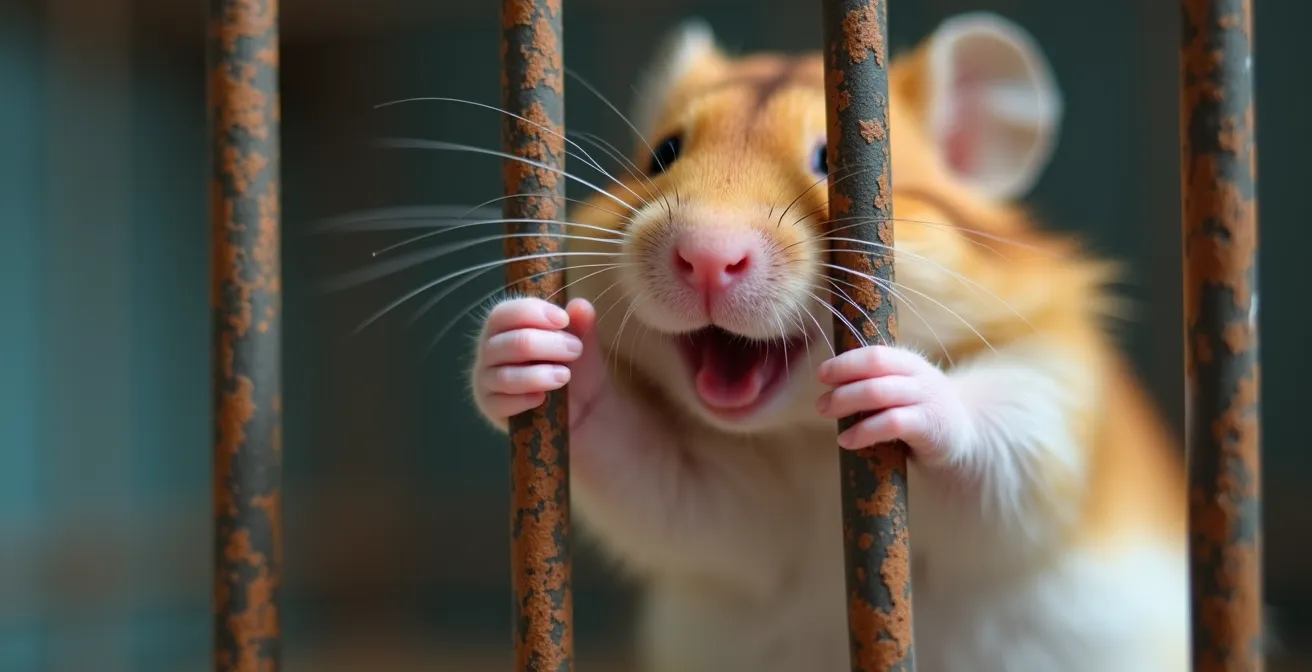
Contrary to popular belief, a hamster biting its cage bars is not bored or seeking attention; it is exhibiting a severe stereotypic behavior, a clear signal of psychological distress caused by an inadequate environment.
- This behavior is directly linked to a lack of deep bedding, insufficient space, and an inability to perform natural, hardwired instincts like burrowing and foraging.
- Treating the symptom (e.g., covering bars) is ineffective. The only solution is to address the root environmental failures that cause the stress.
Recommendation: Stop treating the noise as a quirk and start treating the environment as the problem. Audit your hamster’s enclosure against scientific welfare standards, not pet store minimums.
The persistent, grating sound of a hamster chewing on its metal cage bars is a familiar noise to many owners. It’s often dismissed as a funny quirk, a sign of “boredom,” or a way for the hamster to ask for a treat. This interpretation could not be more wrong. This behavior, known in animal science as a stereotypic behavior, is the equivalent of a human in a bare cell pacing endlessly. It is an unambiguous cry for help, a manifestation of profound psychological distress stemming from an environment that denies the animal its most fundamental, biologically programmed needs.
The “boredom” myth is dangerous because it leads to ineffective solutions like buying more chew toys or providing more out-of-cage time. While enrichment is important, these actions fail to address the core problem: the cage itself is a source of chronic stress. A hamster’s entire world is its enclosure. When that world prevents it from performing the behaviors of its natural ethogram—its complete portfolio of survival instincts—its mental health collapses. Bar biting is not a habit to be broken; it is a distress signal that demands we fundamentally rethink what a hamster needs to not just survive, but to thrive.
This guide will deconstruct the environmental failures that lead to bar biting. We will explore the scientific evidence behind proper housing standards to provide you with a clear roadmap for creating a habitat that eliminates stress and allows your hamster’s true, natural behaviors to emerge.
Summary: A Guide to Understanding and Eliminating Hamster Stress Behaviors
- 450 Square Inches: The Minimum German Standard for Happiness
- 6 Inches Deep: Why Hamsters Need to Tunnel to Feel Safe?
- Back Arching: Why Small Wheels Cause Permanent Damage?
- Tank vs. Wire Cage: Which Is Better for Respiratory Health?
- Why Hamsters Need Sand (Not Dust) to Degrease Their Fur?
- Foraging Toys vs. Bowls: How to Simulate Natural Feeding Behaviors?
- Hardware Cloth vs. Chicken Wire: The Fatal Mistake New Keepers Make
- Why Round Cages Are Psychologically Damaging for Parrots?
450 Square Inches: The Minimum German Standard for Happiness
The first and most critical failure in modern hamster care is the underestimation of their need for space. Pet store cages, often marketed as “starter kits,” are tragically undersized and a primary driver of stress. While the title suggests 450 square inches, current welfare science points to an even larger minimum. In Germany, a country with some of the highest animal welfare standards, the recommended minimum is far greater. In fact, an area of at least 775 square inches (5000 cm²) of unbroken floor space is the baseline according to German animal welfare organizations.
This isn’t an arbitrary number; it’s based on scientific observation of hamster behavior. A landmark 2007 study directly investigated the link between enclosure size and stress. The findings were stark: while wire-gnawing was observed across all cage sizes, it was significantly more frequent and lasted for much longer periods in smaller cages. Hamsters in cramped quarters spend more time trying to escape, a clear indicator of dissatisfaction and anxiety. A large cage isn’t a luxury; it is the foundational requirement for mental well-being, providing the canvas upon which all other natural behaviors can be expressed.
Providing ample space is the first step in telling your hamster that it is safe and its territory is secure. Without this fundamental element, any other form of enrichment is merely a temporary distraction from a state of constant, low-level panic. An undersized cage is not a home; it’s a prison, and bar biting is the sound of an inmate rattling the bars.
6 Inches Deep: Why Hamsters Need to Tunnel to Feel Safe?
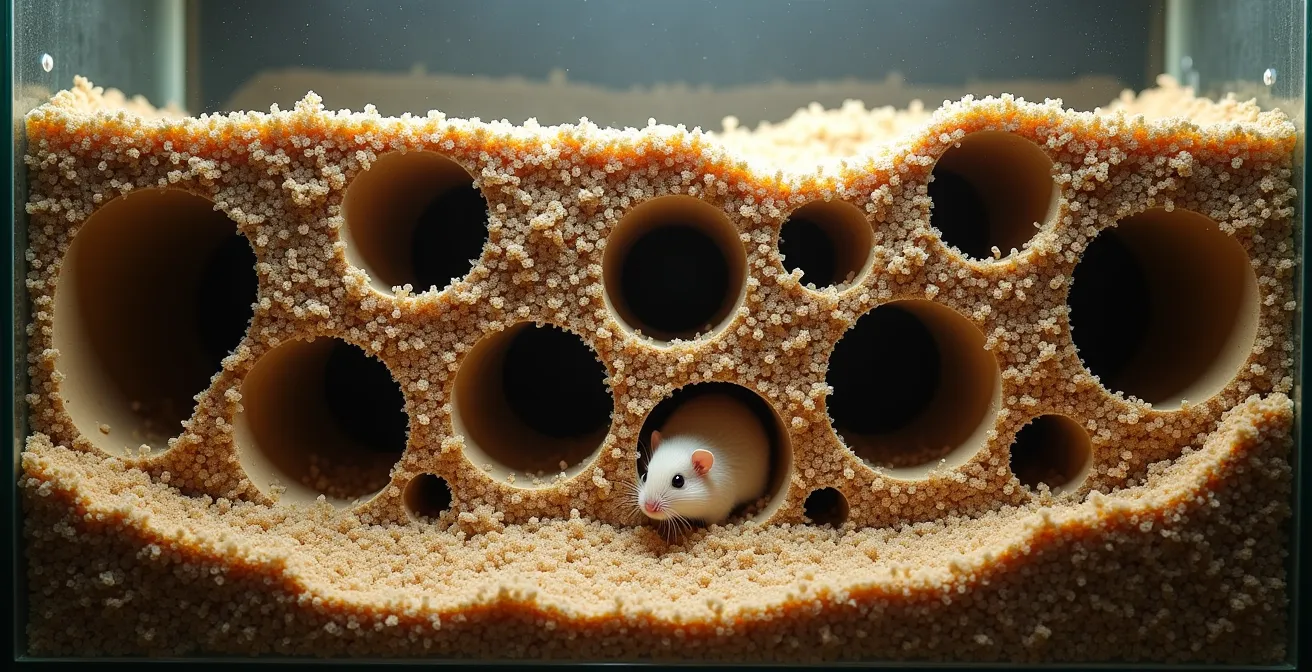
Hamsters are fossorial animals, meaning they are biologically hardwired to dig and live in burrows. In the wild, their burrows are complex, multi-chambered systems deep underground that provide protection from predators, temperature regulation, and a secure place to sleep and store food. Denying a hamster the ability to burrow is like denying a bird the ability to fly; it thwarts a core survival instinct and creates immense anxiety. A shallow layer of bedding is one of the most common and cruelest forms of environmental deprivation for a hamster.
The visual below illustrates the complexity of a natural hamster burrow. It is not a simple nest but an entire subterranean home. To replicate this feeling of security, a minimum of 6-8 inches of suitable bedding is required, though 10-12 inches is ideal for allowing a stable burrow system to be constructed. Paper-based bedding is excellent for holding tunnel shapes.
The link between insufficient bedding depth and bar biting is not theoretical. As the veterinary scientists Fisher & Gebhardt-Heinrich noted in their definitive study on the subject, the results are undeniable:
Hamsters kept with 10 cm deep bedding showed significantly more wire-gnawing and a higher running wheel activity than the hamsters in the other groups. In 80 cm deep bedding wire-gnawing was never observed.
– Fisher & Gebhardt-Heinrich, Behaviour of golden hamsters study
This is a powerful conclusion: providing the ability to engage in this one natural behavior can completely eliminate the primary symptom of cage stress. Deep bedding isn’t enrichment; it’s a non-negotiable psychological necessity.
Back Arching: Why Small Wheels Cause Permanent Damage?
After security, the need for movement is paramount. In the wild, hamsters are incredibly active, and a German study found that even in cages, they will run an average of 8.3 kilometers (over 5 miles) per night on their wheels. This makes the wheel the single most important piece of enrichment in a hamster’s life. However, most wheels included in commercial cages are dangerously small, forcing the hamster to run with its back arched and head tilted up. This unnatural posture doesn’t just cause discomfort; it leads to chronic pain, spinal deformities, and arthritis over time.
A wheel that is too small is not exercise equipment; it’s a torture device. The hamster is caught in a cruel bind: its instinct compels it to run, but doing so causes physical pain. This added layer of stress and pain contributes significantly to the overall psychological burden that manifests as bar biting and other stereotypic behaviors. Choosing the correct wheel size is not a matter of preference but one of preventing permanent physical injury.
Ensuring your hamster’s wheel is safe and appropriately sized is a simple yet profoundly impactful act of responsible care. It allows them to fulfill their intense need for exercise without sacrificing their physical health. Use the following checklist to audit your current setup.
Action Plan: Auditing Your Hamster’s Wheel for Spinal Safety
- Measure the Diameter: Confirm the wheel meets the minimum size for your species. Syrian hamsters require a minimum 12-inch diameter wheel, while dwarf hamsters need at least an 8-inch one.
- Observe Their Posture: Watch your hamster run. Their spine must remain completely straight, not curved or arched upwards. Their head should not be tilted back.
- Check for Hazards: Ensure the wheel has a solid running surface, not mesh or bars, which can cause a painful condition called bumblefoot. There should be no crossbars that could trap a limb.
- Assess the Stability: The wheel should be stable and not wobble or rattle excessively, which can be frightening and discourage use.
- Plan for Replacement: If the wheel fails any of these checks, identify and purchase a suitable replacement immediately. This is an urgent welfare priority.
Tank vs. Wire Cage: Which Is Better for Respiratory Health?
The debate between a wire cage and a glass tank (or a similar DIY bin cage) is a crucial one. While wire cages offer superior ventilation, this single benefit is vastly outweighed by their numerous, significant drawbacks from a welfare perspective. For an animal whose primary sense of security comes from being hidden and protected, a wire cage is a nightmare of 360-degree exposure. This constant vulnerability is a major source of anxiety.
Furthermore, and most importantly, the shallow plastic bases of nearly all commercial wire cages make it impossible to provide the necessary depth of bedding for burrowing. This fact alone renders them unsuitable. A tank-style enclosure, on the other hand, fully supports deep bedding, completely eliminates the possibility of bar biting, and provides a much greater sense of security by muffling external noise and creating solid walls. For these reasons, the Royal Veterinary College recommends glass tanks over traditional barred cages. While the title mentions respiratory health—a concern often raised about tanks—proper ventilation is easily achieved with a well-fitting mesh lid made from hardware cloth.
The following table provides a clear comparison of how each enclosure type addresses the key psychological needs of a hamster.
| Factor | Glass Tank | Wire Cage |
|---|---|---|
| Bar Biting Risk | Eliminated completely | Common stress behavior |
| Deep Bedding Support | Excellent (12+ inches) | Limited by tray depth |
| Noise Protection | Muffles external sounds | Full exposure to noise |
| Security Feeling | 360-degree protection | Exposed from all angles |
| Ventilation | Good with mesh lid | Excellent natural airflow |
When the primary goal is to eliminate psychological distress, the choice is clear. A tank-style enclosure is vastly superior at meeting a hamster’s core needs for security and burrowing, making it the ethical choice for any responsible owner.
Why Hamsters Need Sand (Not Dust) to Degrease Their Fur?
Beyond the primary needs for space and burrowing, hamsters have other essential instincts that must be met for their well-being. One of the most important is grooming, which they do using sand. Hamsters do not bathe in water; instead, they roll in sand to remove grease, dirt, and oils from their fur. Providing a sand bath is not a luxury—it’s a critical component of their hygiene and a source of positive enrichment.
The key, however, is using the correct material. Products marketed as “chinchilla dust” are extremely dangerous for hamsters. The fine particulate matter is easily inhaled and can lead to fatal upper respiratory infections. Safe, appropriate sand is what’s needed. This allows them to engage in their natural rolling and digging behaviors without risking their health.
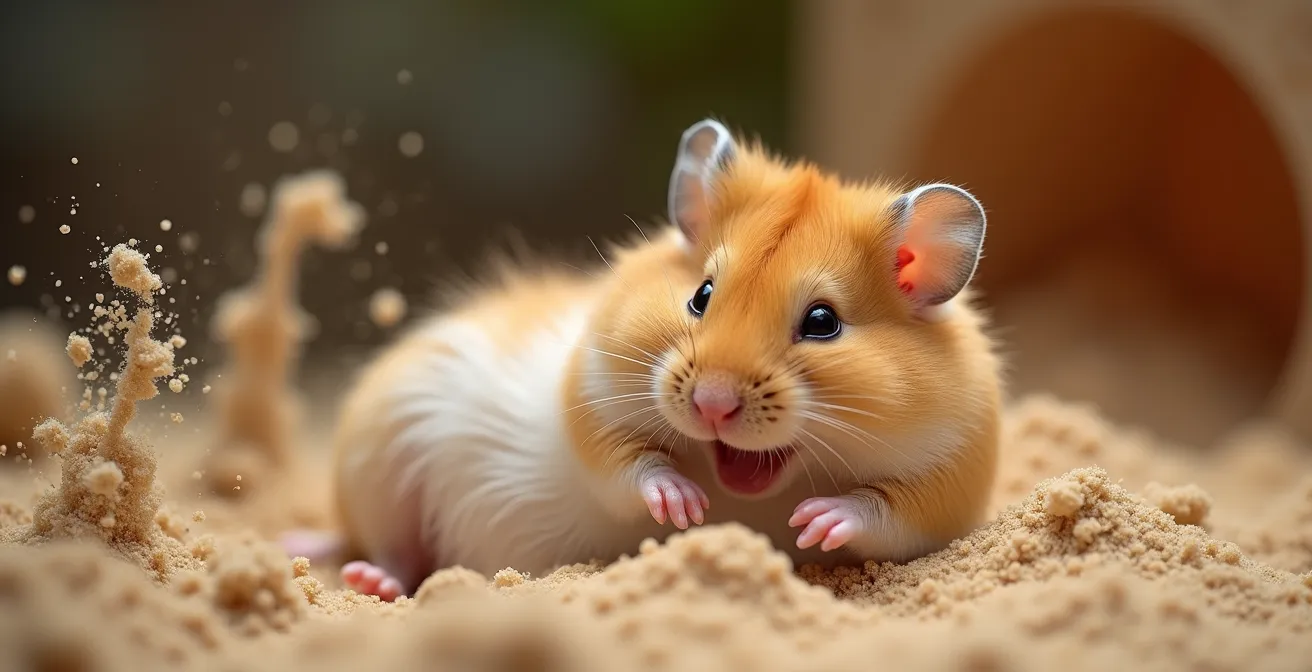
Watching a hamster use a sand bath for the first time is often a revelation for owners; they dig, roll, and flick sand with apparent joy. This is an innate behavior that provides both physical and mental stimulation. To ensure your hamster’s safety, always use appropriate materials.
- Safe Options: Use heat-treated children’s play sand or non-calcium reptile sand that has no added dyes.
- Dangerous Materials: You must strictly avoid chinchilla dust, chinchilla sand (which is often still too dusty), construction sand, or craft sand, as their sharp particles can damage fur and skin.
- Container: The sand bath should be provided in a ceramic or glass dish heavy enough that it won’t tip over, and large enough for the hamster to roll around in comfortably.
Foraging Toys vs. Bowls: How to Simulate Natural Feeding Behaviors?
How a hamster gets its food is just as important as what it eats. In nature, a hamster would spend a significant portion of its waking hours searching for seeds, grains, and insects. This act of foraging is a powerful instinct. Simply placing food in a bowl every day completely removes this crucial mental activity from their lives, contributing to the under-stimulation that fuels stress behaviors.
The solution is to “scatter feed”—sprinkling their daily food mix throughout the enclosure, hiding it in different substrates and inside foraging toys. This encourages them to search, dig, and work for their food, engaging their minds and bodies. This isn’t making life harder for them; it’s making it more meaningful. This principle is backed by a fascinating zoological concept known as “contrafreeloading.” Extensive research on contrafreeloading demonstrates that many animals, hamsters included, will actively choose to work for their food even when identical free food is readily available in a bowl.
Working for a reward is inherently more satisfying than receiving a handout. By ditching the bowl and embracing scatter feeding, you are not just providing food; you are providing a purpose. You are re-introducing a vital part of your hamster’s natural ethogram that has been erased by the convenience of domestication. This simple change can have a massive impact on reducing stress and promoting calm, natural behaviors.
Hardware Cloth vs. Chicken Wire: The Fatal Mistake New Keepers Make
For owners who create their own enclosures or build lids for tanks, the choice of mesh material is a critical safety decision where a common mistake can be fatal. Many new keepers, seeing it as a cheap and easy option, will use “chicken wire” for ventilation lids or barriers. This hexagonal, flexible wire is an extreme hazard.
A hamster’s instinct is to test every boundary. They will climb on mesh lids and try to squeeze through any gap. The flexible nature of chicken wire allows a hamster to push its head or a limb through an opening, but the wire can then spring back, trapping and strangling them. Similarly, some “natural” wood bridges with wide, inconsistent rung spacing pose the same trapping risk. Safety must always supersede aesthetics.
The only safe material for lids and barriers is rigid, galvanized hardware cloth with a small mesh size. This material is a solid, unyielding grid that prevents an animal from forcing its way through. When building or buying any part of a hamster’s habitat, you must be vigilant about potential trapping hazards.
- Safe Mesh: Always use 1/2 inch or 1/4 inch galvanized hardware cloth. Its rigid grid structure is secure.
- Unsafe Materials: Never use chicken wire or any mesh with large, flexible, or irregularly-sized openings.
- Constant Vigilance: Routinely check all elements of the enclosure, from toys to bridges to lids, for any gaps or holes where a head, foot, or toe could become trapped.
Key Takeaways
- Bar biting is a stereotypic behavior, a sign of severe psychological distress, not boredom or a simple bad habit.
- The root cause is an environment that prevents natural instincts like burrowing deep, running long distances, and foraging for food.
- Meeting science-based welfare standards—like 775+ sq. in. of space and 10+ inches of bedding—is the only effective way to stop the behavior.
Why Round Cages Are Psychologically Damaging for Parrots?
The distress caused by unsuitable housing is not unique to a single species. The well-documented psychological damage seen in parrots kept in round cages—which offer a complete absence of corners for security and create a disorienting environment—provides a vital lesson for the keepers of all caged animals. This phenomenon, where an animal develops obsessive, repetitive, and sometimes self-destructive behaviors due to chronic environmental stress, is broadly termed “cage rage.”
While the visual is different, the underlying cause is identical to a hamster’s bar biting. As veterinary experts at PetHelpful explain, “Cage rage is a genuine psychological disorder that any animal that lives in a cage can suffer from… It is caused by the animal being kept in a cage far too small.” Hamsters, particularly the larger Syrian species, are at an extremely high risk for developing this condition due to the prevalence of inadequate commercial housing. Their bar biting, wall climbing, and frantic chewing are all symptoms of this very real disorder. They are trapped in an environment that causes constant fear and frustration, and these behaviors are their only outlet.
Understanding this concept is the final key to shifting your perspective. Your hamster is not being “naughty” or “annoying.” It is suffering. The responsibility lies entirely with the caregiver to provide an environment that honors the animal’s biology and removes the sources of its psychological torment. By doing so, you can replace the frantic energy of cage rage with the calm, content behaviors of a happy and secure animal.
Now that you understand the “why” behind these stress behaviors, the next logical step is to perform a complete audit of your hamster’s environment and create a plan to implement these crucial changes. Begin by providing the proper habitat, and you will see the distress signals fade away, replaced by the quiet confidence of an animal whose needs are finally being met.