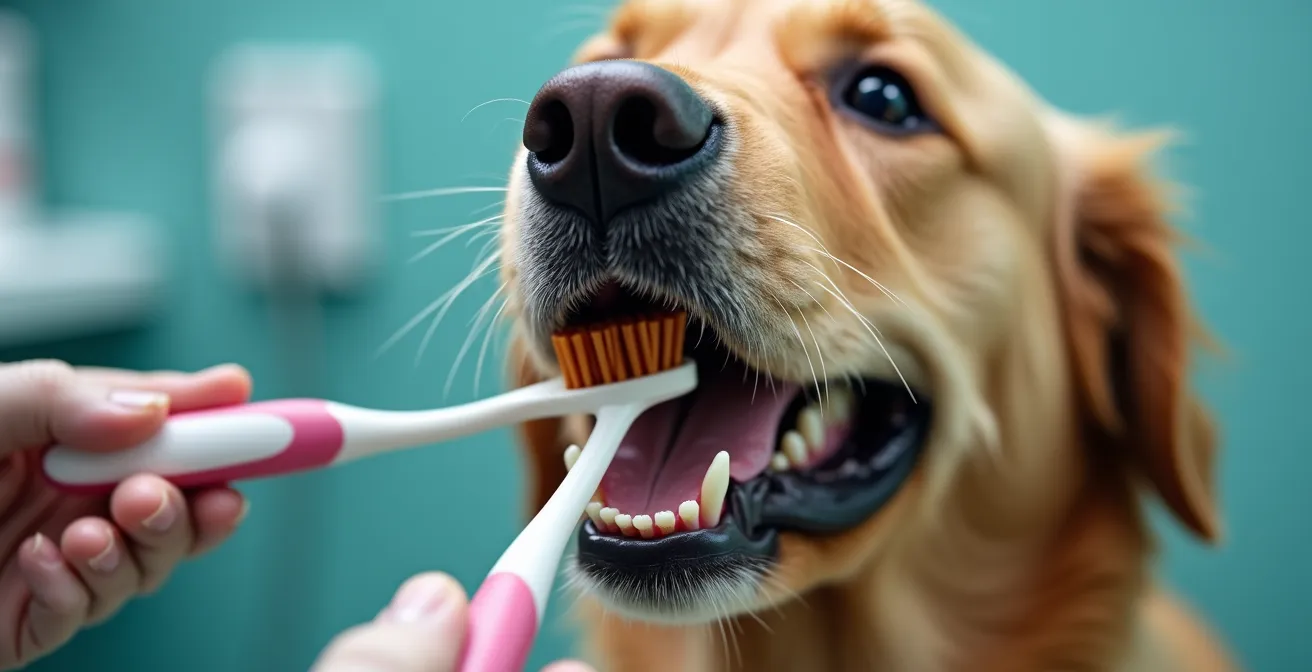
Imperfect brushing with enzymatic toothpaste is far more effective than no brushing at all because the enzymes actively disrupt plaque biofilm on contact.
- The glucose oxidase/lactoperoxidase system creates an antibacterial agent that works chemically, reducing the reliance on aggressive mechanical scrubbing.
- Focusing on a gentle, consistent daily application—even just on the outer surfaces of teeth—is the key to preventing plaque from hardening into tartar within 24-48 hours.
Recommendation: Start with a 4-week desensitization plan, aiming for simple, daily contact with the paste rather than a perfect scrub.
As a veterinary dental hygienist, I see the guilt and frustration in the eyes of loving pet owners every day. You know you *should* be brushing your dog’s teeth, but the reality is a wrestling match. Your dog hates it, you feel like you’re doing it wrong, and the toothbrush never seems to reach those back molars. You wonder, “Is this even worth it?” The common advice is to just “brush better,” but that often feels impossible. You might have heard about other options, like dental chews or water additives, but they don’t replace the core need for active biofilm disruption.
Here is the single most important thing I can tell you: the goal is not a perfect, vigorous scrub. The secret lies in understanding the chemistry you’re holding in your hand. What if the real key wasn’t your technique, but the product’s ability to work for you? Enzymatic toothpaste is designed specifically for this reality. It leverages a powerful chemical reaction that starts breaking down plaque the moment it makes contact, meaning every clumsy attempt, every quick swipe, is a small but significant victory for your dog’s oral health.
This guide will change your perspective on dental care. We will move away from the pressure of perfection and focus on the power of consistency. We’ll explore the science that makes this possible, provide a realistic plan to get started, and clarify exactly what makes this approach both safe and effective. You’ll learn why frequency trumps duration, why “doggy breath” is a medical alarm bell, and how to make every effort count, turning a daily chore into a powerful preventative health measure.
This article will guide you through the essential aspects of using enzymatic toothpaste effectively, transforming your approach from a stressful struggle to an empowered, consistent routine. The following sections break down the science, the technique, and the critical context you need to succeed.
Summary: Understanding the Power of Enzymatic Brushing
- Glucose Oxidase: How Chemistry Breaks Down Plaque?
- From Licking to Brushing: A 4-Week Desensitization Plan
- Fluoride and Xylitol: Why You Cannot Share Your Paste?
- Daily vs. Weekly: At What Frequency Is Brushing Useless?
- Finger Brush vs. Handle: Which Reach Is Better for Molars?
- Why Daily Brushing Is Non-Negotiable for Toy Poodles?
- Anesthesia-Free Cleaning: Why It’s Cosmetic and Not Medical?
- The Smell of Decay: Why “Doggy Breath” Is Actually Periodontal Disease?
Glucose Oxidase: How Chemistry Breaks Down Plaque?
This is the core of why enzymatic toothpaste is so effective, even with imperfect application. It’s not about scrubbing plaque off; it’s about initiating an enzymatic cascade that makes the mouth a hostile environment for harmful bacteria. The magic happens through a two-part system, primarily involving an enzyme called glucose oxidase and another called lactoperoxidase, which are naturally found in saliva but are present in much higher concentrations in the paste.
Here’s how the contact-based efficacy works: When you apply the toothpaste, the glucose oxidase reacts with the glucose (sugars) and oxygen present in your dog’s mouth. This reaction produces a small, steady amount of hydrogen peroxide. This is where the second enzyme, lactoperoxidase, comes in. It uses this hydrogen peroxide to convert naturally occurring ions in saliva into a powerful antibacterial agent called hypothiocyanite. You don’t need to rinse it off; in fact, you shouldn’t. The paste is designed to stick to the teeth and gums, allowing this chemical reaction to continue working long after you’ve put the brush away.
This process is about disrupting the bacterial biofilm before it can organize and harden. As explained by veterinary experts, this is a targeted chemical attack on oral bacteria. According to the Lidercare Veterinary Guide’s analysis of this mechanism:
The lactoperoxidase pathway can generate hypothiocyanite (OSCN⁻), which inhibits bacterial metabolism tied to plaque.
– Veterinary Enzymatic Research, Lidercare Veterinary Guide
So, when you’re struggling to get a perfect scrub, remember this: your main job is simply to be the delivery system. Get the paste in there. The contact-based efficacy ensures the enzymes do the heavy lifting, actively breaking down the very foundation of plaque.
From Licking to Brushing: A 4-Week Desensitization Plan
Knowing that enzymes do most of the work should relieve some pressure. Now, let’s focus on the practical side: making the experience positive, or at least tolerable, for your dog. The goal is to build trust and create a predictable routine. A slow, four-week desensitization plan based on positive reinforcement is the most successful approach we use in veterinary practice. Forget about reaching every tooth on day one. The first week is just about creating a positive association with the paste and your touch.
This process is about gradual steps. You start by simply letting your pet taste the toothpaste (they are often flavored with poultry or malt) from your finger as a treat. Once they accept this, you move to gently rubbing the paste on their front teeth with your finger. Only then do you introduce a soft-bristled tool. The key is to keep sessions short, positive, and end before your dog gets stressed. This builds the foundation for a lifetime of cooperative care.
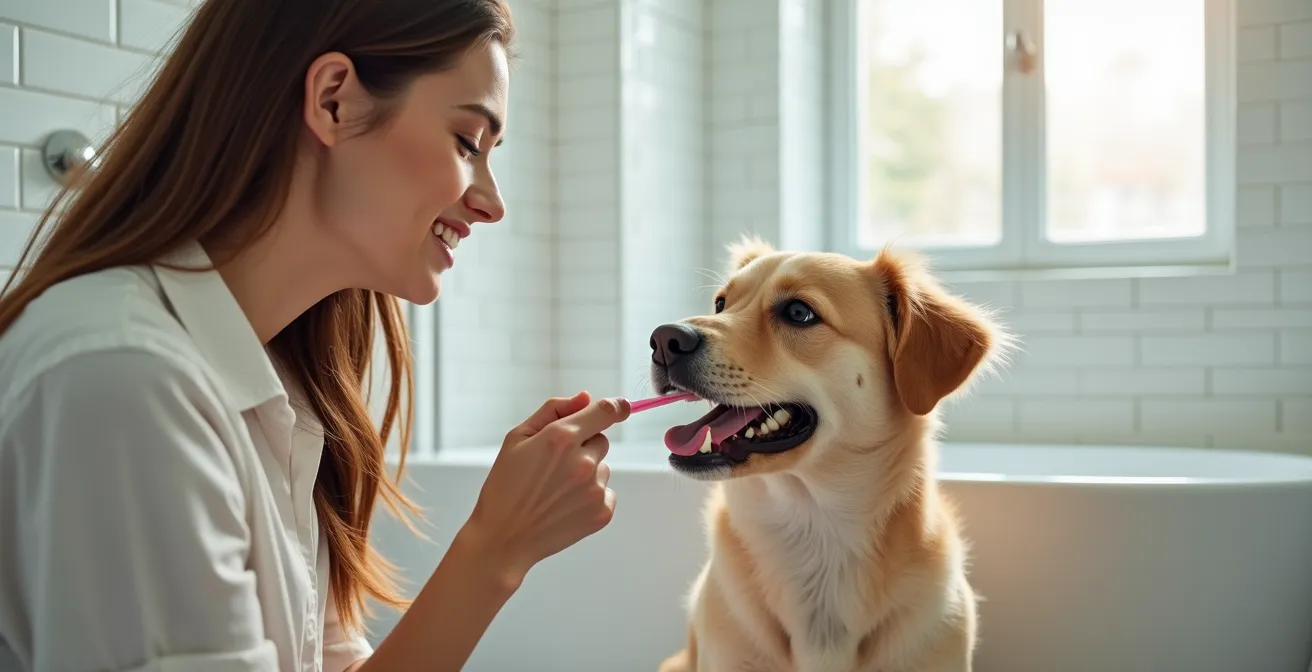
As you can see in this gentle interaction, the focus is on comfort and trust, not force. Each successful session, no matter how short, is a win. Below is a structured plan to guide you. If your dog shows resistance at any stage, simply go back to the previous step for a few more days before trying again. Patience is your most important tool.
Action Plan: Auditing Your Brushing Approach
- Positive Association: For 3-5 days, let your dog lick the enzymatic toothpaste off your finger. Do not attempt to brush. This is a treat.
- Introduce Touch: For the next week, apply a dab of paste to your finger and gently rub it on the outside of their most accessible teeth, like the canines. Keep it short (15-20 seconds) and follow with praise.
- Introduce the Tool: In week three, introduce a soft finger brush or a very soft-bristled toothbrush. Let them lick the paste off the brush first, then attempt a few gentle circular motions on the front teeth only.
- Expand Your Reach: In week four, start working your way back to the premolars on the sides. Focus only on the outer surfaces; this is where most tartar accumulates.
- Master the Molars: Once they are comfortable, you can start targeting the large chewing teeth (molars) in the back. A longer-handled brush may be necessary to reach this area effectively.
Fluoride and Xylitol: Why You Cannot Share Your Paste?
This is a critical, non-negotiable safety rule: never use human toothpaste on your dog. While it seems convenient, ingredients that are safe for us can be extremely toxic to them. The two biggest culprits are fluoride and xylitol. Dogs are much more sensitive to fluoride than humans, and since they swallow the paste instead of spitting it out, they can easily ingest enough to cause severe gastrointestinal upset. In large quantities, it can be fatal.
However, the more immediate and common danger is xylitol. This artificial sweetener is found in many human dental products, peanut butter, and sugar-free gums. In humans, it’s metabolized without issue. In dogs, the body mistakes it for real sugar and triggers the pancreas to release a massive amount of insulin. This leads to a rapid, life-threatening drop in blood sugar called hypoglycemia. Even a small amount can be dangerous. According to the Merck Veterinary Manual, veterinary toxicology data shows that a dose of more than 0.1 g/kg can cause hypoglycemia, while doses over 0.5 g/kg can lead to acute liver failure.
The swiftness of this reaction is what makes it so perilous. The signs of xylitol poisoning—vomiting, weakness, staggering, collapse, and seizures—can appear within 15 to 30 minutes of ingestion. This is why it’s essential to only use products specifically formulated for veterinary use. Your dog’s enzymatic toothpaste is designed to be safely swallowed and is free from these harmful ingredients. Always read labels, even on “natural” products, and keep all human dental care products securely out of your pet’s reach.
Daily vs. Weekly: At What Frequency Is Brushing Useless?
This is a question I hear all the time. Owners who struggle to brush might aim for once a week, thinking it’s better than nothing. While the intention is good, the science of plaque tells a different story. Brushing that is less frequent than every 48 hours is largely ineffective at preventing tartar. The soft, sticky bacterial biofilm known as plaque begins forming on teeth within hours after a cleaning. If left undisturbed, it starts to mineralize into hard calculus, or tartar, in as little as 24 to 48 hours. Once tartar has formed, it cannot be removed with a toothbrush; it requires professional scaling by a veterinarian.
Therefore, the goal is daily disruption. Daily brushing is the gold standard for preventing periodontal disease, a condition that is alarmingly common. In fact, veterinary research indicates that more than 80% of dogs over the age of three show signs of this inflammatory disease. Think of it like this: weekly brushing is like trying to sweep away a snowstorm with one pass of the broom a week. You might clear a little, but the accumulation will always win. Daily brushing is like a constant melting process that never allows the snow to build up in the first place.
However, don’t let “perfect” be the enemy of “good.” Clinical findings from veterinary practices like The Drake Center show that a routine of brushing at least three times per week can significantly prevent tartar buildup. But daily brushing is what demonstrates optimal results in preventing the first stage of disease, gingivitis, which appears as a red, inflamed line along the gums. The takeaway is clear: frequency is far more important than duration or perfection. A quick, 60-second swipe with enzymatic paste every day is vastly superior to a 5-minute battle once a week.
Finger Brush vs. Handle: Which Reach Is Better for Molars?
Choosing the right tool is just as important as the toothpaste itself. The two most common options are the finger brush and the long-handled toothbrush. There isn’t a single “best” one; the right choice depends on your dog’s size, mouth shape, and your comfort level. A finger brush, which is a small rubber sheath with soft bristles that fits over your index finger, is an excellent starting tool. It feels less foreign to the dog than a hard plastic brush and gives you better tactile control, allowing you to feel exactly where you are and how much pressure you’re applying. It’s ideal for puppies, small dogs, and during the initial desensitization phase.
The primary limitation of a finger brush is its reach. It can be difficult to get to the outer surfaces of the rear molars, especially in larger dogs, without putting your fingers far into their mouth. This is where a long-handled brush excels. Brushes designed for dogs often have angled heads and softer bristles than human brushes. They allow you to easily reach the large premolars and molars in the back of the mouth, which are major sites of tartar accumulation. Dual-headed brushes offer bristles on both sides of the head, allowing you to clean inner and outer surfaces simultaneously, though they can be bulky for smaller breeds.
The following table, based on recommendations from veterinary dental specialists, can help you decide. Many owners find it helpful to use both: a finger brush for the front teeth and a long-handled brush for the sides and back.
| Brush Type | Best For | Advantages | Limitations |
|---|---|---|---|
| Finger Brush | Small dogs, puppies, training phase | Better control, gentler introduction | Limited reach to back molars |
| Long-handled Brush | Large dogs, dolichocephalic breeds | Reaches rear molars, angled bristles for subgingival cleaning | Less control in small mouths |
| Dual-headed Brush | Medium dogs, experienced pets | Cleans multiple surfaces simultaneously | May be too large for toy breeds |
Why Daily Brushing Is Non-Negotiable for Toy Poodles?
While all dogs benefit from daily brushing, for certain breeds, it’s not just recommended—it’s a fundamental necessity. Toy breeds like Poodles, Yorkies, Chihuahuas, and Maltese are poster children for severe periodontal disease. This isn’t because their owners are negligent; it’s due to their anatomy. These breeds suffer from a phenomenon called dental crowding. They have the same number of teeth as a German Shepherd (42 adult teeth), but packed into a much smaller jaw. This crowding creates countless nooks and crannies where food and bacteria become trapped, dramatically accelerating plaque and tartar formation.
Furthermore, toy breeds often retain their deciduous (baby) teeth, which can cause misalignment of the adult teeth, worsening the crowding. Their shallow tooth roots also mean that once periodontal disease takes hold and causes bone loss, teeth can become loose and fall out much more quickly than in larger breeds. For these dogs, skipping a few days of brushing isn’t a minor setback; it’s an open invitation for aggressive, rapidly progressing dental disease.
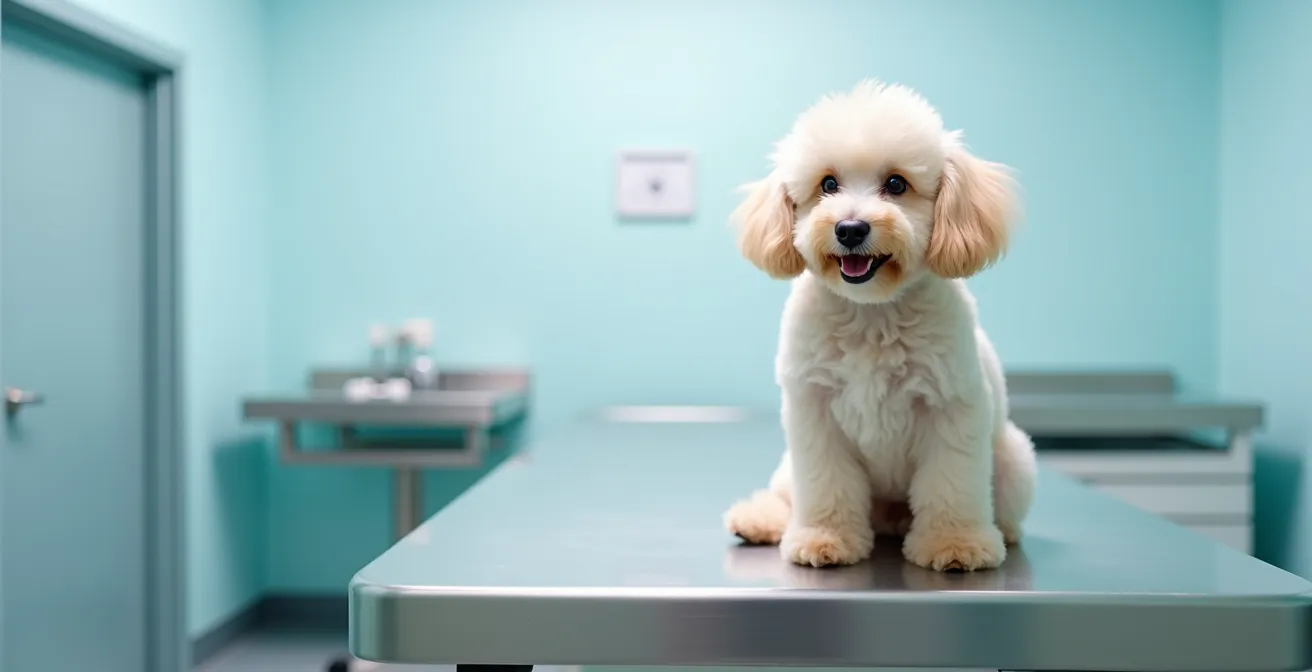
This is where your daily enzymatic brushing routine becomes a lifeline. You don’t need to stress about reaching the tight inner surfaces. Remember, the goal is disruption. As dental research confirms that nearly 96% of tartar accumulates on the outer (buccal) surfaces of the teeth—the side facing the cheek. This is great news for you, because this surface is the easiest to access. A quick, daily swipe of enzymatic toothpaste along the outside of the upper arcade of teeth can have a massive preventative impact for these high-risk breeds.
Anesthesia-Free Cleaning: Why It’s Cosmetic and Not Medical?
You may have seen groomers or specialty services offering “anesthesia-free dental cleaning.” It sounds like a wonderful, safe alternative to a veterinary procedure. However, it’s crucial to understand that this is a purely cosmetic procedure, not a medical one. It can give owners a false sense of security while the real disease process continues unchecked in the most critical area: below the gumline.
Anesthesia-free cleaning involves using hand scalers to scrape the visible tartar off the crowns of the teeth. The teeth may look white and clean afterward, but the most dangerous bacteria live in the subgingival zone—the pocket between the tooth and the gum. Periodontal disease is an infection of this area. A conscious, anxious animal will not tolerate the probing and cleaning of these sensitive tissues. Therefore, the root cause of the disease is left completely untreated. The American Veterinary Dental College (AVDC) has a firm position on this matter, emphasizing the medical necessity of anesthesia.
Anesthesia-free dental cleaning only scrapes the visible tartar on the crown while disease-causing bacteria thrive unseen below the gumline.
– American Veterinary Dental College, AVDC Position Statement
A proper veterinary dental cleaning, known as a Comprehensive Oral Health Assessment and Treatment (COHAT), requires general anesthesia. This allows the veterinary team to safely perform a full-mouth examination, take dental X-rays to assess the tooth roots and jaw bone, and meticulously clean and polish the teeth both above and, most importantly, below the gumline. Your daily brushing with enzymatic toothpaste is the best tool to *prevent* the need for these procedures, but it cannot replace them once significant disease is present. Most dogs require professional cleanings every 1-3 years, depending on breed and home care.
Key Takeaways
- Enzymatic toothpaste works chemically on contact, making every brushing attempt valuable, regardless of technique.
- Daily consistency is more important than brushing duration; a quick daily swipe is better than a weekly battle.
- Never use human toothpaste. Ingredients like xylitol are highly toxic to dogs and can be life-threatening.
The Smell of Decay: Why “Doggy Breath” Is Actually Periodontal Disease?
One of the most common complaints I hear from dog owners is about “doggy breath.” It’s so prevalent that it’s often dismissed as a normal, unavoidable part of having a dog. This is a dangerous misconception. Chronic bad breath, or halitosis, is not normal. It’s the most common sign of an underlying medical problem: periodontal disease. That signature foul odor is not just “dog breath”; it’s the smell of active infection and tissue decay in your dog’s mouth.
The smell is caused by volatile sulfur compounds (VSCs), which are waste products produced by the anaerobic bacteria that thrive in the plaque biofilm and subgingival pockets. When you smell that odor, you are literally smelling the byproducts of a bacterial infection that is destroying the gums, ligaments, and bone that hold your dog’s teeth in place. As plaque hardens into tartar within 24-48 hours, it creates a rough surface that attracts even more plaque, and the bacterial population explodes. The infection deepens, and the smell worsens.
Ignoring this symptom is like ignoring smoke because you don’t see flames. By the time you notice persistent halitosis, the disease process is already well underway. This is not just a “mouth problem.” The bacteria in the mouth can enter the bloodstream through the inflamed, bleeding gums and travel to other parts of the body. As veterinary professionals like Dr. Angie Haag-Eggenberger warn, chronic oral infections can contribute to serious systemic health issues, including heart, kidney, and liver disease. Your daily brushing with enzymatic toothpaste is your first and best line of defense against this, as it disrupts the bacterial colonies before they can produce these foul-smelling, tissue-damaging compounds.
Now that you understand the science, the technique, and the urgency, you are empowered to make a real difference in your dog’s health. Take the first step towards a healthier mouth for your dog by starting a consistent, even if imperfect, daily brushing routine tonight.