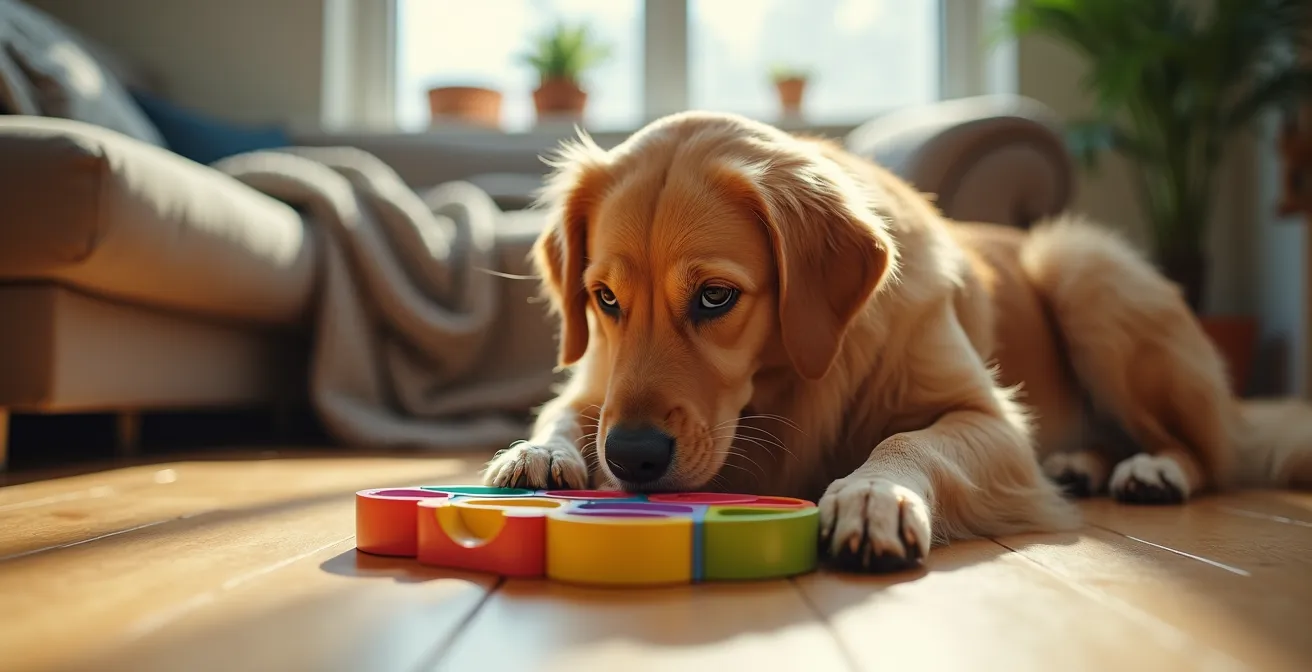
Contrary to popular belief, stopping destructive chewing isn’t about punishment or more exercise—it’s about providing your pet with the right ‘job’.
- Interactive toys fulfill core instincts (to hunt, chew, and problem-solve) that physical exercise alone cannot satisfy.
- A simple toy rotation system and DIY puzzles prevent boredom far more effectively than a constantly full toy box.
Recommendation: Replace the food bowl with a puzzle feeder to immediately add 10-15 minutes of cognitive work and decompression to your pet’s day.
You walk in the door, and the evidence is everywhere: pillow stuffing covers the floor like a fresh snowfall, your favorite shoe now has a custom ventilation system, and the corner of the sofa has been meticulously deconstructed. The immediate feeling is frustration, followed by a familiar question: “Why?” You’ve tried the common advice. You take your dog for long walks, you’ve bought a pile of chew toys, and you’ve told them “No!” more times than you can count. Yet the destruction continues.
Most conventional wisdom frames this as a “behavior problem.” But what if that shredded cushion isn’t a sign of a “bad pet,” but a desperate ‘job application’ from a brilliant but underemployed mind? The instinct to chew, shred, and problem-solve is deeply wired into our dogs and cats. When that instinct has no productive outlet, it gets channeled into the most available materials—your furniture. The solution, therefore, isn’t to suppress the behavior, but to redirect that powerful cognitive energy into a fulfilling “career.” It’s time to shift your role from frustrated owner to a creative and solution-oriented Enrichment Coordinator.
This guide will show you how to do exactly that. We’re moving beyond simply giving your pet a toy and into the realm of strategic enrichment. We’ll deconstruct the science of play, learn how to choose the right “tools” for your pet’s specific chewing “job,” and build a sustainable system that provides the mental stimulation they are craving. The goal is to make their approved activities so engaging that your sofa becomes uninteresting by comparison.
This article provides a complete framework for transforming destructive chewing into productive play. You’ll find a structured guide to selecting the right tools, understanding your pet’s deep-seated needs, and implementing practical, everyday strategies. Here’s how we’ll build your pet’s new “career.”
Summary: Why Interactive Toys Reduce Destructive Chewing in 90% of Cases?
- Kongs vs. Nylabones: Which Safe Toy for a 30kg Power Chewer?
- How to Use Wand Toys Without Frustrating Your Cat’s Hunt Cycle?
- The Bowl Replacement Strategy to Slow Down Eating by 5 Minutes
- How to Rotate 10 Toys so Your Pet Never Gets Bored?
- Cardboard and Towels: 3 Free Puzzles for Smart Dogs
- How to Survive the Teething Phase of a German Shepherd Puppy?
- The “Wait” Game: Teaching Emotional Regulation to Impulsive Dogs
- Why “Alpha Theory” Is Obsolete in Modern Dog Training?
Kongs vs. Nylabones: Which Safe Toy for a 30kg Power Chewer?
For the owner of a powerful chewer, the toy aisle can feel like a minefield. The primary concern is often durability, leading many to grab the hardest object on the shelf. However, a true Enrichment Coordinator knows that the goal isn’t just to find a toy that survives, but to provide the *right kind* of chewing satisfaction safely. Kongs and Nylabones represent two fundamentally different “chewing jobs.” A Kong is a problem-solving task; its bouncy, flexible rubber is designed to be stuffed, encouraging a dog to work, lick, and forage for a reward. A Nylabone, made of rigid nylon, caters to a dissecting or gnawing instinct.
While extreme durability is a selling point for nylon toys, it comes with a significant risk that is often overlooked. The very rigidity that makes them last can be a hazard to a dog’s dental health. In fact, choosing a toy that is too hard for your dog’s chew style can lead to painful and expensive consequences. A startling veterinary case report revealed that two out of three dogs studied experienced cracked molars from using hard nylon toys. This highlights a critical principle: a toy’s safety is just as important as its longevity.
The following table breaks down the core differences, helping you choose the right “tool” not just for your dog’s jaw strength, but for the instinctual job you want them to perform.
| Feature | Kong Extreme (Black) | Nylabone Power Chew |
|---|---|---|
| Material | Natural rubber (flexible) | Tough nylon (rigid) |
| Chewing Style | Problem-solving/’work’ oriented | Dissecting/tearing instinct |
| Interactive Features | Treat-stuffable, bouncy play | Flavor-infused, no stuffing |
| Dental Impact | Gentler on teeth, flexible | Helps clean teeth but harder |
| Durability | High for rubber, may wear faster | Extremely long-lasting |
| Price Range | $15-20 | $10-15 |
For a 30kg power chewer, the black Kong Extreme offers the best of both worlds: high durability combined with the mental engagement of a puzzle. It provides a safe and productive outlet for their energy, channeling their focus into a “job” rather than simply testing the limits of their jaw against an unyielding object.
How to Use Wand Toys Without Frustrating Your Cat’s Hunt Cycle?
For our feline companions, play isn’t just a fun diversion; it’s the fulfillment of a deeply ingrained predatory sequence. A laser pointer dot that can never be caught or a wand toy that abruptly vanishes can lead to frustration and anxiety, sometimes even worsening problem behaviors. A successful play session must allow the cat to complete their natural instinctual loop: stalk, hunt, catch, kill, and feast. Using a wand toy effectively means choreographing this entire sequence, transforming you from a mere operator into a “prey director.”

The key is to mimic the behavior of real prey. Start with slow, erratic movements that dart behind furniture, triggering your cat’s stalking behavior. Allow them several pounces and near-misses before you let them make a satisfying “catch.” This is the crucial moment many owners skip. Once caught, let the cat “kill” the toy—they should be able to bite it, hold it, and perform the classic bunny-kicks. This is the physical and mental climax of the hunt. After a short victory, you can gently end the game by slowing the toy’s movements and, most importantly, providing a “feast” in the form of a high-value treat. This completes the cycle and leaves your cat feeling accomplished, not agitated.
By following this “Catch, Kill, Feast” protocol, you provide a powerful enrichment activity that builds confidence, expends mental energy, and strengthens your bond. It’s a job well done for your little hunter.
The Bowl Replacement Strategy to Slow Down Eating by 5 Minutes
One of the most powerful and simplest changes an Enrichment Coordinator can make is to eliminate the food bowl entirely. A bowl delivers a day’s worth of calories in 60 seconds of mindless scarfing. Replacing it with a puzzle feeder or snuffle mat transforms a 60-second activity into a 10-to-15-minute “job” of foraging and problem-solving. This isn’t just about slowing down fast eaters to prevent bloat; it’s about providing a crucial dose of daily mental work, or cognitive load, which is often more tiring than physical exercise.
This simple switch has a profound impact on a dog’s well-being. The acts of sniffing and licking, which are central to using these feeders, are scientifically recognized as decompression activities that lower stress and anxiety. In fact, research on canine enrichment demonstrates that dogs engaged in puzzle feeders show a 60% reduction in anxiety-related behaviors, including destructive chewing. Mealtime becomes a therapeutic session, channeling their focus into a productive task and leaving them calmer and more satisfied afterward.
Starting is easy. For a beginner, a snuffle mat is a perfect “entry-level job,” as it simply requires them to use their nose to find kibble hidden in the fabric. As they become more proficient, you can progress to treat-dispensing balls and eventually to more complex, multi-step puzzle feeders. This progression prevents both boredom with the same old puzzle and the learned helplessness that can come from a puzzle that is too difficult. It’s a full career path in a box.
This single change provides more daily stimulation than an extra walk around the block, directly addressing the root cause of boredom-based destruction and building a calmer, more fulfilled companion.
How to Rotate 10 Toys so Your Pet Never Gets Bored?
Walking into a room filled with two dozen toys might seem like a pet’s paradise, but it’s actually a recipe for boredom. This phenomenon, known as object habituation, means that constant access to a toy makes it lose its novelty and value. A single new toy is often more exciting than a whole basket of familiar ones. The role of an Enrichment Coordinator is to act as a curator, not just a provider. As experts in the field advise, “Rather than offering a huge array of toys, rotate the toys and offer new ones periodically,” as noted by Zoom Room Dog Training.
A successful rotation system is simple and sustainable. The goal is to create a constant sense of novelty that keeps your pet engaged and excited about their “work tools.” A highly effective method is the Three-Bin System:
- Bin 1: The “Active” Bin. This contains 3-4 toys that are currently available to your pet. These should be a mix of types: a puzzle toy, a chew toy, and a soft toy, for example.
- Bin 2: The “Resting” Bin. This bin holds another 3-4 toys, kept out of sight. These are the toys that will feel “new” in the next rotation.
- Bin 3: The “Special” Bin. This contains 1-2 of the highest-value, most durable, or most engaging puzzle toys (like a frozen Kong). These are not part of the daily rotation but are brought out for special occasions or when you need a guaranteed long-lasting distraction.
Once a week, simply swap the contents of the “Active” and “Resting” bins. The toys that have been hidden away for a week will re-emerge with renewed interest, their scents having dissipated and their novelty restored. This simple act of curating access transforms a boring pile of plastic into a dynamic library of engaging opportunities.
By managing their resources this way, you prevent “toy burnout” and ensure that when your pet needs a job, the tools you provide are always exciting and engaging.
Cardboard and Towels: 3 Free Puzzles for Smart Dogs
Providing top-tier enrichment doesn’t have to drain your wallet. Some of the most effective “jobs” for a smart dog can be created from common household items you’d normally recycle or throw away. These DIY puzzles are perfect for satisfying a dog’s natural instincts to forage, shred, and problem-solve in a safe and approved manner. As an Enrichment Coordinator, your creativity is your best resource. With a few basic items, you can design engaging work that costs nothing.

These puzzles are fantastic because they engage different parts of your dog’s brain and fulfill distinct behavioral needs. The towel forager encourages scent work and manipulation, while the cardboard dissector provides a safe, satisfying outlet for the instinct to tear things apart. Here are three simple, no-cost puzzles to get you started:
- The Towel Forager: Take an old bath or hand towel and lay it flat. Sprinkle some of your dog’s kibble or dry treats along its length. Roll the towel up tightly. For an extra challenge, tie one or two loose knots in the rolled towel. Your dog’s job is to use their nose and paws to unroll and un-knot the towel to get the food.
- The Cardboard Dissector: Use empty cereal boxes, paper towel tubes, or other plain cardboard packaging. Always remove any plastic lining, tape, or staples first. Place treats inside and close the flaps. For an easier start, leave the treats partially visible. Your dog gets the immense satisfaction of shredding the cardboard to get their reward.
- The Muffin Tin Scenter: Place a few treats in the cups of a muffin tin. Cover each cup with a tennis ball or another dog-safe toy. Your dog must use their nose to locate the treats and their brain to figure out how to remove the ball to access them.
By offering these simple, free puzzles, you provide a powerful outlet for your dog’s cognitive energy, proving that effective enrichment is about ingenuity, not expense.
How to Survive the Teething Phase of a German Shepherd Puppy?
The teething phase of a high-energy, large-breed puppy like a German Shepherd can feel like living with a small, furry piranha. Their intense need to chew is driven by the discomfort of new teeth erupting, but it’s also a critical period of oral exploration. Simply redirecting them to a toy is often not enough; you need a multi-faceted strategy that soothes their gums, engages their minds, and teaches them appropriate behavior. This isn’t just about survival; it’s a foundational training opportunity.
A successful approach combines physical relief with mental fatigue. Soothing their sore gums is paramount. The KONG Puppy toy, made from a softer rubber, is ideal for this. Freezing it—filled with dog-safe broth, wet food, or yogurt—creates a long-lasting, cooling chew that directly addresses the inflammation. However, physical relief alone is only half the battle. A bored, teething puppy is a destructive puppy. Engaging their brain is just as crucial for managing their behavior. Behavioral studies on teething puppies show that 15-20 minutes of puzzle toy engagement can reduce teething-related whining and destructive behaviors by up to 70%. A tired brain leads to a calmer puppy.
Case Study: German Shepherd Puppy Teething Management Program
A GSD breeder implemented a successful protocol to manage teething destruction. The program combined a steady rotation of frozen KONG Puppy toys, swapped out every four hours to maintain novelty and soothing power. This was paired with structured “trade-up” training: whenever a puppy was caught chewing an inappropriate item (like furniture), they were calmly interrupted and taught to exchange the item for a high-value frozen treat or a pre-stuffed Kong. This positive-reinforcement method teaches what *to* chew, rather than just punishing what *not* to chew. The program resulted in an 80% reduction in destructive chewing incidents by the time the puppies reached 6 months of age.
By providing the right tools for their gums and the right “work” for their brains, you can navigate this challenging phase and build a strong foundation for a well-behaved adult dog.
The “Wait” Game: Teaching Emotional Regulation to Impulsive Dogs
For a dog prone to destructive behavior, the world is full of temptations that demand immediate action. The lack of impulse control is a major driver of unwanted chewing. Before they can be trusted alone, they need to learn a fundamental skill: emotional regulation, or the ability to tolerate a moment of frustration without acting on it. The “Wait” game is not just a parlor trick; it’s a foundational exercise in building this crucial mental muscle. It’s the “preschool” for the job of being a calm, well-adjusted companion.
The beauty of this training is that it uses the very thing the dog wants—an engaging puzzle toy—as the ultimate reward for their patience. This creates a powerful positive association with self-control. You start small, asking for just a second or two of “wait” before releasing them to their reward. As they succeed, you gradually increase the duration and complexity. This isn’t about dominance; it’s about building a shared language and teaching your dog that good things come to those who wait. Each successful repetition strengthens the neural pathways for patience, making it their default response over time.
This skill directly translates to a reduction in destructive chewing. A dog that has practiced waiting for a toy is less likely to impulsively grab a shoe when they feel a moment of boredom or anxiety. They have learned to pause and think, rather than immediately react. It’s a cornerstone of building a reliable canine “employee.”
Your Action Plan: Progressive ‘Wait’ Training with Interactive Rewards
- Begin by asking for a 2-second ‘wait’ while holding a visible, baited puzzle toy before giving the release cue.
- Gradually increase the duration to 10 seconds over the first week, always releasing them to the interactive toy as the reward.
- Incorporate micro-waits during play: pause the game for a 3-second ‘wait’ before resuming the fun.
- Practice a longer ‘wait’ while you are actively filling a puzzle toy, so the dog learns to watch the preparation calmly.
- Advance to asking for a ‘wait’ while the dog has a toy in their mouth, teaching them not to chew until given permission.
- Reward the longest, most challenging successful wait with a “jackpot”—a special, high-value reward like a frozen KONG.
This training is one of the most effective long-term strategies for creating a dog that can manage their own impulses and make good choices, even when you’re not there to supervise.
Key takeaways
- Destructive chewing is not a “bad behavior” but an unmet instinctual need for mental work and problem-solving.
- For cats, effective play must complete the full “hunt, catch, kill, feast” sequence to be truly satisfying and prevent frustration.
- Rotating a small set of 3-4 toys weekly is far more engaging than providing constant access to a large number of toys.
Why “Alpha Theory” Is Obsolete in Modern Dog Training?
For decades, the dominant narrative in dog training was based on “alpha theory”—the idea that owners must establish dominance over their dog through force, intimidation, and being the “pack leader.” This approach frames destructive chewing as an act of defiance to be punished. However, modern animal behavior science has overwhelmingly debunked this theory. It was based on flawed observations of captive, unrelated wolves, a social structure that has no bearing on the human-canine relationship. The modern, effective approach is one of partnership and enrichment.
Instead of viewing your dog as a subordinate trying to climb the ranks, the enrichment model sees them as a member of a different species with unique needs and motivations. Destructive behavior is not a challenge to your authority; it’s a communication of an unmet need—usually for mental stimulation. The job of the owner is not to be a “boss” but a skilled “enrichment coordinator” who understands those needs and provides appropriate outlets. This shift in mindset from dominance to enrichment is not just kinder; it’s vastly more effective. In fact, comparative training studies demonstrate that dogs trained with positive reinforcement and enrichment show three times better recall rates and problem-solving skills than those trained with dominance-based methods.
Case Study: From Dominance to Enrichment: A Shelter’s Transformation
A large animal shelter struggling with high stress levels and behavioral issues in its dog population made a systemic shift. They replaced all their “alpha”-based handling protocols with enrichment-focused strategies. Instead of confrontational training for issues like resource guarding, they used interactive puzzle toys and positive reinforcement to build confidence. The results were dramatic: within six months, the shelter saw a 75% reduction in resource guarding behaviors and a 60% increase in adoption rates, as the dogs were calmer, happier, and more appealing to potential families.
Embracing your role as an Enrichment Coordinator and providing your pet with a fulfilling “job” is the most reliable path to a peaceful home and a strong, trusting bond. Stop trying to be an alpha, and start being their best employer.