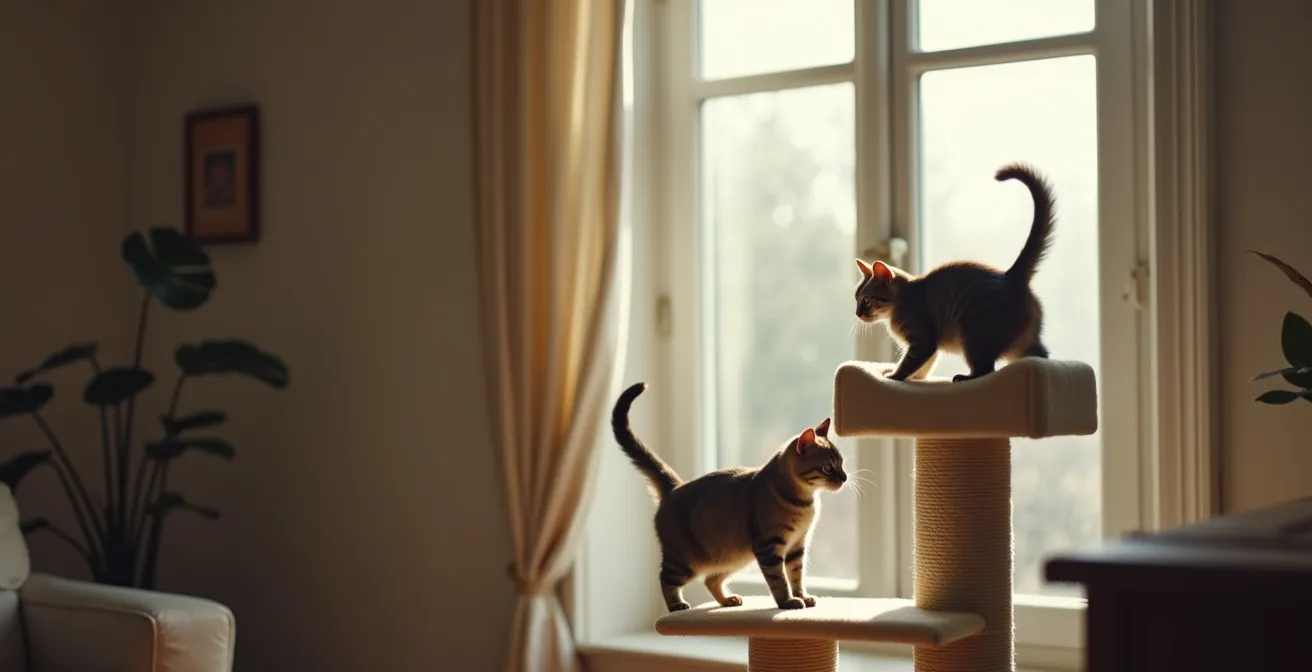
The conflict over the top perch isn’t a behavior problem; it’s an environmental design flaw.
- A single cat tree, no matter how large, creates resource scarcity, forcing competition for height, views, and safety.
- True multi-cat harmony comes from engineering a “vertical superhighway” with multiple structures, varied textures, and separate “viewing channels.”
Recommendation: Stop trying to find one “perfect” tree. Instead, start thinking like a feline architect and build a network of vertical options to create an environment of abundance.
If you share your home with more than one cat, you’ve likely witnessed the silent, tense standoff for the highest perch on the cat tree. You may have even seen it escalate into a brief, fur-flying skirmish. The common advice is often to “get a bigger tree,” but this rarely solves the core issue. The fight isn’t just about a comfortable spot; it’s a complex drama of territory, security, and status playing out in the vertical dimension of your home. The top perch represents the ultimate resource: a vantage point for surveying territory (a predator instinct) and a safe retreat from ground-level threats (a prey instinct).
For a multi-cat household, a single tower, no matter its size, becomes a single point of failure—a throne that can only have one ruler. This creates a state of perpetual, low-grade stress and competition. The dominant cat may hoard the resource, leaving the more timid cat feeling insecure and exposed. The underlying problem isn’t that your cats are “bad” or don’t get along; it’s that their environment is forcing them into a zero-sum game. To truly resolve this, we must move beyond the idea of a single piece of furniture and start thinking like feline environmental psychologists.
This article will deconstruct the cat’s perception of vertical space. We won’t just recommend products; we will explore the principles of territorial architecture. We’ll analyze why stability is non-negotiable, how a window view functions as “cat TV,” and why a dead-end on a cat tree can be a source of intense anxiety. By understanding the psychology behind their needs, you can transform your home from a battlefield into a thriving, multi-level ecosystem that promotes confidence and peaceful coexistence.
For those who prefer to see these principles in action, the following video offers a wonderful immersion into how a thoughtfully redesigned environment can completely change the dynamics of a multi-cat home. It serves as a powerful visual testament to the concepts we are about to explore.
To help you navigate this new way of thinking, we have structured this guide to address the most critical environmental factors. You will learn not just what to buy, but how to think about space, texture, and flow from your cat’s point of view. Let’s begin building a better world for your feline family.
Contents: The Feline Architect’s Guide to Vertical Space
- Wobble Factor: Why Maine Coons Reject Cheap Trees?
- The “TV” Effect: Why the View Matters More Than the Carpet?
- Dead Ends: How to Arrange Furniture to Prevent Ambushes?
- Sisal vs. Wood: Providing Texture Variety on the Tree
- Disinfecting Carpeted Trees: How to Remove Ringworm Spores?
- Sisal vs. Carpet: Which Material Do Adult Cats Actually Prefer?
- Why High Shelves Help Anxious Cats Feel Secure?
- Why Your Cat Scratches the Sofa Despite Having a Post?
Wobble Factor: Why Maine Coons Reject Cheap Trees?
From a feline perspective, stability is not a luxury; it is the foundation of trust. A cat, especially a large breed like a Maine Coon, experiences the world through a finely tuned sense of balance. When they leap onto a perch, they expect a solid landing. A tree that sways, creaks, or wobbles under their weight sends a primal signal of danger. This isn’t just a minor annoyance; it’s a betrayal of their physical confidence, which I call kinetic confidence. A cat that doesn’t trust its environment will be an anxious cat.
Cheaply made cat trees, often built with thin particleboard and narrow bases, are the primary culprits. They may look appealing in a store, but they are not engineered to handle the dynamic forces of a cat in motion. Consider that a quality structure must be able to support 20-40 pounds of active felines simultaneously, often launching themselves from the floor. This requires a wide, heavy base (at least 20 inches square), solid wood or metal-reinforced construction, and a low center of gravity.
When a cat rejects a wobbly tree, it’s not being “picky.” It’s making a rational decision based on a risk assessment. The ground, or your sturdy oak bookshelf, becomes a more reliable option. Investing in a rock-solid, well-engineered tree isn’t just about durability; it’s about providing a fundamental sense of security that allows your cat to relax and truly own their vertical space.
The “TV” Effect: Why the View Matters More Than the Carpet?
While humans see a window, cats see a television. A view of the outside world—with its passing birds, rustling leaves, and distant movements—is a critical source of mental stimulation. This “cat TV” effect engages their predator instincts in a safe, passive way, preventing boredom and the destructive behaviors that can follow. In a multi-cat home, access to these “viewing channels” becomes a valuable resource, and competition for the best seat can become a source of conflict.
Placing a single cat tree in front of one window, while a good start, can inadvertently create another “single throne” scenario. A more effective strategy is to provide multiple viewing stations. This doesn’t necessarily mean buying identical trees. It’s about thinking architecturally. By positioning two separate, smaller trees or a series of sturdy wall shelves at different windows, you create distinct, non-competing entertainment zones. One cat can watch the bird feeder from the living room window, while another observes street life from the bedroom.
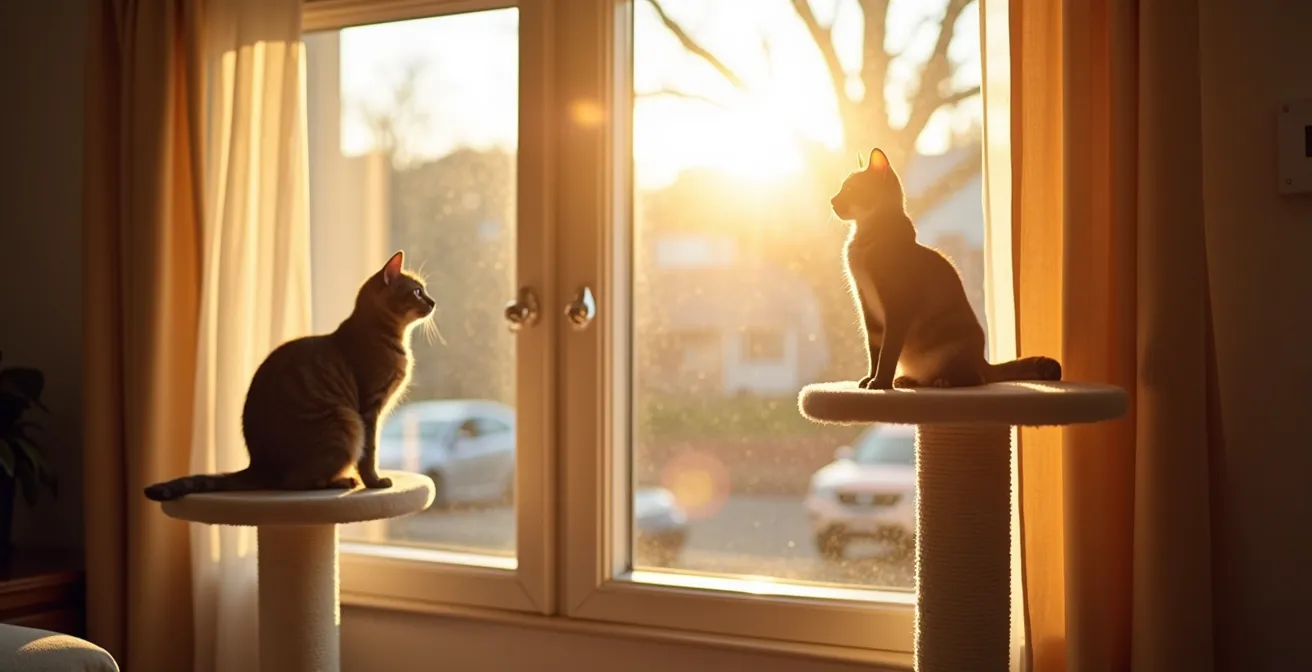
As this image illustrates, the goal is separation and choice. This strategic placement transforms a scarce resource (the one good view) into an abundant one. You are not just adding perches; you are diversifying your cats’ portfolio of entertainment and enrichment. This approach acknowledges that the quality of the mental engagement a perch provides can be far more valuable to a cat than the plushness of its carpet.
Dead Ends: How to Arrange Furniture to Prevent Ambushes?
A cat’s sense of security is deeply tied to its ability to navigate its territory with confidence. This includes having clear escape routes. From a feline environmental perspective, many cat trees are poorly designed because they create “dead ends.” A typical tree with a single central pole and stacked perches creates only one path up and down. For the cat on the top perch, this design can become a trap. A more dominant cat can block the single exit, leaving the high-perched cat feeling cornered and vulnerable.
As Michu Pet Experts note in their guide on “Territorial Conflicts on Cat Tree,” this feeling of control is paramount:
A cat’s territorial instinct is one of its core traits… High spots are especially attractive because they provide a view of the surroundings and a sense of control. That’s why the Cat Tree often becomes a central resource that cats fight over – it means height and control.
– Michu Pet Experts, Territorial Conflicts on Cat Tree – Managing Multiple Cats
The solution is to think in terms of a vertical superhighway, not a cul-de-sac. Look for trees with multiple poles, staggered platforms that create several paths of ascent and descent, or connect the tree to other furniture (like a bookshelf or a sturdy cabinet) to create alternate escape routes. The platforms themselves should be positioned to facilitate flow; an ideal spacing of 12-18 inches apart allows for easy movement. This turns the tree from a potential ambush point into a dynamic part of a larger network, empowering the more timid cat with the confidence that it can always retreat safely.
Sisal vs. Wood: Providing Texture Variety on the Tree
Scratching is not just a habit; it’s a vital form of feline communication and maintenance. When a cat scratches, it is doing three things: shedding the outer sheath of its claws, stretching its muscles, and, most importantly, leaving both a visual and scented mark. The post becomes a “billboard” that says, “I was here.” In a multi-cat home, providing a variety of scratching textures is akin to offering different pens to a writer—it allows for more nuanced expression and reduces competition.
While sisal rope is the gold standard for vertical scratching due to its excellent durability and scent retention, it shouldn’t be the only option. Cats, like people, enjoy variety. Integrating different materials on a single tree or across multiple structures creates an environment of textural abundance. Wood offers a more natural and rigid surface for clawing, leaving satisfying visible marks. Carpet is often preferred for lounging and “kneading” rather than aggressive scratching, as it can snag claws.
The key is to observe your cat’s preferences and provide options that cater to different functions. A tree that combines a sisal-wrapped pole for intense scratching, a wooden base for a different sensation, and a carpeted perch for napping is a well-rounded piece of territorial architecture.
| Material | Marking Effectiveness | Durability | Cat Preference |
|---|---|---|---|
| Sisal Rope | Excellent scent retention | Very High | Preferred for vertical scratching |
| Wood | Visible claw marks | High | Natural texture appeal |
| Carpet | Can snag claws | Medium | Preferred for lounging |
| Seagrass/Jute | Moderate | Medium | Alternative texture option |
Disinfecting Carpeted Trees: How to Remove Ringworm Spores?
Hygiene is an often-overlooked aspect of feline environmental psychology. An unclean space can harbor not only pathogens but also stressful scent-markers from illness or conflict. This is especially true for contagious issues like ringworm (a fungus, not a worm), whose spores can stubbornly persist in soft materials like carpet. A carpeted cat tree can become a reservoir for reinfection, making proper disinfection crucial for both physical health and psychological peace.
Standard household cleaners are often ineffective against resilient fungal spores. A veterinary-grade decontamination protocol is required to ensure the environment is truly clean. This involves a multi-step process of physical removal and chemical neutralization. For multi-cat households, this challenge highlights a key architectural strategy: the quarantine tree. Having a secondary, easily disinfectable structure made of wood or plastic with removable pads is an invaluable tool. It allows an ill cat to maintain access to vertical territory—reducing recovery stress—without contaminating the primary, more comfortable structures shared by healthy cats.
Furthermore, selecting trees with removable, machine-washable cushion covers is a proactive measure that simplifies routine hygiene and extends the life of the furniture, ensuring the cat’s primary comfort spots remain clean and inviting.
Action Plan: Veterinary-Grade Decontamination Protocol
- Debris Removal: Remove all loose debris and hair with a vacuum cleaner equipped with a HEPA filter to contain spores.
- Chemical Application: Apply an accelerated hydrogen peroxide solution (e.g., Accel/Virox), following the manufacturer’s dilution instructions for porous surfaces.
- Contact Time: Allow the solution to sit for the recommended contact time, typically 10 minutes, to effectively eliminate fungal spores.
- Veterinary Consultation: For severe or persistent contamination, consult a veterinarian about the use of prescribed enilconazole solutions.
- Preventative Design: Prioritize cat furniture with removable and washable cushion covers to simplify future cleaning and maintain high hygiene standards.
Sisal vs. Carpet: Which Material Do Adult Cats Actually Prefer?
The debate between sisal and carpet often misses a crucial point: cats don’t just choose a material, they choose a function. The preference for sisal or carpet is directly linked to the behavior they wish to perform at that moment. Understanding this functional difference is key to designing a vertical space that truly meets their needs. It’s not about which is “better,” but about providing both for their distinct purposes.
Sisal is for work. Its rough, shreddable texture is perfect for the vigorous, full-body stretch and scratch that maintains claw health and deposits territorial scent. A tall, sturdy sisal post allows a cat to extend fully, which is a highly satisfying and instinctive behavior. In contrast, carpet is for rest. Its softness provides a comfortable, warm surface for lounging, napping, and kneading. While cats may occasionally scratch carpet, its tendency to snag claws makes it less ideal for the primary “work” of claw maintenance.
As behavior consultant Irith Bloom notes, “Most cats really enjoy scratchers, but it’s not a ‘one size fits all’ situation! Some cats like their scratcher to be horizontal, while others prefer vertical.” This highlights the need for variety. A well-designed multi-cat environment offers both. An ideal cat tower might feature tall, sisal-wrapped poles for climbing and scratching, leading up to plush, carpeted platforms for resting. Structures should be sufficiently tall; towers between 60-72 inches provide excellent vertical territory with multiple platforms, allowing cats to choose the surface that matches their immediate behavioral need.
Why High Shelves Help Anxious Cats Feel Secure?
Height is a primary currency in the feline world. A cat’s instinctual drive to seek high places is rooted in a powerful, dual-sided psychological need inherited from its ancestors: the need for prospect and refuge. As cat and dog trainer Irith Bloom explains, cats are both predators and prey animals. Height grants them the predator’s advantage of a clear vantage point to survey their territory (prospect) while simultaneously providing the prey animal’s requirement for a safe haven from perceived ground-level threats (refuge).
An anxious cat, in particular, benefits immensely from this sense of refuge. The ground can feel exposed and unpredictable. A high shelf or perch becomes a “safe zone” where the cat is out of the main flow of traffic, away from the unsolicited attentions of other pets or people, and can observe the world from a position of control. From this elevated position, nothing can sneak up on them from behind, which dramatically reduces anxiety.
In a multi-cat household, providing a network of these high perches is a powerful tool for peace. The “Creating a Second-Story Safe Zone Network” strategy involves using wall-mounted shelves, the tops of sturdy bookshelves, and multi-level cat trees to build an elevated highway. This allows a more timid cat to navigate a room without ever having to touch the floor, thereby avoiding potential confrontations and building confidence. It ensures that every cat has access to its own secure “safe zone,” transforming the home into a less stressful, three-dimensional territory.
Key Takeaways
- It’s about territory, not just trees: The goal is to design a rich vertical environment, not just own a single object.
- Stability equals confidence: A wobbly tree creates anxiety. A solid structure provides the psychological security cats need.
- Create pathways and choices: A “vertical superhighway” with multiple routes, views, and textures prevents conflict by creating resource abundance.
Why Your Cat Scratches the Sofa Despite Having a Post?
It’s one of the most common frustrations for cat owners: you’ve provided a scratching post, yet your cat continues to shred the arm of your new sofa. This isn’t an act of defiance; it’s an act of communication. The cat is telling you that your sofa is a superior “billboard” for their territorial message than the post you’ve offered. From a feline perspective, the sofa often wins for several key reasons: it’s incredibly stable, it’s located at a major social intersection of the home, and its sturdy, woven texture is immensely satisfying to shred.
When your cat scratches the furniture, they are essentially conducting a “Failed Billboard Audit” on the scratching post you provided. Was the post too short for a full-body stretch? Did it wobble, undermining their confidence? Was it hidden in a corner, far from the socially significant areas where they want to leave their mark? A scratching post is not just a tool for claw maintenance; it is a communication hub. If it’s not in a prime location, it’s like putting a billboard in the middle of a desert.
The most critical factor in a multi-cat home is competition. A single post must serve as the billboard for multiple cats, which can lead to conflict or avoidance. This is where the cardinal rule of multi-cat resources comes into play. The general rule of thumb is the number of cats + 1 for key resources. While this is most famous for litter boxes, it applies equally to scratching posts. Two cats need at least three distinct, appealing scratching locations to feel secure in their ability to communicate without conflict. By making the *sanctioned* scratching posts more appealing and numerous than the sofa, you can finally win the communication war.
Frequently Asked Questions about Cat Trees for Multiple Cats
How many cats can safely use one large cat tower simultaneously?
Most well-constructed large cat towers can safely accommodate 3-4 average-sized cats simultaneously without structural concerns, though individual cat personalities and territorial behaviors often limit practical usage to 2-3 cats at once.
Should I get one large tower or multiple smaller ones?
The choice depends on your cats’ relationships and available space. One large tower with 4+ platforms works for bonded cats that enjoy sharing space, while more territorial or anxious cats benefit far more from multiple separate structures placed in different areas to create distinct territories.
How do I introduce a new cat tree without causing disputes?
Gradual introduction prevents territorial conflicts by allowing cats to explore and claim areas naturally. Start by placing the new tree in a neutral area of the home. Use positive reinforcement like treats, catnip, or favorite toys on the tree to create positive associations. If possible, allow each cat individual, supervised time to investigate it before allowing them to access it together.