
A reliable recall isn’t taught; it’s built upon a foundation of other, more critical obedience skills that manage impulse control.
- True off-leash safety comes from mastering impulse control via “Stay” and “Place,” not just yelling “come.”
- The “Emergency Down” is faster and safer than a recall in the majority of crisis situations.
Recommendation: Stop drilling a failing recall and start building the underlying commands that create a thinking, responsive partner.
That heart-stopping moment when the leash slips and your dog bolts is a nightmare every owner fears. You call their name, your voice cracking with panic, but they’re gone—deaf to your pleas, captivated by a squirrel, another dog, or the lure of the unknown. The common advice is to use a happier voice, offer better treats, and never punish the dog for returning. While not wrong, this advice fails to address the core problem: a life-saving recall is not a standalone party trick. It’s the capstone of a comprehensive safety system.
Most owners focus entirely on the “come” command, practicing it until they’re blue in the face with little progress in high-distraction environments. They are trying to build a roof without first erecting the walls. The truth is, a dog that cannot hold a “Stay” when a leaf blows by or remain on their “Place” mat when the doorbell rings will never have a truly reliable recall. The chase is inherently more rewarding than your treat pouch. To overcome this, you must change the equation entirely.
This article reframes the challenge. Instead of asking “How do I teach recall?”, we will ask, “How do I build a system of impulse control that makes recall the logical, safe, and reliable conclusion?” We will deconstruct this system piece by piece, from foundational commands that build a dog’s “off switch” to the advanced conditioning that makes obedience more compelling than chaos. This is not about one command; it’s about building a responsive partner you can trust with their life.
To provide a complete visual overview, the following video summarizes the key techniques for achieving a perfect recall, complementing the foundational principles we are about to explore in this guide.
This guide will walk you through the essential components of this safety system. We will explore each command not as an isolated skill, but as an integral part of building a dog with the impulse control necessary for true off-leash freedom.
Summary: The Real System Behind a Life-Saving Recall
- Duration, Distance, Distraction: How to Proof a Stay Command?
- How the “Place” Command Solves Doorbell Barking Chaos?
- The Emergency Down: How to Drop Your Dog at a Distance?
- Variable Reinforcement: How to Wean Off Constant Treating?
- Loose Leash vs. Focused Heel: What Do You Really Need on Walks?
- Why 15 Minutes of Obedience Tires a GSD More Than 1 Hour of Running?
- The 5-Meter Leash: Giving Freedom Without Losing Control
- Why the Clicker Is Faster Than Voice for Teaching New Skills?
Duration, Distance, Distraction: How to Proof a Stay Command?
The “Stay” command is the bedrock of impulse control. A dog that cannot resist the urge to move for 30 seconds in your living room will certainly not resist the urge to chase a cat across a busy street. The failure of most “Stay” training is a rush to add difficulty. The key is to master the “3 Ds”—Duration, Distance, and Distraction—systematically and independently. You must build a solid foundation of duration (the length of time the dog holds the position) before you even think about adding distance (how far you are from the dog). Only when the dog is proficient with both should you introduce mild distractions.
Start by asking for a one-second stay from one foot away. It sounds absurdly simple, but this is where you build the pattern of success. Gradually increase the duration in small increments. Your goal is for the dog to succeed every single time. Rushing this process teaches the dog that “Stay” is optional and that breaking the command is a viable strategy to get what they want. It’s not about testing the dog’s limits; it’s about methodically expanding them.
Case Study: Errorless Learning vs. Strategic Failure
A fascinating study by the Fenzi Dog Sports Academy compared two training groups. Group A was set up for 100% success (“errorless learning”), while Group B experienced controlled “failures” where breaking the stay was immediately and calmly corrected, teaching them it wasn’t a productive choice. The results were counter-intuitive: Group B, which learned from managed mistakes, showed a 40% faster acquisition of the command and 60% better retention under high distraction. This shows that allowing for strategic, controlled failure can accelerate learning by clarifying consequences.
This doesn’t mean letting your dog fail constantly. It means that when a mistake happens, it becomes a clear, non-emotional teaching moment. If the dog breaks, you don’t scold; you calmly reset them, perhaps at an easier criterion. This builds a resilient dog that understands the parameters of the command, rather than a fragile one that only succeeds in a perfect, sanitized environment. The “Stay” isn’t about freezing the dog in fear; it’s about teaching them active, thoughtful self-control. This is the first and most critical brick in the wall of a reliable recall.
How the “Place” Command Solves Doorbell Barking Chaos?
If “Stay” is about impulse control in a static position, “Place” is about creating a psychological anchor. It’s a designated spot—a specific mat or bed—that becomes your dog’s “safe zone” and default behavior in moments of chaos. For the owner of a runaway dog, the doorbell is often a trigger point: the excitement of a visitor sends the dog into a frenzy, making a bolt out the open door almost inevitable. The “Place” command directly solves this problem by giving the dog a specific, incompatible job to do: go to your spot and stay there until released.
This isn’t just about controlling the dog; it’s about changing their emotional state. The Place mat becomes a location associated with calm and reward. By practicing sending the dog to their Place in low-stress situations and rewarding them heavily for staying, you build a powerful positive association. When the doorbell rings, the command is no longer a restriction but a cue for a familiar, rewarding behavior. This shifts the dog’s mindset from reactive (barking, jumping, rushing the door) to responsive (hearing the cue, going to the mat, and waiting for the next instruction).
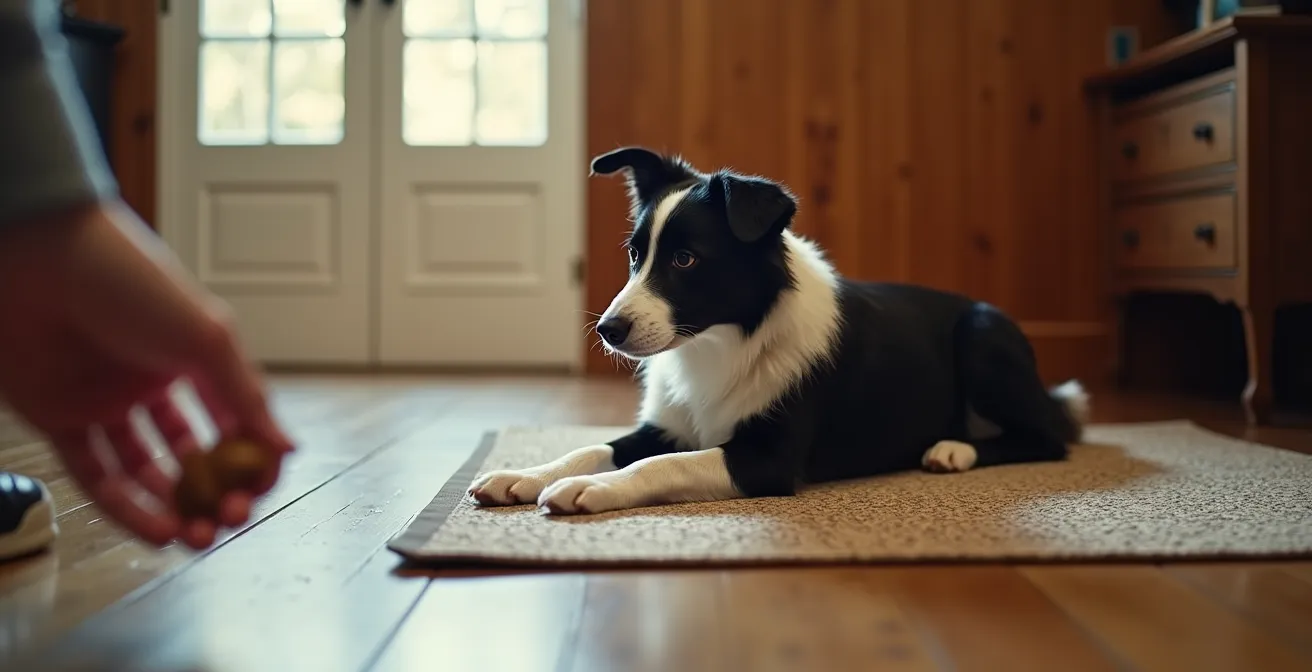
As seen in the image, the goal is a dog that is relaxed but attentive, observing the situation from a safe distance without feeling the need to manage it themselves. This simple mat becomes a boundary that redefines the dog’s role during arrivals. They are no longer the frantic greeter but a calm observer. This skill of disengaging from a high-arousal trigger is directly transferable to an off-leash environment. A dog that can ignore a visitor at the door is a dog learning to ignore a squirrel on a walk.
A successful “Place” command demonstrates that you, the handler, are in control of the environment. This builds the dog’s trust in your leadership, a critical component for any off-leash reliability. They learn that their job is to look to you for guidance, not to make their own decisions in a moment of excitement.
The Emergency Down: How to Drop Your Dog at a Distance?
This is the command that most directly supports the article’s title. In a true life-or-death situation—your dog running towards a busy road—a recall might fail. The dog could be too far, too distracted, or moving too fast. An “Emergency Down,” however, is a reflex. It’s an instant stop, dropping the dog to the ground wherever they are. In a crisis, speed is everything. An emergency down stops a dog in 0.5 to 1.0 seconds, versus 2.5 to 4.0 seconds for even a good recall. That two-second difference can be the margin between safety and tragedy.
Training the Emergency Down is about prioritizing speed above all else. Unlike other commands, you don’t start with duration. You start with speed at close range. The goal is an instantaneous drop from a standing position. You reward the speed of the drop, not the length of the stay. You want the command to be so ingrained that it bypasses the dog’s thought process. It should be a muscle memory, triggered by your verbal cue.
Only after you have a lightning-fast down at your feet do you begin to add distance, one foot at a time. The standard never changes: speed is the priority. If the dog’s drop becomes slow or hesitant as you add distance, you have moved too fast. You must return to the distance where it was instant and rebuild from there. This command is not a casual “lie down”; it is a non-negotiable, life-saving stop. It must be trained, proofed, and maintained with the seriousness it deserves.
Action Plan: Proofing Your Emergency Down
- Week 1 (Speed): Practice ‘Down’ from a standing position 50 times daily at a 1-foot distance. Your only goal is an instant drop.
- Week 2 (Urgency): Add an urgent tone to your voice without adding any distance. Time the drop; the goal is under 0.5 seconds from command to the dog’s belly touching the ground.
- Week 3 (Initial Distance): Only after achieving consistent sub-second drops, add 1 foot of distance. Maintain the speed standard.
- Week 4+ (Incremental Distance): Increase distance by only 2 feet per week. If speed falters, immediately return to the previous successful distance and solidify it before proceeding.
- Proofing Phase (Distractions): Once the down is reliable at 20+ feet, begin introducing mild distractions (e.g., a rolling ball), always ensuring speed is never sacrificed for the complexity of the distraction.
An Emergency Down gives you a critical tool that a recall does not: the ability to stop your dog’s forward momentum instantly. It buys you time to assess the situation, walk to your dog, and secure them safely, turning a potential catastrophe into a controlled event.
Variable Reinforcement: How to Wean Off Constant Treating?
Many owners become “walking treat dispensers.” Their dog will only comply if a reward is visible, and the reliability vanishes the moment the treats are gone. The solution is not to stop rewarding, but to make the rewards unpredictable through variable reinforcement. This psychological principle is the same one that makes slot machines so addictive. If you get a small payout every single time, it becomes boring and predictable. But if you never know which pull will result in a huge jackpot, the act of playing becomes intensely exciting.
Variable reinforcement builds intense focus because the dog never knows which repetition will result in a ‘jackpot,’ making compliance more exciting than predictable rewards – it’s the psychological equivalent of a slot machine for dogs.
– Susan Garrett, DogsThat Podcast Episode 302
To implement this, you first teach a new command using a high rate of reinforcement (a treat for every success). Once the dog understands the command, you switch to a variable schedule. They might get a treat for the first repetition, nothing for the next two, a piece of their kibble for the fourth, and a “jackpot” (a handful of high-value treats) for the fifth. The dog doesn’t know what’s coming, so they perform every repetition with focus and enthusiasm. It’s crucial, however, to apply this intelligently. Life-saving commands like recall and the emergency down should always maintain a much richer rate of reinforcement than simple tricks like “shake a paw.”
The following table, based on expert recommendations, provides a clear framework for how to adjust reinforcement schedules based on the command’s importance. This data from leading trainers at DogsThat shows how to maintain high reliability for critical skills while building independence for others.
| Command Type | Initial Rate | 6 Months | Maintenance | Rationale |
|---|---|---|---|---|
| Life-Saving (Recall/Down) | 100% (every rep) | 80% variable | 60% jackpot | Maintain high reliability |
| Safety (Stay/Wait) | 100% | 60% variable | 40% random | Balance reliability with independence |
| Convenience (Sit/Shake) | 80% | 30% variable | 10% surprise | Low stakes allow lean schedule |
| Tricks | 60% | 20% random | 5% occasional | Maintenance only |
By using a variable schedule and a wide menu of reinforcers—toys, praise, life rewards like getting the leash on for a walk—you are not just “weaning off treats.” You are building a deeper, more resilient working relationship where compliance is intrinsically motivating for the dog.
Loose Leash vs. Focused Heel: What Do You Really Need on Walks?
The daily walk is often a source of immense frustration for owners of high-energy or reactive dogs. The constant pulling creates tension and makes any training impossible. Many owners are stuck in a cycle of correction, creating a stressful experience for both handler and dog. The problem is often a lack of clarity. Is the dog supposed to be sniffing and exploring, or walking politely by your side? Trying to enforce both simultaneously leads to failure. The solution is to create a “two-mode” walking system with distinct cues: “Free Walk” for sniffing on a loose leash, and “With Me” for a focused heel.
By using different cues, and initially even different equipment (e.g., a harness for “Free Walk,” a flat collar for “With Me”), you provide absolute clarity to your dog. They learn that when the “Free Walk” cue is given, they have a certain radius to explore and sniff. This fulfills their natural canine needs. When the “With Me” cue is given, their job is to be in a specific heel position, attentive to you. This is the mode for navigating busy sidewalks, parking lots, or passing other dogs.
Case Study: The Two-Mode Walking System
A professional trainer documented a remarkable 6-week transformation using this “Mode Switch” protocol. The 12 reactive dogs in the study learned distinct cues for a loose-leash ‘Free Walk’ and a focused ‘With Me’ heel. The clear differentiation between the two modes reduced pulling by 85% and frustration behaviors (like lunging and barking) by 90%. Most importantly, cortisol (stress hormone) levels were significantly lower when dogs understood the expectations for each mode, proving that clarity reduces stress and improves behavior.
This system isn’t just about making walks more pleasant; it’s about building engagement and responsiveness. The focused heel (“With Me”) is a powerful tool for managing your dog in distracting environments. A dog that can heel past a distraction is learning the same impulse control needed for an off-leash recall. The walk becomes a training opportunity, not a daily battle. You are teaching your dog to switch their brain from “explore mode” to “work mode” on your cue, a fundamental skill for any reliable off-leash work.
Why 15 Minutes of Obedience Tires a GSD More Than 1 Hour of Running?
Owners of high-energy breeds like German Shepherds often believe the solution to a wild dog is more physical exercise. They run their dogs for miles, only to find them still bouncing off the walls. This is because they are building a canine athlete with incredible stamina but no “off switch.” The key to a truly tired, settled dog is not just physical exertion, but mental work. The cognitive load of a focused 15-minute obedience session is far more exhausting for a dog than a mindless one-hour run.
Every time a dog has to choose to obey a command over following an instinct—to “Stay” instead of chasing, to “Heel” instead of pulling—they are exercising their prefrontal cortex. This mental effort consumes a tremendous amount of energy. In fact, veterinary research shows that dogs performing cognitive tasks burn 20% more glucose in the prefrontal cortex compared to physical exercise alone. It’s the neurological equivalent of us taking a difficult exam.
Every act of obedience requiring impulse inhibition consumes significant mental energy from the prefrontal cortex – it’s like asking a human to solve complex math problems while resisting their favorite food.
– Dr. Patricia McConnell, The Cognitive Cost of Canine Self-Control

Physical exercise is necessary for health, but it does not teach self-control. Short, daily sessions focused on commands that require thought and impulse inhibition—like the proofed “Stay,” the “Place” command with distractions, or a precision “Heel”—will do more to create a calm and manageable companion than hours of fetch. A mentally tired dog is a content dog, one that is less likely to engage in problem behaviors and more likely to be responsive to your cues when it truly matters.
The 5-Meter Leash: Giving Freedom Without Losing Control
The gap between on-leash reliability and off-leash freedom is a chasm that many owners are afraid to cross. The 5-meter (or 15-foot) long line is the bridge. It is the single most important tool for safely transitioning to off-leash work. It allows the dog to experience a sense of freedom, make choices, and practice recall from a distance, while you maintain a crucial safety net. Unlike a retractable leash, which teaches a dog to pull to get more length, a long line is a static training tool.
The goal is not to use the long line to reel your dog in like a fish. Its purpose is to manage the environment and prevent self-rewarding behaviors. If your dog ignores a recall cue to chase a bird, the long line allows you to gently step on the end, preventing the chase from ever starting. The dog learns that ignoring you is unproductive. It doesn’t lead to the fun they were hoping for. This management is critical. Every time a dog successfully ignores a recall and gets to chase something, the recall cue is weakened, and the unwanted behavior is strengthened.
Proper handling is key to safety. Never wrap the line around your hand or wrist, as a sudden bolt could cause serious injury. Instead, gather it in loose loops in your non-dominant hand, allowing it to feed out smoothly. Your other hand guides the line. As you progress, you can let the dog drag the line, giving them more freedom while you still have the ability to step on it if needed. This systematic progression builds confidence in both you and your dog.
This progression must be systematic to be effective. A well-structured plan, as detailed in the chart below, allows you to gradually increase freedom while ensuring success at every stage. This example of a proven training progression shows how to methodically fade the leash’s presence.
| Week | Leash Setup | Check-in Frequency | Success Criteria |
|---|---|---|---|
| 1-2 | Held 5m line | Every 30 seconds | 80% voluntary returns |
| 3-4 | Dropped 5m line | Every 45 seconds | 85% voluntary returns |
| 5-6 | Dragging 3m line | Every 60 seconds | 90% voluntary returns |
| 7-8 | Tab only (30cm) | Every 90 seconds | 95% voluntary returns |
Key Takeaways
- A life-saving recall is a system built on impulse control, not a single command trained in isolation.
- The Emergency Down is a faster, more reliable “stop” in a crisis than a recall.
- Mental fatigue from short, focused obedience sessions is more effective for creating a calm dog than hours of physical exercise alone.
Why the Clicker Is Faster Than Voice for Teaching New Skills?
When you’re building a system of commands where split-second reliability matters, the tools you use for communication are critical. While a verbal marker like “Yes!” can work, a clicker is a more precise and efficient tool for teaching new behaviors. The reason lies in timing and clarity. Behavioral research shows that a clicker marks behavior within 0.1 seconds, while a verbal marker averages a 0.8 to 1.2-second delay. In dog training, a second is an eternity. By the time you say “Yes!”, the dog may have already done two or three other things. The click “takes a picture” of the exact moment the dog does the right thing, eliminating any confusion.
The click is like a camera shutter, precisely capturing the exact moment the dog performs the correct action – a verbal marker is too slow and vague to pinpoint fleeting behaviors like a head turn or weight shift.
– Karen Pryor, Clicker Training Fundamentals
Furthermore, the click is an emotionally neutral sound. Our voices are filled with emotion. When we get frustrated, our tone changes, which can add stress and confusion to the training session. A click is always the same. It simply means, “What you did at that exact moment earned you a reward.” This clarity and consistency accelerates learning, especially for complex behaviors.
Case Study: Clicker vs. Voice in Complex Behavior Chains
A formal study compared the speed of teaching a 10-step behavior chain to two groups of dogs. The clicker-trained group achieved the full chain in an average of 3.2 sessions. The group trained with a verbal marker required an average of 5.8 sessions. The key factor was not just speed, but precision. The clicker’s emotional neutrality allowed handlers to maintain 98% timing accuracy, even when they felt frustrated. Handlers using a verbal marker saw their accuracy drop to 72% under stress, which directly slowed their dogs’ learning.
For the owner of a dog with a poor recall, this precision is a game-changer. It allows you to mark and reward the slightest head turn in your direction from 50 feet away, the first tiny step in building a reliable recall. You’re not waiting for the finished behavior; you’re building it piece by piece with surgical precision. This is how you build a reliable system, not by hoping, but by clearly and consistently communicating what you want.
The journey to a reliable recall is not a sprint, but a marathon of building a solid relationship based on clear communication and mutual trust. Stop chasing your dog and start building a partner who chooses to stay with you. Begin today by shifting your focus from the destination—the recall—to the journey: building a foundation of impulse control, one command at a time.