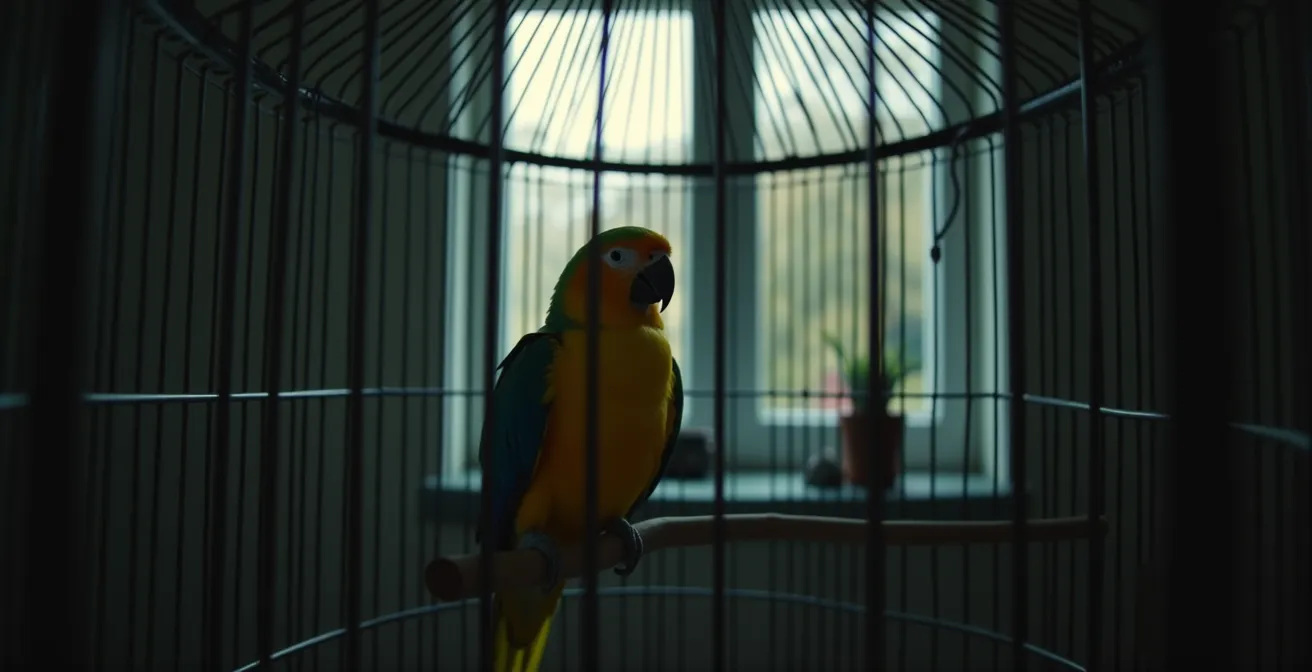
A round cage, despite its aesthetic appeal, functions as a psychological trap by disrupting a parrot’s innate need for spatial orientation and security.
- The absence of corners removes essential “spatial anchors,” leading to chronic stress and disorientation.
- This flawed environmental design directly contributes to stereotypic behaviors like bar-biting, which are symptoms of psychological distress, not mere boredom.
Recommendation: Immediately replace any circular enclosure with a high-quality, rectangular cage that provides the minimum required wingspan dimensions and a psychologically stable environment.
For many well-intentioned bird owners, the choice of a cage is guided by aesthetics. A sleek, circular cage can seem like an elegant addition to a home, a beautiful display for a beautiful animal. The common advice against them often feels superficial: they lack corners for a sense of security, or it’s harder to attach toys. While true, these points barely scratch the surface of a much more profound architectural failure. This isn’t a matter of inconvenience; it’s a fundamental violation of your parrot’s neurological and psychological needs.
Viewing a cage not as a container but as a piece of psychological architecture is the first step toward responsible aviculture. The geometry of a parrot’s environment dictates its mental state. An endless curve provides no points of reference, no defensible corners, and no defined territories for resting, playing, or eating. For a creature whose instincts are hardwired for navigating complex, three-dimensional forested environments, a round cage is the equivalent of living in a sensory deprivation chamber. It’s an environment that actively works against their cognitive and instinctual blueprints.
This article moves beyond the platitudes to deconstruct the cage as an ecosystem. We will explore how the very materials of a cage can be toxic, why sunlight through a window is a poor substitute for proper lighting, and how the act of foraging is critical for mental stimulation. By understanding the principles of avian-centric design, you can transform your parrot’s enclosure from a source of stress into a sanctuary that promotes genuine well-being.
For those who prefer a visual guide, the following video offers practical steps on how to modify and improve upon flawed cage designs, providing a great complement to the environmental principles discussed in this article.
To fully grasp the elements of a healthy avian habitat, this guide is structured to address the most critical aspects of your parrot’s environment. The following sections break down everything from material safety to the psychological importance of space, providing a complete blueprint for responsible cage design.
Table of Contents: A Blueprint for an Avian-Centric Environment
- Zinc and Lead Poisoning: The Hidden Dangers in Cheap Aviary Wire
- UVA/UVB Lighting: Why Window Sunlight Isn’t Enough for Vitamin D3?
- Foraging Toys vs. Bowls: How to Simulate Natural Feeding Behaviors?
- Teflon and Candles: The Household Fumes That Kill Birds Instantly
- Wingspan Ratios: How to Calculate Minimum Flight Dimensions?
- 450 Square Inches: The Minimum German Standard for Happiness
- Permethrin Danger: Why Dog Spot-Ons Can Kill Cats?
- Why “Bar Biting” Is a Sign of Psychological Distress, Not Boredom?
Zinc and Lead Poisoning: The Hidden Dangers in Cheap Aviary Wire
Beyond the shape of a cage, its very composition can pose a lethal threat. Many inexpensive cages, particularly those with a shiny silver finish, are made from galvanized wire. This process involves coating steel with zinc, a heavy metal that is highly toxic to parrots. Birds, with their natural inclination to chew and explore with their beaks, can easily ingest flakes of zinc, leading to heavy metal poisoning—a slow, painful, and often fatal condition. Symptoms can be vague, ranging from feather plucking to seizures, and are frequently misdiagnosed.
Lead is another insidious poison found in cheap metal toys, solder points on poorly constructed cages, and even some powder coatings. Like zinc, lead accumulates in the body, causing severe neurological and organ damage. The safest materials are those certified for medical or food-grade use. While more expensive, a cage made of medical-grade stainless steel is an investment in your bird’s longevity, as it is non-toxic, non-porous, and incredibly durable.
The following table breaks down the safety profiles of common cage materials, highlighting the long-term risks associated with cheaper alternatives.
| Material | Safety Level | VOC Emissions | Longevity |
|---|---|---|---|
| Medical-grade Stainless Steel | Excellent | None | 20+ years |
| Powder-coated Steel | Good if certified | Low after curing | 10-15 years |
| Galvanized Wire | Poor | Zinc off-gassing | 5-10 years |
| Chrome-plated | Variable | Can flake | 5-7 years |
Ultimately, the burden of safety falls on the owner. You must assume that any uncertified metal surface is a potential hazard until proven otherwise. This diligence is a cornerstone of creating a truly safe avian environment.
UVA/UVB Lighting: Why Window Sunlight Isn’t Enough for Vitamin D3?
Placing a parrot’s cage near a sunny window seems like a natural way to provide essential light. However, this is a common and dangerous misconception. While the visible light passes through, modern window glass is designed to filter out ultraviolet radiation. Crucially, research shows that nearly all beneficial UV radiation is blocked by window glass. Without direct exposure to UVB rays, birds cannot synthesize Vitamin D3, a hormone vital for calcium metabolism. A chronic deficiency leads to brittle bones, egg-binding in females, and a compromised immune system.
To architect a healthy indoor habitat, you must replicate the full spectrum of natural sunlight. This requires the installation of a dedicated, bird-safe UVA/UVB lighting system. These full-spectrum bulbs should be positioned 18-24 inches from the primary perches and run on a timer to simulate a natural 12-hour photoperiod. This not only supports physical health but also regulates the bird’s circadian rhythm, influencing everything from sleep cycles to hormonal balance.
The visual below illustrates a proper setup, where the lighting is integrated into the cage environment to provide comprehensive coverage without being intrusive.
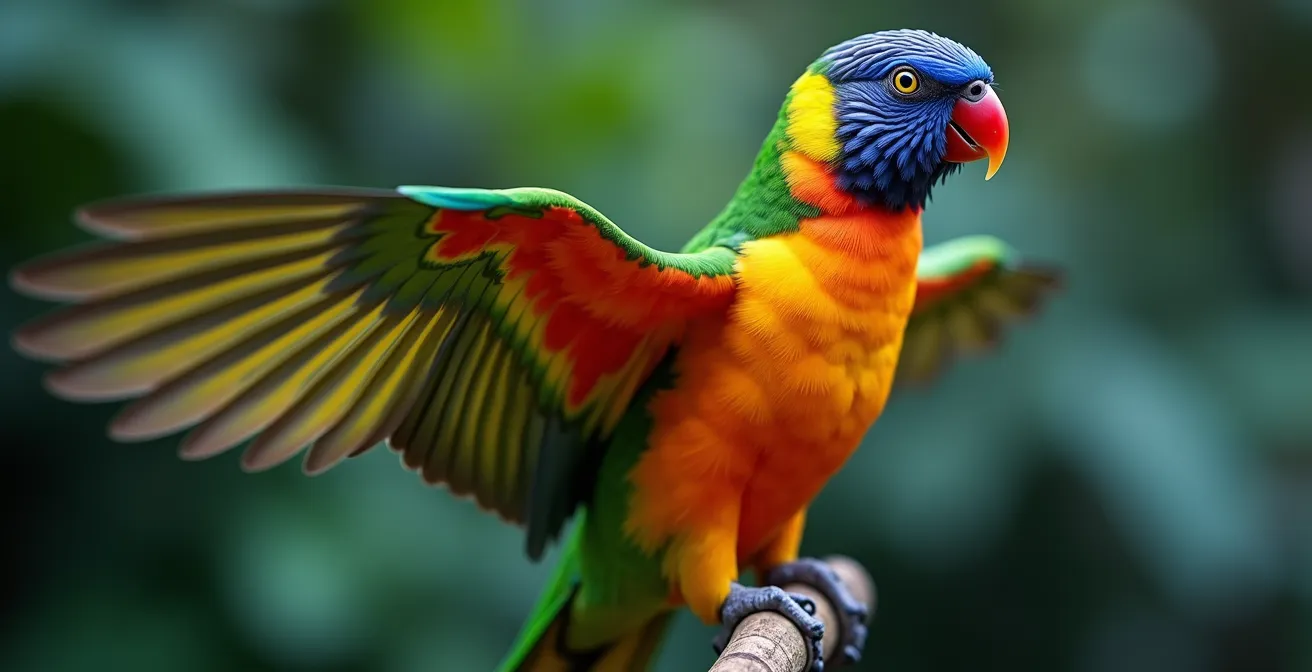
The positive impact of this environmental enrichment is not theoretical. It is a proven method for improving avian welfare, reversing behavioral issues, and promoting robust physical health.
Case Study: Circadian Rhythm Restoration in Captive Parrots
A 2023 veterinary study documented significant behavioral improvements in parrots exposed to 12-hour photoperiods with full-spectrum lighting. According to the findings published in The Veterinary Nurse, birds showed reduced stereotypic behaviors, improved feather condition, and normalized hormonal patterns within just 4 weeks of implementing timer-controlled UVA/UVB systems.
Foraging Toys vs. Bowls: How to Simulate Natural Feeding Behaviors?
In the wild, parrots spend a significant portion of their day foraging for food. This process involves problem-solving, physical exertion, and exploration. Serving food in a bowl, while convenient, strips away this crucial mental and physical activity, leading to boredom, obesity, and behavioral problems. A parrot that has its food delivered requires only minutes to eat, leaving it with hours of unoccupied time, which often manifests as destructive or stereotypic behaviors. The goal of a well-architected environment is to reintroduce the “work” of eating.
This is rooted in a behavioral principle known as “contrafreeloading,” where animals actively choose to work for food even when an identical, free source is available. This choice reveals that the effort itself is inherently rewarding and enriching. As Dr. Laurie Hess, a Board-Certified Avian Specialist, explains in the PetMD Avian Behavioral Health Guide:
Contrafreeloading demonstrates that parrots prefer to work for food even when freely available food is present, indicating that the effort itself provides psychological enrichment.
– Dr. Laurie Hess, Board-Certified Avian Specialist
Implementing foraging should be a gradual process. Start with simple puzzles and progressively increase the difficulty. You can begin by placing food in paper cups lightly covered with tissue paper, then move to crumpled paper balls with treats inside, and eventually introduce complex puzzle feeders with multiple steps. The objective is to transform feeding time from a passive event into an engaging, cognitively stimulating activity that occupies their time and mind, mimicking their natural instincts.
Teflon and Candles: The Household Fumes That Kill Birds Instantly
A parrot’s respiratory system is a marvel of efficiency, but it is also exceptionally fragile and sensitive to airborne toxins that are harmless to humans. Many common household items release fumes that can cause sudden death in birds, a condition known as “Teflon toxicity” or Polytetrafluoroethylene (PTFE) toxicosis. PTFE is the non-stick coating found on most cookware, as well as on some space heaters, hair dryers, and ironing board covers. When overheated, it releases a colorless, odorless gas that destroys a bird’s lung tissue.
The danger is acute and immediate. As veterinary toxicology data confirms, PTFE-coated cookware becomes lethal to birds when it reaches temperatures around 280°C (536°F), which can happen in as little as two to five minutes on a stovetop. Beyond PTFE, other airborne threats include scented candles, air fresheners, aerosols, cleaning products, and smoke. The “pleasant” scents we enjoy are often composed of volatile organic compounds (VOCs) that are poison to an avian respiratory system.
As an avian welfare architect, your responsibility extends beyond the cage to the entire airspace of your home. You must create a “flight-safe” zone by systematically eliminating these invisible threats. This means replacing all non-stick cookware with alternatives like stainless steel, cast iron, or ceramic, and ceasing all use of scented products and aerosols in the home. An air purifier with a HEPA and carbon filter placed near the cage can provide an additional layer of protection.
Your Action Plan: Room-by-Room Airborne Toxin Audit
- Kitchen: Immediately discard all cookware, toasters, and air fryers with non-stick coatings. Opt for stainless steel, ceramic, or cast iron.
- Bathroom: Remove all aerosol products (hairspray, deodorant), scented candles, and plug-in or spray air fresheners.
- Living Room: Be wary of new furniture or carpets, which can off-gas formaldehyde. Use a handheld VOC meter for testing if concerned.
- Utility Room: Store all cleaning products in sealed containers in a separate, well-ventilated area away from the bird. Check space heaters for PTFE components.
- Bedroom: Replace any plug-in air fresheners and check hair styling tools (straighteners, dryers) for non-stick surfaces, which can also release fumes.
Wingspan Ratios: How to Calculate Minimum Flight Dimensions?
The single most critical failure of most commercial cages, especially round ones, is their inadequate size. A cage is not a permanent residence but rather a “home base” within a larger living area. However, even this home base must be large enough to allow for fundamental movements. The absolute minimum requirement is that a bird can fully extend and flap its wings without touching the sides of the cage. This is not a luxury; it’s a basic biological necessity for muscle and joint health.
To move beyond arbitrary manufacturer recommendations, avian veterinarians and welfare experts have established a clear formula based on wingspan. According to avian veterinary research, optimal cage dimensions should be calculated as follows: the width should be at least 1.5 times the bird’s full wingspan, the depth should be at least 1 times the wingspan, and the height should be sufficient for comfortable perching and movement. For a bird with a 20-inch wingspan, this translates to a cage that is at least 30 inches wide and 20 inches deep.
Furthermore, one must consider “usable living volume.” A cage packed with oversized toys and perches has significantly less functional space. The layout of accessories should be thoughtfully planned to create open flight paths and distinct zones for activity and rest, not a cluttered obstacle course. The table below demonstrates how wingspan translates into minimum cage size for common species and how accessories impact the actual usable space.
| Species | Wingspan | Minimum Cage | Usable Volume After Accessories |
|---|---|---|---|
| Budgerigar | 12 inches | 24x18x18 | 60% of total |
| Cockatiel | 14 inches | 30x18x24 | 55% of total |
| African Grey | 20 inches | 36x28x48 | 50% of total |
| Macaw | 40 inches | 60x40x72 | 45% of total |
A cage that fails the wingspan ratio test is not a home; it is a storage container. It restricts movement, promotes muscle atrophy, and contributes significantly to psychological distress.
450 Square Inches: The Minimum German Standard for Happiness
While many regions lack specific, enforceable standards for pet bird housing, several European countries have adopted progressive legislation based on decades of behavioral science. These standards provide an excellent, data-driven benchmark for what constitutes a humane environment, moving the conversation from opinion to evidence. They serve as a powerful counter-argument to the often-inadequate sizes promoted by cage manufacturers.
These laws are not arbitrary; they are the result of studies correlating enclosure size with indicators of psychological well-being, such as the reduction of stereotypic behaviors and increased exploratory activity. They represent a legal acknowledgment that space is a fundamental component of animal welfare. This legislative progress provides a clear, ethical blueprint for responsible owners everywhere.
Case Study: A Comparison of Progressive European Cage Legislation
An analysis from avian welfare organization Star Avian highlights how different countries quantify well-being. Germany’s 2024 animal welfare standards mandate a minimum cage floor space of 450 square inches for small parrots. Switzerland goes further, requiring 600 square inches plus mandatory daily flight time. Austria is even more progressive, with a minimum of 750 square inches and a requirement for access to an outdoor aviary. These standards reflect a scientific consensus on the direct link between space and psychological health.
This perspective is strongly echoed by veterinary experts who witness the consequences of inadequate housing firsthand. Dr. Scott McDonald, DVM, a respected avian veterinarian, states the ethical imperative plainly:
In my opinion it is cruel and inhumane to keep birds, as highly intelligent and energetic as parrots, in cages so small they cannot fully spread their wings.
– Dr. Scott McDonald, DVM, Wingspan Study for Cage Selection
Adopting these evidence-based minimums is not about meeting a legal requirement you may not be subject to; it’s about aligning your practices with the scientific understanding of what a parrot needs to thrive, not just survive.
Permethrin Danger: Why Dog Spot-Ons Can Kill Cats?
In a multi-pet household, creating a safe environment requires understanding that a product safe for one animal can be lethal to another. The well-known danger of using dog-specific flea and tick treatments containing permethrin on cats is a stark example. Cats lack the specific liver enzyme to metabolize this chemical, leading to severe neurological damage and often death. This concept of species-specific toxicity is even more critical when a bird shares the home.
Parrots are, on a physiological level, far more fragile than mammals. Their high metabolic rate and unique respiratory system make them exquisitely sensitive to toxins. In fact, toxicology studies demonstrate that avian species show extreme sensitivity to pyrethroid toxins like permethrin, being up to 1000 times more vulnerable than mammals. Even indirect exposure—such as a bird perching on a recently treated dog or inhaling airborne droplets—can be fatal.
Therefore, an avian welfare architect must establish strict cross-contamination protocols. Any topical medication applied to a dog or cat must be done in a separate, closed room, with the bird secured in another part of the house. Hands must be washed thoroughly after application, and a minimum separation time of several hours must be observed before the treated pet is allowed near the bird’s living space. It is always safer to opt for bird-safe pest control methods, such as environmental treatments with diatomaceous earth, and to consult an avian vet before introducing any chemical product into the home.
Key Takeaways
- A cage’s geometry is a critical factor in a parrot’s psychological health; round cages lack the spatial anchors necessary for security.
- Cage selection must prioritize non-toxic materials (like stainless steel) and dimensions that accommodate at least 1.5x the bird’s wingspan.
- Environmental enrichment, including full-spectrum lighting and foraging opportunities, is not optional but essential for preventing stereotypic behaviors.
Why “Bar Biting” Is a Sign of Psychological Distress, Not Boredom?
Bar biting is one of the most misunderstood behaviors in captive parrots. It is often dismissed as a sign of simple boredom, a playful habit, or an attempt to get attention. In reality, it is a classic stereotypic behavior—a repetitive, unvarying action with no obvious goal or function. In the language of animal welfare, this is a profound indicator of a poor environment and a sign of significant psychological distress. It is the avian equivalent of a person pacing endlessly in a small room; it’s a coping mechanism for an intolerable situation.
The root cause is an environment that is profoundly under-stimulating and restrictive. When a highly intelligent animal is deprived of the ability to fly, forage, explore, and socialize naturally, its brain seeks an outlet for that frustrated energy. Bar biting becomes that outlet. It is a symptom of a condition that some trans-species psychologists, like Dr. Gay Bradshaw, have compared to severe trauma in humans.
Captive parrots exhibit symptoms very similar to Complex PTSD in humans, including persistent sadness, suicidal thoughts, explosive anger, isolation, and distrust.
– Dr. Gay Bradshaw, PhD, Trans-species Psychology and Complex PTSD in Birds
The solution is not to punish the behavior but to address its environmental cause. This involves a radical redesign of the bird’s world: a larger, properly shaped cage, a rich foraging program, a variety of destructible toys to redirect chewing instincts, and positive reinforcement training. Fortunately, these behaviors are often reversible when the environment is corrected.
Study: Reversing Stereotypic Behavior Through Environmental Enrichment
A 2024 study detailed by AnimalWised followed 30 parrots with severe bar-biting behaviors. After implementing a targeted enrichment plan—including placing destructible materials on the most-bitten bars and increasing foraging opportunities to 6 hours daily—the results were dramatic. Within 8 weeks, 87% of the birds showed a significant reduction in the behavior, and 40% stopped it completely, proving that bar-biting is a direct response to a deficient environment.
Begin today. Re-evaluate your parrot’s environment not as a decorative object, but as their entire world. The first step toward becoming a true avian welfare architect is to measure, observe, and commit to designing for their psychological well-being, not for human aesthetics.