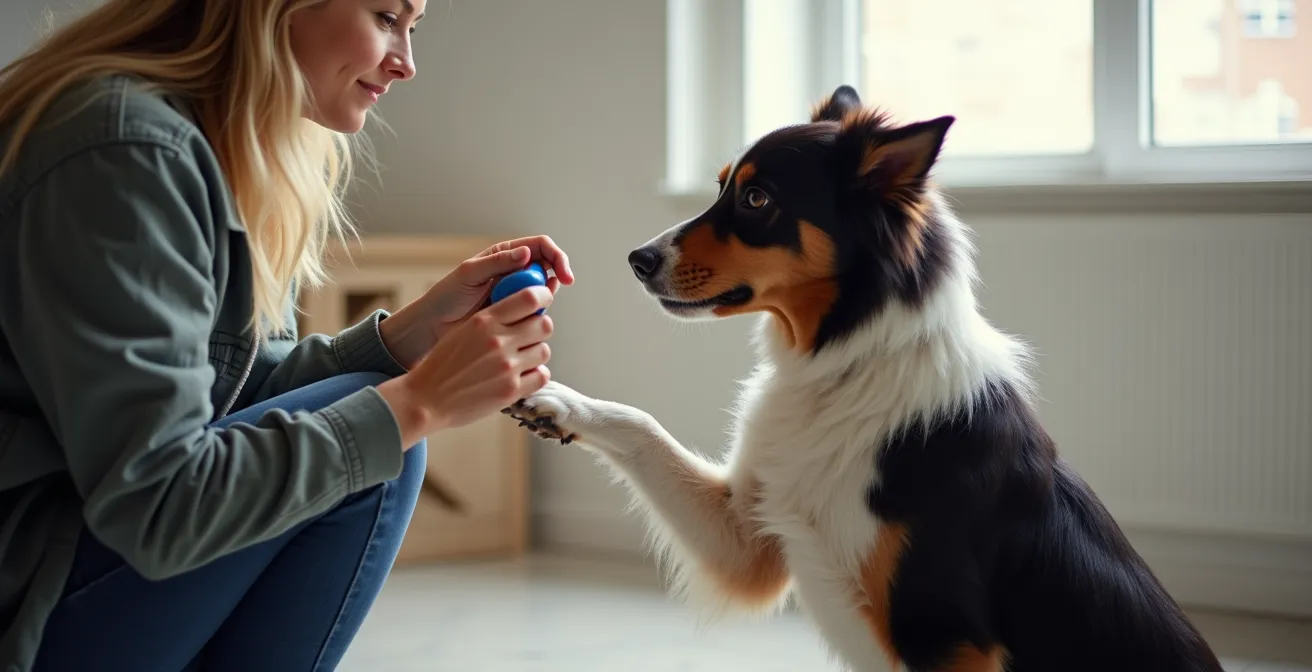
The clicker’s speed advantage isn’t philosophy; it’s pure mechanics, delivering a cleaner, faster data signal than the human voice.
- A click provides an instantaneous, unambiguous “yes” signal, eliminating the cognitive delay a dog experiences trying to interpret vocal tone and timing.
- It allows for the precise capture of fleeting micro-behaviors, building a complex skill from a clear, error-free blueprint.
Recommendation: Treat the clicker as a precision instrument for initial skill acquisition, not a permanent fixture, to build behaviors faster and with greater accuracy.
For the traditional trainer, the clicker—that small plastic “box”—can seem like an unnecessary gadget. You’ve trained dogs successfully for years with your voice, your hands, and your intuition. You understand timing and reinforcement. So, why complicate things? The common arguments about “positive training” often miss the point for a professional focused on results. The debate isn’t about being “kinder”; it’s about being more efficient.
The resistance is understandable. If verbal markers like “Yes!” or “Good” work, why add another tool to the chain? The answer lies not in a different training philosophy, but in superior engineering. The core advantage of a clicker over the voice is not emotional, but mechanical. It’s an issue of signal clarity, transmission speed, and data integrity. While the voice is an analog tool with inherent variability in tone, volume, and latency, the clicker is a digital switch. It is either on or off. This binary nature provides a razor-sharp event marker that is neurologically easier and faster for an animal to process.
This article will deconstruct the clicker from an engineering perspective. We will move past the dogma and analyze it as a tool. We will explore how to calibrate it, why its timing is less prone to “signal degradation” than a voice command, and how to use it to build a behavioral blueprint with maximum efficiency. We will also define the exact parameters for phasing it out, leaving you with a perfectly honed skill under verbal control, built in a fraction of the time. This is not about changing how you train, but about upgrading a single component for a massive gain in performance.
This guide provides a complete mechanical breakdown of this high-speed training tool. The following sections will guide you through each component, from initial calibration to advanced application and eventual decommissioning.
Table of Contents: A Mechanical Breakdown of High-Speed Training
- Classical Conditioning: How to Load the Clicker Correctly?
- Free Shaping: How to Get Your Dog to Offer Behaviors Creatively?
- Clicking Late: Why You Are Reinforcing the Wrong Action?
- When to Stop Clicking: Moving from Acquisition to Maintenance
- Touch: How to Guide a Dog Without Pulling the Leash?
- How to Time Your Click to Capture the Exact Behavior?
- Gee and Haw: Teaching Left/Right Before You Strap on Skis
- Liver vs. Kibble: Matching the Payment to the Difficulty of the Job
Classical Conditioning: How to Load the Clicker Correctly?
Before any tool can be used for precision work, it must be calibrated. In clicker training, this calibration process is called “loading the clicker.” This isn’t a mystical ritual; it’s a straightforward application of classical conditioning, the same principle discovered by Pavlov. The objective is to build a strong, reflexive association between the sound of the click and a high-value reward. The click, initially a neutral sound, must become a powerful predictor of reinforcement. Done correctly, this process is incredibly fast.
The goal is to forge an automatic emotional response. When the dog hears the click, it should instantly anticipate a reward. This isn’t a thought process; it’s a conditioned reflex. This automaticity is what gives the click its power as an event marker. It ends the “what did I do right?” guesswork for the dog and replaces it with a clear, instantaneous “that!” signal. To achieve this, the initial sessions should be short, rapid, and focused solely on creating this link.
Follow these foundational steps to properly calibrate your tool. The focus is on speed and creating an unmistakable link between the sound and the reward.
- Step 1: Start with a high-value reward. For initial calibration, a piece of kibble is insufficient payment. Use something potent like small cubes of roast chicken. Push and release the clicker to make the sound, then immediately provide the treat. The sequence is always click, then treat.
- Step 2: The click marks the moment; the treat is the payment that follows. During training, you must click during the desired action, not after. The click effectively ends the behavior. Don’t worry if the dog stops what it’s doing to look for the treat—that’s the desired effect. The timing of the treat itself is less critical than the timing of the click.
- Step 3: Once the dog reliably looks to you for a treat after hearing the click (often after just a dozen repetitions), you can begin asking for more. In a real training scenario, once a behavior is offered reliably, you start refining it. Wait for a slightly longer duration or a faster response before you click. This is how you use the calibrated tool to build the behavior’s blueprint.
Free Shaping: How to Get Your Dog to Offer Behaviors Creatively?
Once the clicker is calibrated, it becomes a powerful tool for a technique called “free shaping.” This is where the mechanical precision of the clicker truly outperforms the voice. Free shaping involves reinforcing successive approximations of a target behavior without any physical or verbal prompting from the handler. You are not telling the dog what to do; you are marking and rewarding the small, voluntary steps it takes toward the final goal. This method encourages a dog to think, experiment, and offer behaviors creatively.
For a traditional trainer, this may seem counter-intuitive. It feels like a loss of control. However, from a mechanical standpoint, you are simply shifting the source of the action from your command to the dog’s own cognitive process. The clicker acts as a highly specific data-capture device, allowing you to select and reinforce the exact moment the dog performs a piece of the desired behavior. For example, if you want to teach a dog to go to a mat, you might first click for a glance toward the mat, then for a step toward it, then for a paw on it, and finally for lying down on it.
This process builds a behavior that is stronger, more resilient, and better understood by the dog because the dog “invented” it. It reduces the handler’s physical input and teaches the animal to be an active participant in the training process, a problem-solver rather than a passive recipient of commands. The image below shows this exact moment of cognitive engagement, where the dog is actively problem-solving its interaction with an object.

This incremental process of building a new action from small, captured components is the essence of operant conditioning. As the founder of this training application, Karen Pryor, stated when describing this method:
This is called ‘shaping’ a behavior.
– Karen Pryor, Karen Pryor Clicker Training Guide
By using a precise marker, you construct the behavior piece by piece, resulting in a clean, reliable final product. The dog doesn’t just learn what to do; it learns the process of learning itself.
Clicking Late: Why You Are Reinforcing the Wrong Action?
The single greatest point of failure in marker training is timing. A late click is not just a missed opportunity; it is corrupted data. From a mechanical perspective, the click is a time stamp that says, “YES, what you did at this exact micro-second is what earned you the reward.” If that time stamp is off by even half a second, you are not marking the intended behavior. You are marking whatever the dog did *after* the intended behavior—looking at you, shifting its weight, or starting to stand up from a sit.
This is where the clicker’s engineering is superior to a verbal marker. The physical action of pressing the clicker has a lower latency than forming a word with your mouth. More importantly, the sound is a novel, high-contrast signal that is instantly recognizable. A verbal “Yes!” can be slurred, delayed by a breath, or have its meaning altered by your tone. The click is always the same. According to AKC experts, the value of the clicker is that it tells your dog exactly which behavior you’re rewarding. By clicking at the right moment, you ‘mark’ the precise action, removing all ambiguity. A dog trained with a precisely timed click learns to offer behaviors with a similar level of precision.
Reinforcing the wrong action leads to “superstitious” chains, where the dog believes it must perform the desired action *plus* the accidentally reinforced action (e.g., sit and then immediately pop back up). This introduces errors into the behavioral blueprint, which are much harder to correct later. The following table breaks down the mechanical consequences of correct vs. incorrect timing.
| Timing | What Gets Reinforced | Training Result |
|---|---|---|
| During behavior | Exact desired action | Fast, precise learning |
| After completion | Post-behavior movement | Confused, slower learning |
| Too early | Pre-behavior anticipation | Incomplete behaviors |
Mastering the timing of the click is non-negotiable. It is the core mechanical skill required to use the tool effectively. Practicing on inanimate objects or even other people can help hone the reaction time needed to capture behavior with the necessary precision.
When to Stop Clicking: Moving from Acquisition to Maintenance
A common misconception among those skeptical of the clicker is that it’s a permanent crutch. This is fundamentally incorrect. The clicker is a tool for behavior acquisition, not long-term maintenance. Its job is to build the initial, perfect blueprint of a behavior with speed and clarity. Once that blueprint is complete and the behavior is reliable on a verbal or visual cue, the tool’s primary job is done. Keeping it in the system for too long is like leaving scaffolding on a finished building—it’s unnecessary and gets in the way.
The industry-standard metric for knowing when to fade the clicker is the “80% rule.” When the dog performs the behavior correctly on cue at least 80% of the time (or 4 out of 5 repetitions) in various environments, the behavior is considered “acquired.” At this point, you can transition from the clicker to a verbal marker (like an enthusiastic “Yes!”) and move to a variable reinforcement schedule. The clicker’s job of providing a 1:1, perfectly-timed marker is complete.
However, the transition must be handled correctly. A critical error is to start using the clicker without delivering a treat. This breaks the foundational calibration (the classical conditioning) and devalues the tool. The click must always predict a reward. When you fade the clicker, you replace it with a verbal marker and begin to make the rewards themselves less predictable, which actually strengthens the behavior for long-term performance.
Case Study: Implementing the 80% Success Rule
A trainer working on a reliable “come” command used the clicker to mark the instant the dog turned and moved toward them. Once the dog was responding successfully on the verbal cue “come” in 4 out of 5 trials in the backyard, they stopped using the clicker for that specific skill. They transitioned to using a cheerful “Yes!” when the dog arrived and rewarded with a treat. As per expert advice, they avoided using the clicker without a treat to ensure the clicker remained an effective tool for teaching *new* skills in the future. This demonstrates the critical transition from the acquisition to the maintenance phase.
Action Plan: Phasing Out the Clicker
- Verify Reliability: Confirm the dog performs the behavior on the verbal/visual cue in at least 80% of trials across different, low-distraction environments.
- Introduce a Verbal Marker: Begin pairing a consistent verbal marker, like an enthusiastic “Yes!”, with the click just before you fade the clicker. Do this for a few sessions so the dog associates the word with the click.
- Swap Tools: Stop using the clicker for this specific, known behavior. Use only your verbal marker (“Yes!”) to indicate success at the moment the behavior is completed.
- Move to Variable Reinforcement: Stop giving a treat every single time. Reward the best, fastest, or most precise repetitions. Continue to use verbal praise and physical affection as reinforcement.
- Re-purpose the Clicker: Reserve the clicker for its primary job: building new behaviors or fixing broken ones. This preserves its value as a high-precision tool.
Touch: How to Guide a Dog Without Pulling the Leash?
One of the most powerful and versatile behaviors you can build with a clicker is a “touch” or hand target. This is a foundational “meta-skill” that acts as a building block for dozens of other, more complex behaviors. The behavior is simple: the dog learns to touch its nose to the palm of your hand on cue. From a mechanical standpoint, this creates a movable target that you can use to guide the dog’s movement without any physical force or leash pressure. It is the ultimate non-coercive guidance system.
The precision of the clicker is essential for teaching a clean hand target. You can click the exact moment the dog’s nose makes contact with your palm. This clarity allows the dog to quickly understand the exact goal. You start by presenting your hand close to the dog’s nose and clicking for any interaction—a sniff, a glance, a lick. Quickly, you raise the criteria to only click for nose-to-palm contact. The process is fast, and the result is a dog that will eagerly move toward your hand wherever you place it.
Once established, you can use the hand target to:
- Guide a dog onto a scale at the vet.
- Teach a “come” command by presenting the target and moving backward.
- Position a dog for grooming or examination.
- Teach spins, leg weaves, and other complex movements for dog sports.
- Move a dog away from a distraction without pulling on the leash.
This single skill replaces physical manipulation with voluntary cooperation. It transforms the dynamic from one of pulling and pushing to one where the dog is an active and willing partner in its own movement. The close-up detail required for this behavior is where the precision of the clicker shines.
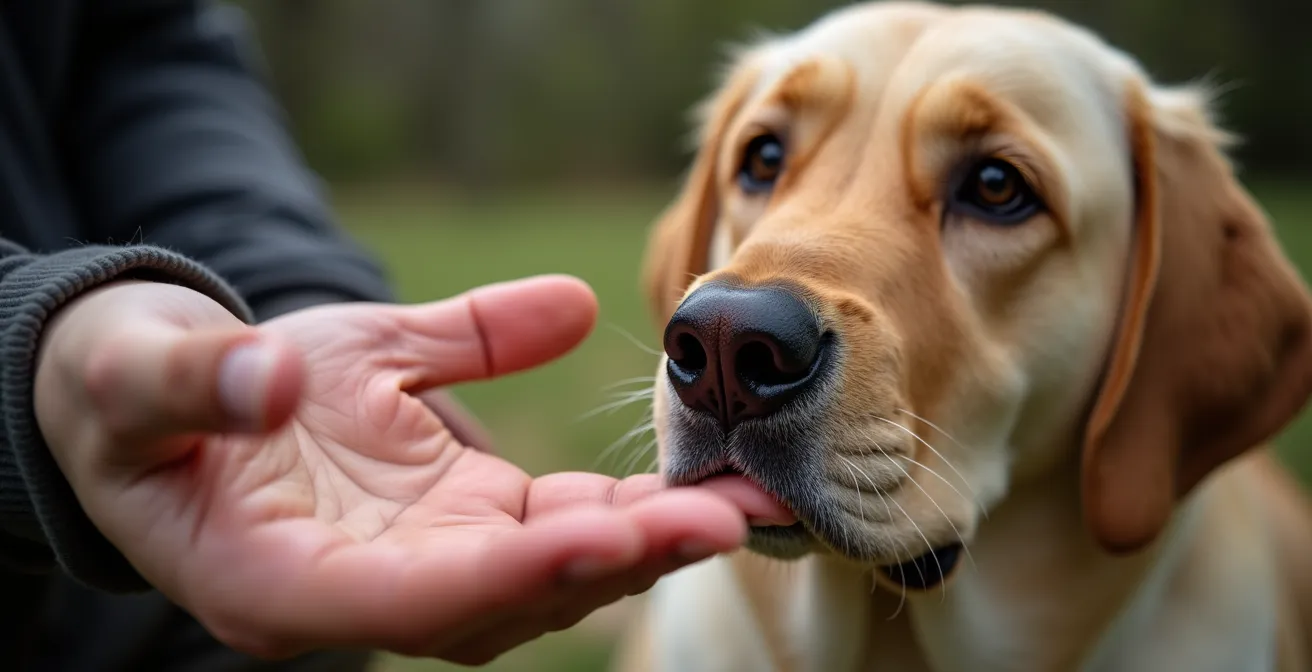
The target becomes a remote control for the dog’s head, and where the head goes, the body follows. It is an elegant mechanical solution to the common problem of physical management, built on a foundation of clear, precise communication.
How to Time Your Click to Capture the Exact Behavior?
The central debate for a skeptical trainer is often: is the clicker *really* better than a well-timed verbal marker? From a purely mechanical standpoint, the answer is yes, but with a critical caveat. The clicker’s primary advantage is its signal consistency and speed. The sharp, uniform sound is a distinct piece of data that is less likely to be confused with other environmental sounds or the handler’s everyday speech. It has a high signal-to-noise ratio. The physical act of pressing a button is often faster and more reflexive for a handler than formulating a word, reducing latency between the behavior and the marker.
However, the effectiveness of any marker—clicker or voice—hinges entirely on the handler’s ability to time it correctly and apply it consistently. The tool itself is inert; the skill is in the application. A poorly timed click is just as useless as a poorly timed “Yes!”. For trainers with excellent verbal timing and consistency, the practical difference may seem small. In fact, some scientific studies have shown that when applied with equal proficiency, the outcomes can be very similar.
For example, some scientific studies show that both clicker and verbal markers are roughly equally likely to result in the same learning speed. This confirms that the *principle* of marking an event is what matters most. A 2017 study from the University of Trieste, published in Psychology Today, tested groups of dogs on a novel task using a clicker, a verbal marker, or a visual signal. The researchers found absolutely no significant differences between the groups in learning success. The key takeaway is that the consistency of the marker is the critical variable, not the specific sound or tool.
So, why choose the clicker? Because it enforces that consistency. It is a tool designed for one job, which makes it easier for the *human* to deliver a consistent, low-latency signal every single time. It takes the variables of vocal tone, pitch, and timing out of the equation, allowing the trainer to focus solely on capturing the behavior. It is a tool for improving the handler’s mechanical skill.
Gee and Haw: Teaching Left/Right Before You Strap on Skis
For any work that requires the dog to operate at a distance, such as skijoring, canicross, or even advanced off-leash heeling, directional commands are essential. Teaching “Gee” (right) and “Haw” (left) is a classic example of building a complex, remote skill where the precision of a clicker is invaluable. You cannot use physical guidance when the dog is 10 feet ahead of you; you must rely on a perfectly understood verbal cue, built with a clear communication system.
A systematic, mechanical approach is the most effective way to build these behaviors. The “Clock Face Method” provides a clear blueprint for this process. It breaks down the environment into a predictable structure, allowing you to systematically teach the desired turns. The clicker is used to pinpoint the exact moment the dog commits its body in the correct direction, capturing the decision to turn right or left.
The training protocol is as follows:
- Establish a Baseline: Position your dog at the center of an imaginary clock face, with 12 o’clock being straight ahead. First, teach a simple “send-out” to a target placed at the 12 o’clock position.
- Introduce “Gee” (Right): Once the send-out is reliable, place a target at the 3 o’clock position. As the dog starts to move, say “Gee” and click/reward the instant it orients its body toward the right-hand target.
- Introduce “Haw” (Left): Repeat the process with a target at the 9 o’clock position for the “Haw” command, clicking the moment the dog commits to the left.
- Capture the Decision: The click must be precise. You are not clicking when the dog reaches the target, but at the moment of commitment—the head turn, the shoulder shift—that indicates the correct directional choice.
- Practice and Proof: Practice extensively in a controlled environment, gradually removing the targets so the dog responds to the verbal cue alone. Only then should you introduce the distractions of speed and an outdoor environment.
This systematic approach uses the clicker to build the behavior in discrete, understandable components. Once the dog understands the verbal cues, they are reliable even when the handler’s body language is unreadable or the environment is noisy. It’s a prime example of building a high-performance skill from a precise, mechanical foundation.
Key Takeaways
- The clicker’s primary advantage is its mechanical precision and speed, providing a clearer signal than the human voice.
- Timing is the most critical skill; a late click reinforces the wrong behavior and corrupts the learning process.
- The clicker is a tool for initial skill acquisition and should be faded once a behavior is reliable on a verbal cue (the 80% rule).
Liver vs. Kibble: Matching the Payment to the Difficulty of the Job
In any performance-based system, the payment must match the work required. In dog training, rewards are the currency, and not all rewards hold the same value. Using a piece of dry kibble to reward a life-saving recall from a major distraction is like paying a master mechanic minimum wage for rebuilding an engine. It’s an insult to the effort and will degrade future performance. A systematic approach to reinforcement requires creating a hierarchy of rewards.
The clicker marks the behavior, but the reward that follows determines the motivation to repeat it. High-value treats, such as liver, cheese, or cooked chicken, should be reserved for breakthroughs, difficult tasks, or performances in highly distracting environments. Low-value treats, like the dog’s daily kibble, are appropriate for practicing already-known behaviors in a sterile environment. As Dr. Kathryn Dench of Gentle Dog Trainers notes, high-value treats should be small, tasty, and something your pet loves, and varying them can prevent boredom.
This concept, known as creating a reinforcement hierarchy, allows the trainer to communicate the value and difficulty of the task to the dog. It’s another layer of information. A dog that receives kibble for a simple “sit” at home and a piece of steak for coming back when chasing a squirrel learns that recall is an extremely high-value action. The table below provides a clear mechanical framework for matching the reward to the task.
| Task Difficulty | Appropriate Reward | Examples |
|---|---|---|
| Easy/Known | Low-value (kibble) | Basic sit, down, stay in familiar environment |
| Moderate/New | Medium-value (training treats) | Learning new trick, adding duration |
| Difficult/Breakthrough | High-value (liver, cheese) | First successful recall from distraction |
| Life Rewards | Environmental (Premack) | Sniffing after stay, play after heel |
Thinking like a mechanic means managing your entire system, and the fuel is as important as the engine. Failing to match payment to the difficulty of the job is a common failure point that leads to a lack of motivation and unreliable performance when it matters most.
By treating the clicker as a precision instrument and the reward as a calculated payment, you shift from simply “training a dog” to engineering a reliable, high-performance behavior. The next step is to integrate this mechanical mindset into every aspect of your training program for maximum efficiency and clarity.