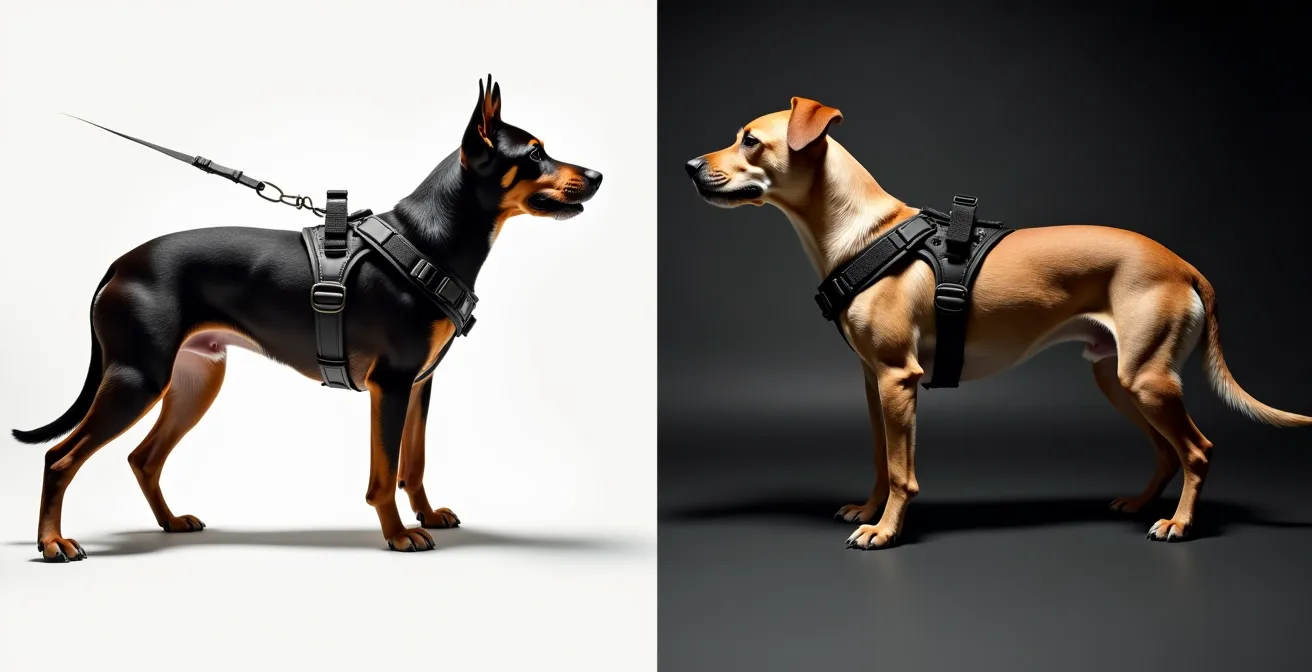
Contrary to popular belief, the ‘Y vs. T’ shape of a harness is not the most critical factor in shoulder restriction; the physics of the pull point and the harness’s dynamic fit during movement are far more significant.
- Scientific studies show that even ‘non-restrictive’ Y-harnesses can significantly reduce shoulder extension, sometimes more than T-shaped harnesses.
- Proper harness fit must be assessed dynamically (while the dog is trotting), as static fitting can hide major rubbing and movement issues.
Recommendation: Shift your focus from harness shape to function. Prioritize a harness that allows at least three fingers’ width of clearance behind the elbow and choose a pull point (front or back clip) that matches your handling goals.
As a dedicated owner of an active dog, you notice the subtle shifts—a slightly altered gait after a long hike, a hesitation before a jump, or a new reluctance to put on their walking gear. You’ve done your research, and the internet presents a fierce debate: the Y-harness, lauded for freeing the shoulders, versus the T-harness (or Norwegian style), often villainized for restricting them. The common advice is to “choose a Y-harness” and “ensure a good fit,” but this guidance is dangerously simplistic.
What if the entire Y vs. T argument is a red herring? What if the key to your dog’s comfort and long-term joint health lies not in the shape of the straps, but in a deeper understanding of biomechanics? The real factors—pull point physics, rib cage clearance, and a concept we’ll call dynamic fit—are where the truth about safety and restriction is found. The latest scientific evidence challenges long-held assumptions, revealing that the harness you thought was “safe” could be creating the very problem you’re trying to avoid.
This article will move beyond the superficial shape debate. We will dissect the mechanical forces at play, explore equipment designed for specific anatomical needs, and provide a clear framework for selecting gear. By understanding the principles of canine ergonomics, you can protect your dog from injury and ensure every walk is a source of joy, not discomfort.
To navigate these crucial topics, this guide is structured to address the most pressing questions about canine walking equipment, from foundational safety to the intricate physics of harness design. Explore the sections below to build a comprehensive understanding.
Summary: The Surprising Truth About Shoulder Restriction in Dog Harnesses
- Why Every Dog Should Be Muzzle Trained Before an Emergency?
- The 5-Meter Leash: Giving Freedom Without Losing Control
- Wide vs. Narrow: Why Sighthounds Need Special Collars?
- The No-Slip Collar: Preventing Escape for Heads Smaller Than Necks
- Halti vs. Gentle Leader: The Risk of Neck Injury if Misused
- Collar vs. Harness: Protecting the Trachea of a Pomeranian
- Rib Cage Clearance: How to Ensure the Harness Doesn’t Rub?
- Pull Point Physics: Why a Walking Harness Chokes a Pulling Dog?
Why Every Dog Should Be Muzzle Trained Before an Emergency?
Before we delve into the complexities of harness biomechanics, we must address a foundational aspect of safety: proactive preparation. A dog in pain from an ill-fitting harness or a related injury is more likely to bite, even if they have a gentle temperament. Muzzle training is not about managing an “aggressive” dog; it’s an essential life skill that ensures safe handling by you or a veterinarian during a high-stress emergency. It is a core component of responsible equipment use and overall preparedness.
Waiting for an injury to happen before introducing a muzzle adds immense stress to an already painful situation. The goal is to create a positive association with the muzzle long before it’s needed. Through gradual, treat-based conditioning, the muzzle can become just another piece of gear, like a leash or harness, that signals a positive experience is coming. This training is an act of foresight that protects everyone involved and allows for calm, effective care when it matters most.
This proactive mindset extends to all equipment. Regular checks for wear and tear, signs of chafing, or changes in your dog’s behavior are non-negotiable. A comprehensive approach to safety involves not only choosing the right gear but also preparing for the possibility of its failure or a related injury.
Action Plan: Emergency Preparedness for Equipment-Related Issues
- Ensure the harness fits with at least 3 fingers’ width behind the dog’s elbow to prevent armpit irritation.
- Check your dog’s Body Condition Score regularly, maintaining a 4-5 out of 9 on the Purina scale for optimal physical condition and proper harness fit.
- Inspect the dog’s skin and fur for signs of chafing or movement restriction during every post-walk grooming or health check.
- Train positive associations with a muzzle before an emergency occurs, using high-value, treat-based conditioning.
- Document any harness-related discomfort behaviors, such as refusing to wear equipment, stopping on walks, or an altered gait, to share with your vet.
Thinking ahead with tools like muzzles and regular fit checks lays the groundwork for a safe and enjoyable active life with your dog.
The 5-Meter Leash: Giving Freedom Without Losing Control
The choice of leash is intrinsically linked to harness function. A standard 6-foot leash often creates tension, as it provides little room for natural exploration. A 5-meter (approximately 16-foot) leash, however, allows a dog to sniff and roam, fulfilling their natural behaviors without pulling the handler off-balance. This freedom is not a loss of control; it is a change in dynamics. Control comes not from a short, tight line, but from understanding the physics of the attachment point on the harness.
This is where the front-clip versus back-clip debate becomes critical. Research confirms that the attachment point dramatically alters pulling behavior. As one study on pulling forces demonstrated, dogs pull with significantly more force when connected to a back-clip harness. This is because the back clip aligns the leash with the dog’s center of gravity, granting them maximum leverage to pull forward. Conversely, a front-clip harness acts as a redirection point. When the dog pulls, the force turns them sideways, disrupting their forward momentum without applying corrective pressure. This protects the handler’s shoulders and back while managing the pulling behavior more effectively.
The following illustration shows the radius of exploration a dog can enjoy on a longer leash, allowing for a more relaxed walk while the handler maintains control through the harness’s physics.

Understanding these dynamics is key to using a longer leash successfully. It allows you to give your dog enriching freedom while the harness’s design does the work of maintaining control.
The choice of attachment point is a strategic decision based on your training goals and your dog’s behavior, as this table illustrates.
| Attachment Type | Physics of Control | Best Use Case | Freedom of Movement |
|---|---|---|---|
| Front-clip Y-harness | Redirects pulling motion sideways | Training & behavior management | Full shoulder extension maintained |
| Back-clip harness | Dog pulls with full body weight | Well-trained dogs, casual walks | Unrestricted but enables pulling |
| Dual-clip harness | Versatile control options | Transitioning from training to everyday | Depends on clip used |
Ultimately, a longer leash paired with the correct attachment point can transform a tense walk into a cooperative and enriching experience for both dog and handler.
Wide vs. Narrow: Why Sighthounds Need Special Collars?
The principle that equipment must match anatomy is most obvious in sighthounds like Greyhounds and Whippets. Their long, slender necks and heads that are smaller than their necks make standard collars both ineffective and dangerous. A sighthound can easily slip out of a regular collar, creating a serious escape risk. This is why wide, “fishtail” collars were developed. The wider surface area distributes pressure more evenly across the neck, reducing the risk of injury to the delicate trachea. More importantly, when fitted correctly, the design prevents the collar from slipping over the dog’s narrow head.
This concept of specialized fit extends beyond sighthounds. Every breed has unique anatomical considerations. For example, brachycephalic (short-nosed) breeds like French Bulldogs have different needs. In fact, biomechanical research indicates that a French Bulldog’s shoulder blade makes up 31% of its total forelimb length, a significant proportional difference compared to other dogs. This unique structure impacts how a harness fits and functions on their body. A harness that works perfectly on a Labrador may rub or restrict a French Bulldog’s movement due to their wider chest and distinct shoulder assembly.
The sheer variety of materials and designs can be overwhelming for any owner. As one expert notes, the choice is not always clear.
Harnesses with straps made of nylon webbing, leather, microfiber and denim… It’s difficult to know which design is the best for your dog.
– Dr. M. Christine Zink, D.V.M., PH.D., Dog World magazine
The key takeaway is to look past generic labels and assess how a piece of equipment interacts with your specific dog’s body shape, from neck structure to shoulder placement.
Choosing the right width and design is not a matter of fashion; it is a fundamental requirement for the safety and comfort of dogs with non-standard body types.
The No-Slip Collar: Preventing Escape for Heads Smaller Than Necks
Beyond sighthounds, many dogs possess a “Houdini”-like ability to escape their harnesses. This is especially common in anxious dogs or those with narrow chests and flexible bodies. For these escape artists, a standard two-strap harness can be a liability. A popular solution is the “escape-proof” or three-strap harness, which adds a crucial third strap around the dog’s abdomen, behind the rib cage. This design makes it nearly impossible for a dog to back out of the harness, providing a vital layer of security.
The Ruffwear Web Master Harness is a well-known example of this concept. Its design incorporates a padded belly strap and five adjustment points to create a secure, form-fitting system. This third strap not only prevents escape but also provides additional support, which can be useful for assisting dogs over obstacles on a trail. The padded straps ensure it remains comfortable for extended wear, a key feature for all-day adventures or for dogs who need to wear a harness consistently.
The image below highlights the positioning of the third strap and the quality of the padding, which are essential for both security and comfort.
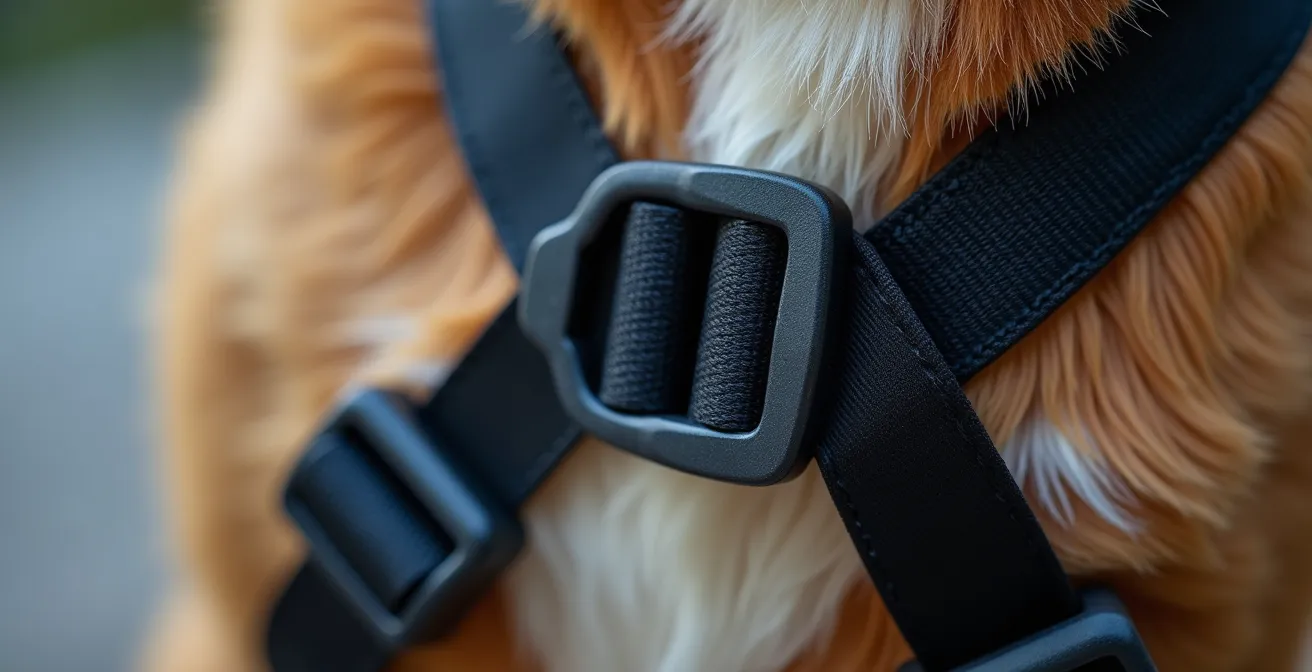
However, this added security comes with a biomechanical compromise. The third strap sits over the dog’s lumbar region (loin), an area of high flexibility. While it prevents escape, it can affect the natural flexion and extension of the spine during running or jumping. Therefore, while a three-strap harness is an excellent tool for anxious dogs or known escapees in urban environments, it may not be the ideal choice for a highly athletic dog competing in sports that require maximum spinal flexibility. The choice, as always, depends on balancing security needs with functional freedom.
For a dog prone to escape, the security offered by a three-strap harness far outweighs the minimal impact on movement for everyday walks, making it a responsible and life-saving choice.
Halti vs. Gentle Leader: The Risk of Neck Injury if Misused
When pulling is a significant issue, many owners turn to headcollars like the Halti or Gentle Leader. These tools are designed to work on the principle of “power steering”: where the head goes, the body will follow. A strap sits over the dog’s muzzle, and when the leash is gently pulled, it guides the dog’s head to the side or downwards, redirecting their focus and momentum. They are often presented as a humane alternative to aversive tools like choke or prong collars.
Indeed, research from the Journal of the American Veterinary Medical Association highlights the problems with traditional aversive collars.
Choke and prong collars have been associated with more pronounced behavioral indicators of stress and lower owner satisfaction with the dog’s lead-walking behavior.
– Veterinary research team, Journal of the American Veterinary Medical Association
While headcollars avoid direct pressure on the trachea, they introduce their own set of risks if misused. The cervical spine (neck) is a complex and delicate structure. A sudden jerk on a headcollar, whether from the handler or the dog lunging at a squirrel, can cause a dangerous whiplash-like injury. These tools require finesse and should never be used with a long line or retractable leash where a high-velocity impact is possible. They are intended for gentle guidance, not forceful correction. Proper conditioning is also vital, as many dogs find the sensation of a strap on their face aversive without positive introduction.
For a strong puller, a headcollar can be a transformative training aid in the right hands, but it must be paired with positive reinforcement training to address the root cause of the pulling, not just manage the symptom.
Collar vs. Harness: Protecting the Trachea of a Pomeranian
For small and toy breeds like Pomeranians, Chihuahuas, or Yorkshire Terriers, the collar versus harness debate is not about shoulder movement—it’s a matter of life and death. These breeds are highly susceptible to tracheal collapse, a chronic condition where the cartilage rings of the windpipe weaken and flatten, causing a harsh, honking cough and difficulty breathing. Any pressure on the neck from a collar, especially if the dog pulls, can exacerbate or even contribute to this devastating condition.
For this reason, a well-fitting harness is not optional; it is a medical necessity. The primary goal is to transfer all leash pressure away from the neck and onto the dog’s chest and rib cage. However, not just any harness will do. The equipment must be proportional to their tiny frame. When selecting a harness for a toy breed, consider the following:
- Measurement is Key: Measure at the base of the neck where it meets the shoulders and the widest part of the chest, just behind the front legs.
- Material Matters: Choose breathable mesh materials to prevent overheating, as small dogs can be more sensitive to heat.
- Proportional Straps: Verify that the strap width is narrow and appropriate for a small dog. Overly wide straps can be bulky and restrict movement.
- Lightweight Hardware: Select harnesses with small, lightweight buckles and D-rings to avoid adding unnecessary weight to a 5-pound frame.
- The Two-Finger Rule: After adjusting, you should be able to comfortably slip two fingers (held flat) between the harness and the dog’s body at all points of contact.
This focus on safety and comfort reflects a broader trend among pet owners. Market research shows that as owners increasingly view pets as family, a significant percentage are prioritizing products designed for walking comfort. For a toy breed, this comfort is directly tied to their respiratory health.
Switching from a collar to an appropriate harness is one of the most important preventative health decisions an owner of a small-breed dog can make.
Rib Cage Clearance: How to Ensure the Harness Doesn’t Rub?
One of the most common harness complaints is chafing or rubbing, particularly in the sensitive area behind the front legs (the dog’s “armpits”). This is almost always a problem of fit, specifically a lack of adequate rib cage clearance. A harness that sits too close to the front legs will inevitably rub with every stride, causing skin irritation, hair loss, and pain. The golden rule is to ensure there is a gap of at least three fingers’ width between the back of the harness strap and the dog’s elbow.
However, checking this on a stationary dog is not enough. This brings us to the crucial concept of dynamic fit. A harness can appear to fit perfectly when a dog is standing still, only to slide forward and cause problems once the dog starts moving. A groundbreaking gait analysis study using 3D motion capture technology confirmed this. The research revealed that a harness’s impact on the shoulder’s range of motion and its potential to rub only became apparent when the dogs were trotting. In a static position, these issues were hidden. To properly assess fit, you must watch your dog walk and trot, observing if the harness stays in place or shifts forward with each extension of the front leg.
Material choice also plays a role in preventing chafing, especially for dogs with sensitive skin or for use in wet conditions. Different materials have vastly different properties regarding heat retention, water absorption, and friction.
| Material Type | Heat Retention | Water Absorption | Friction When Wet | Best Use Case |
|---|---|---|---|---|
| Open-cell foam | High | High | Moderate | Short walks, dry conditions |
| Closed-cell foam | Moderate | Low | Low | Water activities, all-weather |
| Fleece lining | Low | 1% of weight | Very low | Sensitive skin, long wear |
| Neoprene | High | Very low | Low | Water sports, heavy activity |
By assessing fit in motion and selecting materials appropriate for your dog’s activity level and skin sensitivity, you can eliminate chafing and ensure the harness remains a tool of comfort, not a source of pain.
Key Takeaways
- Dynamic Fit is Crucial: A harness’s true fit and potential for restriction can only be evaluated when the dog is in motion, not standing still.
- Physics Over Shape: The attachment point (front-clip vs. back-clip) has a greater influence on control and pulling behavior than the Y- or T-shape of the straps.
- Anatomy is Paramount: Equipment must be chosen to match the specific anatomical needs of the dog, from a sighthound’s neck to a toy breed’s trachea.
Pull Point Physics: Why a Walking Harness Chokes a Pulling Dog?
We arrive at the heart of the matter and the most counter-intuitive finding in modern canine ergonomics. The term “walking harness” is often a misnomer. Many harnesses, particularly those with a high neck line and a back attachment point, can actually function like a collar and apply pressure to the throat when a dog pulls. As the dog lunges forward, the leash pulls the entire harness forward and upward, cinching the front straps directly against the trachea. This is the exact problem harnesses are supposed to prevent. This dangerous dynamic is a function of pull point physics.
The widespread belief is that a Y-shaped harness is inherently “non-restrictive.” This assumption has been directly challenged by science. A groundbreaking study from the Royal Veterinary College compared shoulder movement in dogs wearing a “restrictive” T-harness and a “non-restrictive” Y-harness. The results were shocking: the Y-harness, thought to be superior, actually reduced shoulder extension more than the T-harness during both walking and trotting. This finding doesn’t mean T-harnesses are better; it means our entire framework for evaluating harnesses has been too simplistic. It proves that the specific cut, fit, and forces applied are far more important than the general shape.
This complexity has not stopped the market from booming, with the global front-clip harness market demonstrating significant growth driven by owners’ desire for safer tools. Yet, this data highlights a market responding to a simplified narrative, not the complex biomechanical reality. The RVC study forces us to ask a better question: not “Is this a Y or a T?” but “Where does this specific harness sit, how does it move, and where does it apply pressure when my dog pulls?”
Ultimately, your role as an owner is to become a critical observer. Watch your dog move. Feel where the straps tighten when you apply leash pressure. Prioritize rib cage clearance and choose a pull point that aligns with your training goals. By focusing on these functional principles instead of marketing labels, you can truly select a harness that ensures your dog’s safety and freedom of movement.