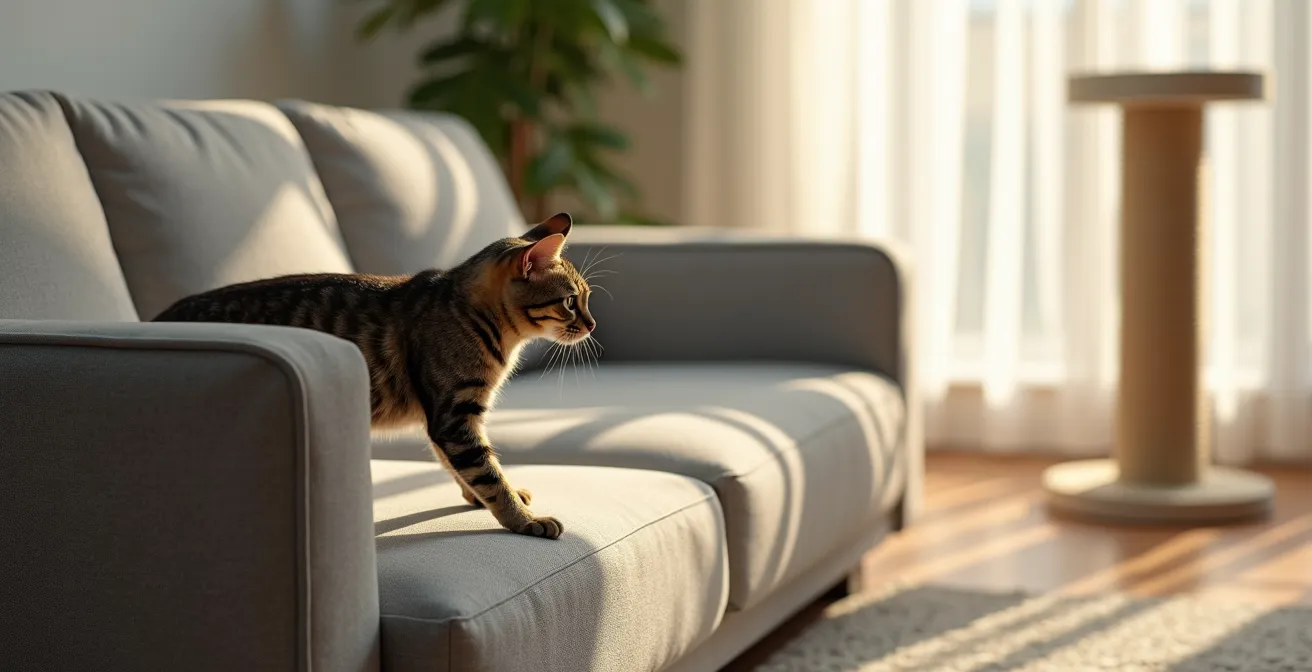
It’s a common belief that a cat scratching furniture despite having a post is an act of defiance. The reality is far more practical: your sofa is simply a better tool for the job. This isn’t a training problem; it’s an equipment problem. Your cat isn’t ignoring the post to spite you; it’s rejecting an object that fails to meet its deep-seated instinctual needs for stability, texture, and location. The solution lies in understanding your cat’s unique “scratching blueprint” to provide a post that is functionally superior to your furniture.
The sight is painfully familiar to many cat owners: a perfectly good, sometimes expensive, scratching post sits untouched in the corner while the arm of the sofa is slowly reduced to a pile of shredded fabric. You followed the advice. you provided the “correct” outlet for a natural behavior, yet the destruction continues. It’s easy to feel frustrated and conclude your cat is stubborn, picky, or simply being destructive for the sake of it. This is a common and understandable feeling for a frustrated owner whose furniture is ruined.
The conventional wisdom often stops at “buy a scratching post” or “trim their nails.” But these solutions fail to address the core of the issue. The problem isn’t that your cat *won’t* use a post; it’s that the post you’ve provided is, from your cat’s perspective, a poor substitute for the highly effective scratching tool that is your sofa. Scratching is a complex, non-negotiable behavior driven by instinct—it’s for nail health, muscle stretching, and, most importantly, scent and visual marking of territory.
But what if the key wasn’t about discipline, but about environmental design? What if, instead of trying to change the cat, you changed the post to be objectively better than the furniture? As a feline environmental consultant, my perspective is that we must decode what makes the sofa so appealing and then replicate those qualities in an appropriate object. It’s about providing a solution that fulfills their instinctual needs so completely that the furniture becomes obsolete.
This guide will walk you through the process of building your cat’s unique “scratching blueprint.” We will deconstruct the essential elements of a successful scratching environment, from material and location to stability and social significance. By understanding these factors, you can finally offer a solution that works *with* your cat’s nature, not against it, saving both your furniture and your peace of mind.
text
To help you navigate this process, we have structured this guide to address every critical aspect of your cat’s scratching needs. The following table of contents will guide you through each step of becoming a feline environmental expert for your own home.
Summary: Decoding Your Cat’s Scratching Blueprint to Save Your Sofa
- Sisal vs. Carpet: Which Material Do Adult Cats Actually Prefer?
- Where to Position Scratching Posts Relative to Sleeping Zones?
- How to Use Double-Sided Tape to Redirect Scratching in 3 Days?
- When to Replace a Post: The Shredded Rope Signal
- Cardboard Flats vs. Tall Poles: Which for a Cat Who Stretches?
- Sisal vs. Wood: Providing Texture Variety on the Tree
- Scissors vs. Clippers: Why Cutting Mats Is Dangerous?
- Why One Cat Tree Is Not Enough for Two Cats?
Sisal vs. Carpet: Which Material Do Adult Cats Actually Prefer?
The first step in our environmental audit is to analyze materials. Many commercial scratching posts are covered in soft carpet, a choice that seems logical to humans but is often confusing for cats. A cat cannot easily distinguish between the “good” carpet on the post and the “bad” carpet on your floor or furniture. This mixed messaging is a common reason for failure. The ideal material allows for a satisfying, shreddable experience without creating this confusion.
This is where sisal rope demonstrates its functional superiority. Its rough, fibrous texture is perfect for catching and shedding the outer husk of a cat’s claw, a primary function of scratching. Unlike carpet, it offers resistance and shreds in a way that provides clear visual evidence of a cat’s territorial claim—those satisfying frayed strands are a mark of a well-used and loved post. Wood is another excellent option, as it most closely mimics what a cat would use in nature.
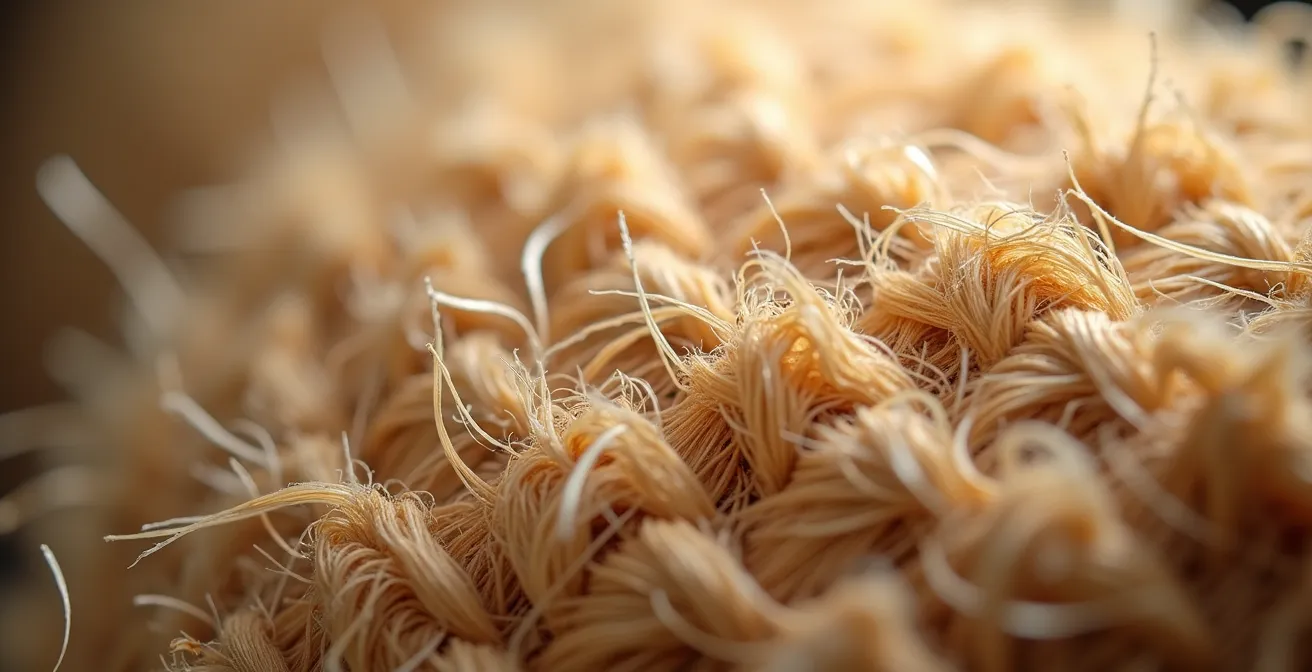
Observing your cat’s current preferences is crucial to building their unique scratching blueprint. Do they gravitate towards the woven texture of the sofa arm, the wooden leg of a table, or a cardboard box left on the floor? Each choice is a clue. Providing a variety of textures at first can help you pinpoint what your cat finds most irresistible. A post wrapped in durable sisal rope is almost always the best starting point for this material audit.
Your Action Plan: Auditing Your Cat’s Scratching Blueprint
- Analyze Damage Patterns: Examine existing scratch spots. Does your cat prefer vertical surfaces like the side of the couch, or horizontal ones like a rug? Note the material—is it fabric, wood, or something else?
- Conduct a Material Test: Offer several small, inexpensive scratchers made of different materials side-by-side: sisal rope, corrugated cardboard, natural wood, and even a carpet remnant. See which one they gravitate towards.
- Observe Stretching Style: Watch your cat after they wake from a nap. Do they perform a long, full-body vertical stretch? This is a strong indicator they need a tall, sturdy post.
- Assess Stability Requirements: Note if they choose the unmoving, heavy sofa over a wobbly chair leg. A post that tips or wobbles will be rejected, as it erodes their confidence.
- Map High-Value Territories: Identify where scratching occurs. Is it near their sleeping area, by a window, or in a central, social part of the home? This map will guide your placement strategy.
Where to Position Scratching Posts Relative to Sleeping Zones?
You can have the perfect post, made of the most irresistible material, but if it’s hidden in a basement corner, it will likely go unused. Placement is not an afterthought; it is a strategic decision rooted in feline social behavior. Cats scratch in prominent locations to leave a clear message: “This is my territory.” A post hidden away serves no purpose for this public declaration.
Think of scratching posts as communication hubs. They should be placed in areas of high value to your cat. One of the most critical locations is near their preferred sleeping areas. Cats have a powerful instinct to stretch and scratch immediately upon waking to flex their muscles and mark their territory. Placing a post right next to their bed intercepts this instinct and provides an immediate, appropriate outlet for it.
Another key area is adjacent to the very furniture they are currently destroying. By placing a functionally superior post directly next to the targeted sofa arm, you are not just offering an alternative; you are offering a better choice in the exact location where the instinct strikes. Finally, posts should be in socially significant areas of the home—the living room where the family gathers, or near entryways. A post in these spots allows your cat to integrate their scent mark with that of the family, reinforcing their sense of belonging and security.
The following table, based on expert observations, breaks down the effectiveness of different placement strategies to help you optimize your home environment.
| Location | Effectiveness | Reason |
|---|---|---|
| Next to damaged furniture | High | Place a scratching post near each item of furniture your cat likes to scratch so they are always near a more suitable option |
| Near sleeping areas | High | Some cats may like a scratching post near their bed, as they may want toscratch right after they wake up |
| Social/family areas | High | Cats prefer resources to be placed somewhat close to other household members |
| Hidden corners | Low | Don’t hide a scratching post in a secluded area if you want your cat to use it |
How to Use Double-Sided Tape to Redirect Scratching in 3 Days?
Once you’ve provided a functionally superior scratching post in a strategic location, you need a way to make the old, inappropriate target—the sofa—less appealing. This is where deterrents come in, but they must be used as a temporary teaching tool, not a permanent punishment. The goal is to make the furniture unpleasant to touch for a short period while simultaneously making the new post highly attractive.
Double-sided tape is an excellent tool for this. The sticky sensation is unpleasant on a cat’s paws, but it’s harmless and doesn’t create fear or anxiety the way a spray bottle might. It simply makes the surface non-viable for scratching. The best way to train your cat not to scratch furniture is to provide them with a better scratching surface, like a post, and place it strategically. By applying the tape to the exact spots your cat targets, you create a clear, passive boundary.
The key to success is the “redirect” part of the equation. As soon as the tape is on the furniture, the new, attractive post (with its superior sisal texture and sturdy build) must be placed directly adjacent. You can make it even more alluring by rubbing it with catnip or using a pheromone spray. When your cat approaches the sofa and is deterred by the tape, they will immediately encounter a far more satisfying alternative. Rewarding them with praise or a treat the moment they use the new post solidifies this positive association. This protocol turns a negative “no” into a positive “yes, right here!”
3-Day Furniture Redirection Protocol
- Day 1 (Apply & Place): Apply strips of double-sided sticky tape to all currently scratched areas of your furniture. Place your new, highly attractive scratching post immediately next to these taped zones.
- Day 1-3 (Attract & Encourage): Rub catnip or spray a feline attractant onto the new post to encourage your cat to investigate it. This makes the “legal” alternative more appealing than just neutral.
- Day 2-3 (Observe & Reinforce): When you see your cat use the new post, immediately provide positive reinforcement. This can be verbal praise, a gentle pet, or their favorite treat. This links the new post with a positive outcome.
- Day 4+ (Assess & Remove): After a few days of consistent use of the new post, you can test removing one piece of tape. If the cat continues to ignore the furniture, you can gradually remove the rest.
- Maintenance (If Needed): If your cat reverts to the old spot, simply reapply the tape. Keep the deterrents in place as long as needed to break the old habit and solidify the new one.
When to Replace a Post: The Shredded Rope Signal
From a human perspective, a scratching post that is shredded, torn, and unsightly looks like it’s ready for the trash. We value things that are new and pristine. But from a feline environmental consultant’s view, a well-shredded post is a sign of success, not failure. It is a communication board covered in victorious messages, a tapestry of territorial claims woven with your cat’s own scent.
A shredded post is a comfortable, familiar object. The frayed sisal is easier to grip, allowing for an even more satisfying scratching session. Throwing it away is like deleting your cat’s favorite saved game or tearing down their proudest artwork. It removes a vital piece of their environmental security and can cause stress, potentially driving them right back to the sturdy, ever-present sofa.
This is where the expert advice becomes counter-intuitive but crucial. As the ASPCA notes, a post’s visual appeal to you is irrelevant compared to its functional value to your cat.
Do not throw away a favorite scratching post when it becomes unsightly. Cats prefer shredded and torn objects because they can really get their claws into the material.
– ASPCA, ASPCA Cat Care Guidelines
So, when *should* you replace a post? The signal for replacement is not aesthetics, but stability. A post should only be retired when its base wobbles, when it can no longer support your cat’s full body weight as they lean into a stretch, or if the core structure is compromised. A wobbly post is a dangerous post, one that erodes confidence. Until that point, a shredded post is a successful post. If the appearance truly bothers you, place a new post next to the old, beloved one and allow your cat to transition at their own pace.
Cardboard Flats vs. Tall Poles: Which for a Cat Who Stretches?
The final element of your cat’s “scratching blueprint” is orientation. Does your cat prefer to scratch vertically, like on the arm of a sofa, or horizontally, like on a doormat or the top of a stair? Many owners provide only one type of post, typically a vertical one, without considering that their cat might be a dedicated horizontal scratcher.
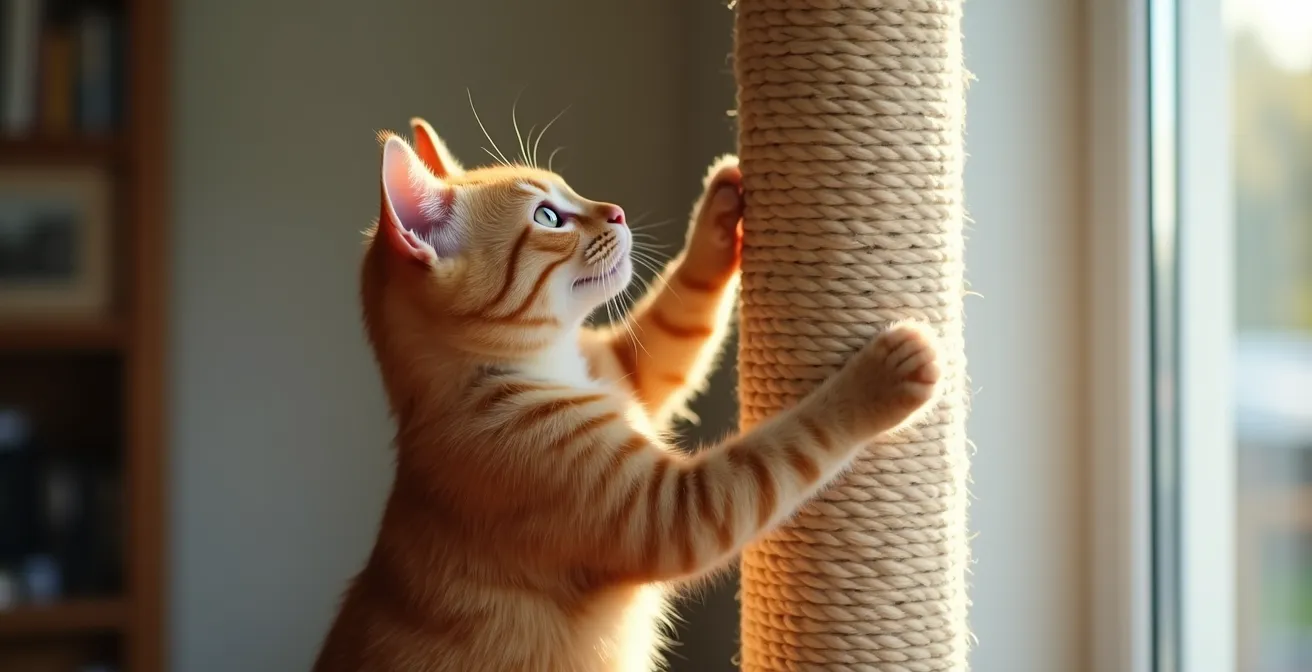
A cat who loves a full-body stretch is sending a clear signal: they need a tall, sturdy, vertical pole. This behavior is not just about nail care; it’s the feline equivalent of a deep yoga stretch, aligning the spine and working the muscles of the back and shoulders. For this, a post must be tall enough for them to fully extend their body without reaching the top, and it absolutely must not wobble. Research shows that cats under 9 years old most often preferred cat trees (75.8%) and simple vertical posts (69.0%), highlighting the importance of verticality for many cats.
On the other hand, some cats are ground-level scratchers. They prefer the stability of a horizontal surface. For these cats, flat cardboard scratchers or low-angled posts are ideal. They provide the necessary resistance and texture at an angle that feels secure. Offering both vertical and horizontal options is the best way to ensure you meet your cat’s specific needs.
Understanding the difference in function is key to making the right choice for your cat’s specific stretching and scratching style. This comparison can help clarify which type of surface will be most successful in your home.
| Surface Type | Best For | Key Benefits |
|---|---|---|
| Tall Vertical Posts (32+ inches) | Full-body stretchers | Most cats prefer a scratching post that is at least 32 inches tall, will not wobble when scratched |
| Horizontal Scratchers | Ground scratchers | Some cats prefer to scratch horizontally, in which case you can place the vertical post on its side or find a horizontal scratcher |
| Angled/Incline Options | Mixed preference cats | Combines benefits of both vertical stretch and horizontal stability |
Sisal vs. Wood: Providing Texture Variety on the Tree
While sisal rope is the gold standard for most scratching posts, a truly enriched environment offers a variety of textures. In the wild, a cat wouldn’t be limited to a single type of tree bark. They would have access to different woods, fallen logs, and earthy surfaces. Replicating this diversity indoors can significantly increase the appeal of a cat tree and keep your cat engaged.
A comprehensive market analysis highlights a key trend: the most successful commercial products, like cat trees and towers, offer a complete environment. The Cat Scratching Posts Market study found that sisal is the most commonly used material, valued for its toughness, but successful products integrate this with other elements. These structures often feature multiple levels, sisal-covered posts, and cozy hideaways, creating a multi-sensory experience that satisfies a cat’s natural instincts to climb, hide, and scratch on different surfaces.
Integrating natural wood is a fantastic way to enhance a scratching environment. A cedar or redwood plank attached to a cat tree or mounted on a wall can be a huge hit, as its scent and texture are novel and highly appealing. Some cats also enjoy the feel of bare, sanded wood. The key is to provide choice. However, a word of caution on carpet: while often included on cat trees, it can create confusion. It is very difficult to teach a cat that scratching the carpet on the tree is acceptable, but the carpet on the living room floor is not. Use it sparingly and prioritize textures that are distinct from your home furnishings.
Checklist for a Multi-Texture Environment
- Incorporate Sisal Rope: Ensure at least one primary post is tightly wrapped in durable sisal rope for satisfying, shreddable scratching.
- Add Natural Wood: Attach a section of natural, untreated wood (like cedar or a thick branch) to the cat tree to provide a different texture and scent.
- Include Cardboard Elements: Place a horizontal or angled cardboard scratcher at the base of the tree for a different scratching sensation.
- Use Carpet Strategically: If the cat tree has carpeted platforms, make sure they are a different texture and color from any carpet in your home to minimize confusion.
- Combine Orientations: Ensure your setup offers both tall vertical surfaces for stretching and stable horizontal or angled surfaces for ground-level scratching.
Key Takeaways
- Your cat scratches furniture not out of spite, but because it is functionally superior to the post you’ve provided.
- A successful scratching post must be stable, tall enough for a full stretch, made of a shreddable material like sisal, and placed in a socially significant area.
- Do not throw away a shredded post; its appearance is a sign of successful use and territorial security for your cat. Replace it only when it becomes unstable.
Scissors vs. Clippers: Why Cutting Mats Is Dangerous?
While not directly related to scratching furniture, managing your cat’s coat is a part of their overall well-being that can influence behavior. A cat in discomfort from painful mats may be more stressed and less inclined to use appropriate resources. However, attempting to remove mats at home can be extremely dangerous if done improperly.
The primary danger lies in how mats form. They pull the skin up into the tangled fur, making it incredibly easy to cut the skin while trying to cut out the mat. Using sharp scissors is particularly risky. A sudden movement from your cat can lead to a serious laceration requiring veterinary attention. The pain and fear from such an incident can also create a long-lasting aversion to grooming.
When dealing with mats, the primary danger is cutting the skin that gets pulled up into the mat. Always use a comb as a shield between the skin and cutting tool.
– Professional Grooming Safety Guidelines
The safest approach is to use specialized tools and a protective technique. Blunt-nosed grooming scissors or clippers reduce the risk of puncture wounds. The most critical technique is to always slide a grooming comb between the mat and the skin. The comb acts as a physical barrier, protecting the skin from the cutting tool. You then cut the mat above the comb, away from the skin. For minor mats, this can work, but for severe, “pelted” mats that form a solid mass of fur, professional help from a groomer or veterinarian is the only safe option. Regular nail trims are also a good preventative measure, as sharp claws can do more damage if the cat is stressed by matting.
Why One Cat Tree Is Not Enough for Two Cats?
In a multi-cat household, the dynamics of territory and ownership become exponentially more complex. The problem of inappropriate scratching is widespread; one study revealed that 58% of cat owners reported inappropriate scratching behavior, and this issue is often magnified when cats have to share resources.
A single cat tree, no matter how large, is often seen as a single resource. In the feline social structure, this can lead to resource competition. One cat, typically the more dominant one, may claim the entire tree as their own. They will mark it with their scent and may guard it, preventing the other cat from using it. This leaves the second cat without a primary, acceptable outlet for their scratching and climbing instincts. Their only recourse is to find another prominent, sturdy object to claim as their own—and that object is often your sofa, a chair, or your doorframes.
The solution, as highlighted in studies on multi-cat households, is to provide multiple scratching resources. This isn’t about extravagance; it’s about providing enough territory to go around. Having multiple posts and trees in different locations throughout the home prevents conflicts and reduces stress. It allows each cat to claim their own space and leave their scent marks without having to compete. This principle, often called “N+1,” suggests providing one resource per cat, plus one extra, to ensure harmony.
This approach directly addresses the root cause of many multi-cat conflicts. An analysis of territory marking behavior confirms that providing multiple scratching posts can improve the chances of success in diverting scratching behavior. It is a proactive strategy that creates a sense of abundance rather than scarcity, allowing each cat to feel secure in their environment. This is the cornerstone of a peaceful, multi-cat home where furniture is no longer the primary battleground for territorial disputes.
To apply these principles, begin by carefully observing your cat’s current habits. Use this information to build their unique “scratching blueprint” and start making targeted, incremental changes to their environment. By providing a solution that is functionally superior and respects their deepest instincts, you can transform your home into a space that works for everyone.