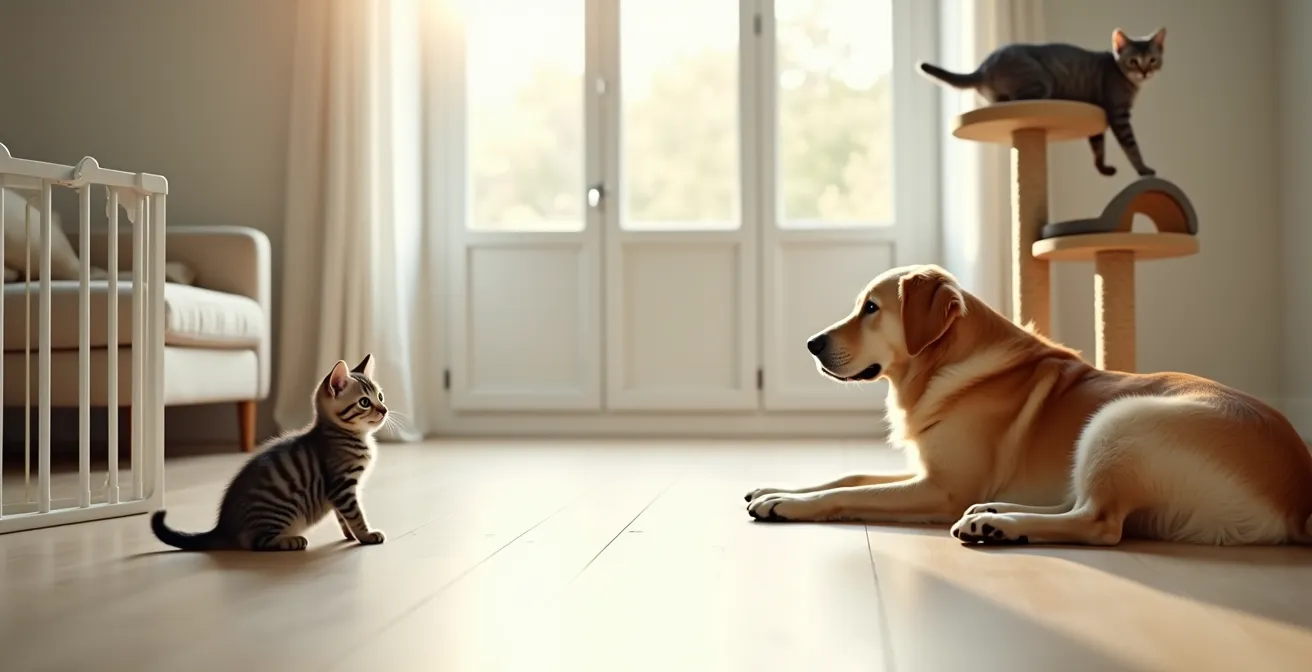
The success of a kitten introduction has almost nothing to do with pet personalities and everything to do with a strict, science-based protocol you control.
- Territorial conflict is prevented by managing senses (smell, sight) before allowing physical contact.
- The single biggest mistake is free-feeding, which creates resource competition instead of positive association.
- A dedicated “safe room” for the first 48 hours is non-negotiable for the kitten’s psychological and physical well-being.
Recommendation: Follow the timeline precisely. Rushing the process by even one day can set back progress by weeks and cement negative associations that are difficult to reverse.
Bringing a new kitten into a home with resident pets is a moment filled with both hope and anxiety. You envision your animals becoming fast friends, cuddling together on the sofa. But the reality is often a tense standoff of hissing, growling, and chasing that leaves you wondering if you’ve made a terrible mistake. Many owners believe the solution is to “let them work it out” or rely on generic advice like brief, supervised meetings. This approach is a gamble, one that ignores the fundamental principles of feline territorial psychology.
The truth is that a peaceful multi-pet household is not built on luck; it’s engineered. The key isn’t simply separating the animals, but executing a deliberate protocol of sensory management. It involves a phased introduction to scent, then sight, then presence, all orchestrated around a positive and non-competitive resource: food. This method systematically de-escalates a pet’s natural instinct to defend its territory against an intruder, reframing the newcomer as a non-threat.
But if the secret isn’t just about actions, but the *why* behind them, what are the critical steps that most owners miss? The answer lies in understanding that you are not introducing animals; you are merging territories. This guide provides a strict, 7-day timeline based on proven behavioral science. It will walk you through creating a secure foundation, managing the crucial first interactions, and interpreting the subtle cues that signal either acceptance or escalating conflict, ensuring the integration is both safe and successful.
To help you navigate this delicate process, this article is structured as a step-by-step plan. Each section covers a critical phase of the introduction, explaining the behavioral science behind it and providing actionable advice to ensure a peaceful transition for all your pets.
Summary: A Behaviorist’s Guide to Kitten Integration
- Why Your Kitten Needs a Solitary Safe Room for the First 48 Hours?
- How to Swap Scents Between Pets Without Direct Contact?
- Visual Barriers or Baby Gates: Which to Choose for High-Prey Drive Dogs?
- The Feeding Mistake That Causes 80% of Early Feline Aggression
- When to Intervene: Rough Play vs. Predatory Drift Signs
- Where to Place the Litter Box to Avoid “Corner Trapping” Stress?
- Diffusers vs. Sprays: Which Pheromone Works for Multi-Cat Tension?
- Why Your Cat Scratches the Sofa Despite Having a Post?
Why Your Kitten Needs a Solitary Safe Room for the First 48 Hours?
The first 48 hours are the most critical phase, and this step is non-negotiable. A dedicated “safe room” or “base camp” is not a punishment; it is a sanctuary. For a kitten, being thrust into a large, unknown territory filled with the scents of other, larger animals is overwhelmingly stressful. This room provides a smaller, manageable space where the kitten can decompress, establish its own scent, and feel secure. This initial period of isolation allows the kitten to acclimate without the immediate threat of a resident pet, drastically lowering stress hormones that can lead to illness and behavioral issues. Territorial security is the foundation of a successful introduction.

The setup of this room is as important as its existence. It must contain all necessary resources: food, water, a litter box, hiding spots, and importantly, vertical space like a cat tree. Height provides a powerful sense of safety for a cat. From this secure base, the kitten can begin to process the sounds and smells of the household from a distance, satisfying its curiosity without feeling threatened. Scientific studies on cat population management back this principle; an 11-year study of campus cats demonstrated that implementing proper protocols, including gradual and controlled introductions, led to a dramatic and sustained decrease in population conflicts and stress, proving that systematic management is highly effective.
Case Study: The Power of Controlled Introduction
An 11-year study of 155 free-roaming campus cats by the University of Central Florida demonstrated that gradual, controlled introductions work. After implementing proper protocols in 1991, which included isolation and managed integration, no new kittens were observed after 1995, and the population decreased by 85% by 2002. This shows that systematic approaches to cat management significantly improve success rates and reduce conflict.
Think of this room as the kitten’s embassy in a foreign land. It’s a sovereign territory from which all future diplomatic missions—scent swapping, visual meetings—will be launched. Getting this first step right ensures the kitten starts from a position of confidence, not fear.
How to Swap Scents Between Pets Without Direct Contact?
After the initial 24-48 hours of solitary confinement, the introduction begins—not face-to-face, but nose-to-nose, indirectly. Cats navigate their world primarily through scent. Before they see each other, they must become accustomed to each other’s smell. This process, known as scent soaking, involves exchanging bedding, toys, or cloths rubbed on each animal. The goal is to create a “group scent,” slowly mixing their individual smells until they become familiar and non-threatening. This olfactory introduction is the most underestimated yet powerful tool in your arsenal.
Failing to do this properly is a primary cause of rejection. A sudden, unannounced scent is the equivalent of a stranger appearing in your living room. By gradually introducing scents, you are giving your resident pet advance notice and time to process the new information. This critical step can significantly lower the risk of stress-related health issues. In fact, research published in Frontiers in Veterinary Science shows the mortality of kittens in their first two months can be around 10%, with stress being a critical factor. Proper, slow introductions are a key part of stress reduction.
There are several methods for scent swapping, each with its own level of intensity. Starting with a simple sock rub and progressing to site swapping allows you to control the “volume” of the introduction based on your pets’ reactions. The following table breaks down the most effective methods.
| Method | Effectiveness | Implementation Time | Best For |
|---|---|---|---|
| Sock/Gauze Facial Rub | High (targets social pheromones) | 2-3 times daily | All multi-pet situations |
| Bedding Rotation | Medium (passive scent) | Every 24-48 hours | Cats with mild anxiety |
| Communal Towel System | Very High (creates unified scent) | Daily rotation | 3+ pet households |
| Site Swapping | Highest (full territory exchange) | After 3-4 days | Confident pets only |
Start with the least invasive method and watch for reactions. A curious sniff is a great sign. Hissing at the scented object is normal; it’s simply communication. It means “I smell this, and I’m not sure about it.” Simply remove the object and try again later. Only move to the next level of scent swapping when the reaction is neutral or positive.
Visual Barriers or Baby Gates: Which to Choose for High-Prey Drive Dogs?
Once your pets are comfortable with each other’s scent (typically after 2-3 days), it’s time for the first visual introduction. This must be done through a secure barrier. The choice of barrier is critical, especially when introducing a kitten to a dog with a high prey drive. Standard baby gates are often too low and can be easily jumped by a determined dog or cat. The goal is controlled visual access without the possibility of physical contact. A tall pet gate, ideally with a smaller cat-sized door, or even stacked baby gates, is a much safer option.
As renowned cat behaviorist Jackson Galaxy emphasizes, the right equipment makes all the difference in preventing accidents. His recommendation prioritizes safety and human convenience, which are both crucial for a low-stress process.
In my experience, the better option is to introduce the cats by either using a pet gate or a screen door. A pet gate works better than a baby gate because pet gates are high and have a walk-through door in them, so that the human doesn’t have to disassemble the base camp door every time he wants to cross that threshold.
– Jackson Galaxy, The Do’s and Don’ts of Introducing Cats to Each Other
For high-prey drive dogs, a “two-barrier system” is the gold standard. This involves using the door to the kitten’s safe room cracked open only an inch (secured with a hook-and-eye latch) and placing a pet gate a few feet back from the door. This creates a buffer zone, preventing the dog from rushing the door and allowing the kitten to approach or retreat at its own pace. Draping a blanket over the gate and gradually lifting it over several days allows you to control the amount of visual stimulation, preventing the dog’s predatory instincts from being triggered by sudden movement.
Your Action Plan: The Two-Barrier System
- Install a primary door with a hook-and-eye latch to maintain a 1-inch crack opening.
- Position a tall pet gate 3-4 feet back from the door to create a buffer zone.
- Drape a blanket over the gate using clothespins for the gradual “curtain raising” technique.
- Ensure the kitten’s side has vertical escape routes, such as a cat tree at least 5 feet high.
- Practice “pattern interrupt” training with your dog, rewarding them for looking away from the kitten and back at you.
During these sessions, the kitten must always have an escape route and a high place to retreat to. The focus should be on rewarding calm behavior from both animals. If the dog fixates, whines, or barks, end the session immediately. The goal is to teach the dog that calmness in the kitten’s presence is rewarded.
The Feeding Mistake That Causes 80% of Early Feline Aggression
The single most powerful tool for building a positive association between pets is food. However, it’s also the area where a critical mistake is most often made: free-feeding. Leaving food out all day creates a mindset of resource guarding. When a new animal arrives, the resident pet sees them as a direct competitor for a constant, valuable resource. This is a recipe for aggression. The solution is to switch all pets to a schedule of 2-4 distinct meals per day. This transforms food from something to be guarded into a special event that happens in the presence of the other animal.
The technique is known as “parallel feeding.” You feed the animals at the same time but on opposite sides of a closed door. This teaches them to associate the pleasant experience of eating with the scent of the other pet. Start with the bowls several feet away from the door. If they eat calmly, move the bowls a little closer at the next meal. The goal is to eventually have them eating peacefully right on either side of the barrier. This simple change in routine can dramatically accelerate acceptance. In one case study by a feline behaviorist, an 11-year-old resident cat accepted a new kitten in just two days by strictly following this feeding protocol.

This method works by hijacking the cat’s primary motivation. The desire to eat overrides the initial anxiety or aggression toward the other pet. Over time, the brain rewires to associate the other pet’s presence with the reward of a meal. Once they are eating calmly on either side of a cracked door or visual barrier, you have successfully built the positive foundation needed for the first face-to-face meeting. Remember to also provide multiple water stations throughout the house to further reduce any potential for resource competition.
Case Study: Accelerated Integration Through Scheduled Feeding
A documented case study showed a remarkably fast integration where an 11-year-old male cat accepted a new female kitten within just two days. The owner strictly followed proper feeding protocols, eliminating free-feeding and using parallel meal times on opposite sides of a door. The positive association was so strong that the cats were found curled up together on the bed shortly after their first full interaction, demonstrating that correct feeding strategy is a powerful accelerator for acceptance.
Abandoning the free-feeding model is the most impactful change you can make. It shifts the entire dynamic from competition to cooperation, setting the stage for a peaceful coexistence.
When to Intervene: Rough Play vs. Predatory Drift Signs
Once you progress to supervised, barrier-free interactions, your role shifts from engineer to referee. This is often the most nerve-wracking phase. It’s crucial to distinguish between normal, healthy rough play and signs of genuine aggression or, in the case of dogs, predatory drift. Rough play between cats involves chasing, pouncing, and batting with retracted claws. It’s often reciprocal—they take turns chasing each other—and there are frequent pauses. Hissing and growling can be part of play, acting as communication to say “that was too much” or “I need a break.” As long as both pets disengage and there’s no injury, this is generally healthy.
Predatory drift, however, is a silent, focused, and non-reciprocal escalation. With a dog, signs include a fixed stare, a stiff body, and a complete lack of play signals like a play bow. The dog is not trying to play; it is tracking prey. With a cat, true aggression involves puffed-up fur, flattened ears, a straight-legged posture, and vocalizations that are more of a shriek than a hiss. There is no reciprocity; one animal is relentlessly pursuing the other, who is clearly trying to escape and hide. Any sign of predatory drift or true aggression requires immediate, calm intervention. Use a loud clap or a spray bottle to interrupt the behavior, separate the animals, and take a step back in the introduction process for a day or two.
It’s vital to manage your expectations regarding the timeline. While this guide outlines a 7-day plan, every animal is an individual. According to veterinary professionals, it can take anywhere from a week to a few months for pets to fully acclimate. A social, confident kitten may integrate faster, while a shy, timid resident cat may require much more time. Rushing the process is the surest way to create a permanent problem. Patience is not passive waiting; it is active, observant management.
Where to Place the Litter Box to Avoid “Corner Trapping” Stress?
A primary source of conflict in multi-pet households is the litter box. It’s a place of vulnerability, and if a cat feels it can be ambushed or “cornered” while using it, it will experience significant stress. This can lead to inappropriate elimination (soiling outside the box) or aggression. The placement of litter boxes is a matter of tactical, territorial strategy. The golden rule is N+1: you need one more litter box than you have cats. For a two-cat household, this means a minimum of three boxes.
However, the placement of these boxes is more important than the number. Never place a litter box in a closet, a small bathroom with only one exit, or behind furniture. These are all dead ends. A cat using a box in such a location can be easily “trapped” by another pet, which is a major source of anxiety and a common trigger for fights. Instead, boxes should be placed in areas with low foot traffic but clear sightlines and multiple escape routes. A corner of a living room or a wide hallway allows the cat to see its surroundings and bolt in at least two different directions if it feels threatened.
Furthermore, the boxes should be distributed throughout the home, including on different floors if you have a multi-story house. This prevents one dominant pet from “guarding” all the boxes and denying access to the other. During the introduction period, using large, open-top boxes is preferable to covered ones. While some cats prefer privacy, open boxes provide maximum visibility and prevent the “out of sight, out of mind” ambush scenario. Ensuring safe and stress-free access to this critical resource is a non-negotiable part of maintaining a peaceful feline society.
Diffusers vs. Sprays: Which Pheromone Works for Multi-Cat Tension?
Synthetic pheromones are a powerful, passive tool for reducing social tension. They mimic the natural chemical signals cats use to communicate safety and familiarity. However, not all pheromone products are the same, and using the right one for the right situation is key. The two main types are diffusers, which provide continuous, area-wide coverage, and sprays, which are used for targeted spot treatments. For the initial introduction, a combination approach is often most effective.
Veterinary behaviorists strongly recommend preparing the environment with pheromones before the new kitten even arrives. This pre-treatment helps establish a baseline of calm.
Before you even bring home the new cat, make sure you have Feliway multicat or optimum going in the main area of your house as well as in the room you will use for holding.
– Cattitude Adjustment Veterinary Behaviorists, Introducing a New Cat to Your Pets
The choice of product depends on the specific chemical it contains and its intended purpose. Feliway Classic contains the F3 facial pheromone, which cats deposit when they rub their cheeks on things to mark them as “safe.” This makes it ideal for the new kitten’s safe room. Feliway Multicat (also known as Friends) contains the cat appeasing pheromone (CAP), which a mother cat produces to soothe her kittens. This is designed specifically to reduce conflict between cats and should be used in common areas where the pets will eventually interact.
A targeted spray can be used on specific points of conflict, like a doorway where hissing occurs, or on carriers before a vet visit. The following table provides a clear guide for selecting the right product for your needs.
| Product Type | Active Compound | Best Use Case | Coverage Area |
|---|---|---|---|
| Feliway Classic Diffuser | F3 facial pheromone | New kitten’s safe room | 700 sq ft continuous |
| Feliway Multicat/Friends | Cat appeasing pheromone | Common areas for meetings | 700 sq ft continuous |
| Targeted Spray | F3 concentrated | Specific conflict zones | Spot treatment 4-5 hours |
| Stacking Protocol | Both types combined | High-tension households | Full home coverage |
Pheromones are not a magic bullet, but they are an invaluable support system. They help lower the overall “volume” of stress in the environment, making all the other steps of the introduction protocol more likely to succeed.
Key Takeaways
- A dedicated “safe room” for the first 48 hours is the single most important step for preventing initial stress and fear.
- Scent swapping before visual contact is crucial; it allows pets to meet on their own terms in a non-threatening way.
- Switching from free-feeding to scheduled meals on opposite sides of a barrier is the most effective way to build positive associations.
Why Your Cat Scratches the Sofa Despite Having a Post?
Even after a seemingly successful introduction, you might notice secondary behavioral issues, like the resident cat suddenly scratching the sofa. This is often not a “bad habit” but a lingering symptom of territorial insecurity. Scratching is a complex behavior; it’s partly for claw maintenance, but it’s also a powerful form of territorial communication. Cats have scent glands in their paws, so when they scratch, they leave both a visual mark (the shredded fabric) and an olfactory one (their scent). When a cat feels its territory is being challenged by a newcomer, it will often increase its “billboard” advertising by scratching in prominent locations like the ends of sofas or doorways.
Simply providing a scratching post is not enough; its placement and type are critical. A post hidden in a back room will be ignored. To be effective, the post must be placed directly in front of or next to the furniture being targeted. You are not trying to punish the cat, but to redirect a natural behavior to a more appropriate surface. The post must also be tall enough for a full-body stretch (minimum 32 inches for an adult cat) and extremely stable—a wobbly post is an unsafe post and will be rejected. By placing an attractive, stable post at the site of the “crime,” you are offering a better alternative for this essential communication.
Case Study: The Three-Month Success Story
Patience is paramount, especially with mature cats. One documented case of two adult male cats required three months of patient introduction work. The owner consistently applied the “baby steps” of scent swapping, parallel feeding, and short, positive interactions. Despite the long timeline, their persistence paid off. The two cats now live in complete harmony, proving that even the most challenging combinations can succeed when the correct, science-backed protocols are followed without rushing.
Ultimately, a successful integration is a marathon, not a sprint. This 7-day plan provides the framework, but you must be prepared to adjust the timeline based on your animals’ individual responses. By understanding the “why” behind their behavior—from resource guarding to territorial marking—you can move from being a frustrated owner to a skilled and empathetic mediator, building a foundation for a peaceful multi-pet household that will last a lifetime.
Now that you have the complete protocol, the next step is to prepare your home and your mindset. Begin by setting up the safe room and switching your resident pet to a scheduled feeding routine before the kitten even arrives. This proactive approach will set the stage for a smooth and successful integration.