In summary:
- Successful integration is a non-negotiable protocol of sensory management, not a “wait and see” process.
- The first 48 hours in a solitary “safe room” are critical for hormonal decompression and scent establishment.
- Introduce pets through a phased protocol: scent swapping first, then controlled visual access, then supervised meetings.
- Use positive reinforcement, like feeding on opposite sides of a door, to build positive associations.
- Learn to distinguish between normal rough play and dangerous “predatory drift” to know precisely when to intervene.
Bringing a new kitten into your home is an exciting moment, but for a household with existing pets, it can also be a source of significant anxiety. You are not just adding a pet; you are introducing a perceived invader into an established territory. Many owners hope for the best, assuming the animals will “figure it out.” This is a dangerous gamble. The truth is, a successful integration isn’t about luck; it’s a meticulously managed process rooted in feline biology and psychology.
The common advice—to “let them sniff under the door”—is woefully inadequate. It ignores the fundamental nature of cats as territorial creatures who communicate through a complex world of scent. A botched introduction can lead to chronic stress, behavioral issues like inappropriate urination, and aggression that can be difficult, if not impossible, to reverse. The goal is not just to prevent a fight today, but to establish a foundation for a lifetime of peaceful coexistence.
This guide moves beyond generic tips. It provides a strict, time-gated protocol based on the principles of sensory management and territorial equity. Over the next seven days, you will act as a confident territorial manager, controlling what your pets see, smell, and experience to shape their perceptions of one another. By following this protocol without deviation, you will create a secure environment that systematically reduces stress and builds a bridge between your resident pets and their new companion.
This article provides a detailed, day-by-day plan for a safe and successful integration. Below, you will find a summary of the key steps we will cover, from setting up the initial safe space to managing the first physical interactions and troubleshooting common issues.
Summary: The Definitive Guide to Harmonious Pet Integration
- Why Your Kitten Needs a Solitary Safe Room for the First 48 Hours?
- How to Swap Scents Between Pets Without Direct Contact?
- Visual Barriers or Baby Gates: Which to Choose for High-Prey Drive Dogs?
- The Feeding Mistake That Causes 80% of Early Feline Aggression
- When to Intervene: Rough Play vs. Predatory Drift Signs
- Where to Place the Litter Box to Avoid “Corner Trapping” Stress?
- Diffusers vs. Sprays: Which Pheromone Works for Multi-Cat Tension?
- Why Your Cat Scratches the Sofa Despite Having a Post?
Why Your Kitten Needs a Solitary Safe Room for the First 48 Hours?
The single most critical step in this entire process is the initial 48-hour separation. This is a non-negotiable decompression phase. A new kitten arriving in your home is overwhelmed; its cortisol (stress hormone) levels are sky-high. Placing it directly into the general population is a recipe for a “fight or flight” response. The safe room acts as an olfactory basecamp, a small, manageable space where the kitten can lower its stress levels and, crucially, establish its own scent signature. For a cat, feeling secure begins with smelling itself in its environment.
This isn’t about punishment; it’s about establishing Territorial Equity. The safe room gives the kitten a space it can unequivocally “own.” This simple act prevents the immediate feeling of resource scarcity that triggers guarding behaviors in both the new and resident pets. With a 23% increase in cat ownership in 2024 and a rise in multi-cat households, understanding this principle is more important than ever. The room should be equipped with everything the kitten needs: food, water, a litter box (placed in separate corners), and a place to hide and feel secure.
The sensory profile of this room matters. It must include the carrier the kitten arrived in, as it serves as a familiar scent anchor. Add a simple cardboard box on its side for a secure hiding spot and a small cat tree or sturdy chair to provide a vertical escape. This allows the kitten to survey its new, small territory from a position of safety. Finally, installing a Feliway Classic diffuser 24 hours before the kitten arrives helps biochemically signal that the space is safe, further accelerating the decompression process.
How to Swap Scents Between Pets Without Direct Contact?
Once the kitten is settled in its safe room, the first “meeting” between pets must be olfactory, not physical. This process of scent swapping is your first act of sensory management, and it must be done with intention. You are not just exchanging smells; you are telling a story. By bringing a scented item from one pet to another, you, the trusted human, are vouching for the newcomer, associating their unfamiliar smell with your own reassuring presence.
Not all scents are created equal. There is a scent hierarchy in feline communication. Bedding carries strong territorial markers, while scents from the cheeks (collected by gently rubbing a cloth on their face) carry “friendly” or affiliation pheromones. Therefore, your protocol should be progressive. Begin by swapping bedding or soft toys. After a day or two of this, you can move on to presenting the more intimate cheek scents on a cloth. Initial hissing is normal; it is an acknowledgment of a new presence. The goal is to see that hissing diminish over time, not to eliminate it instantly.
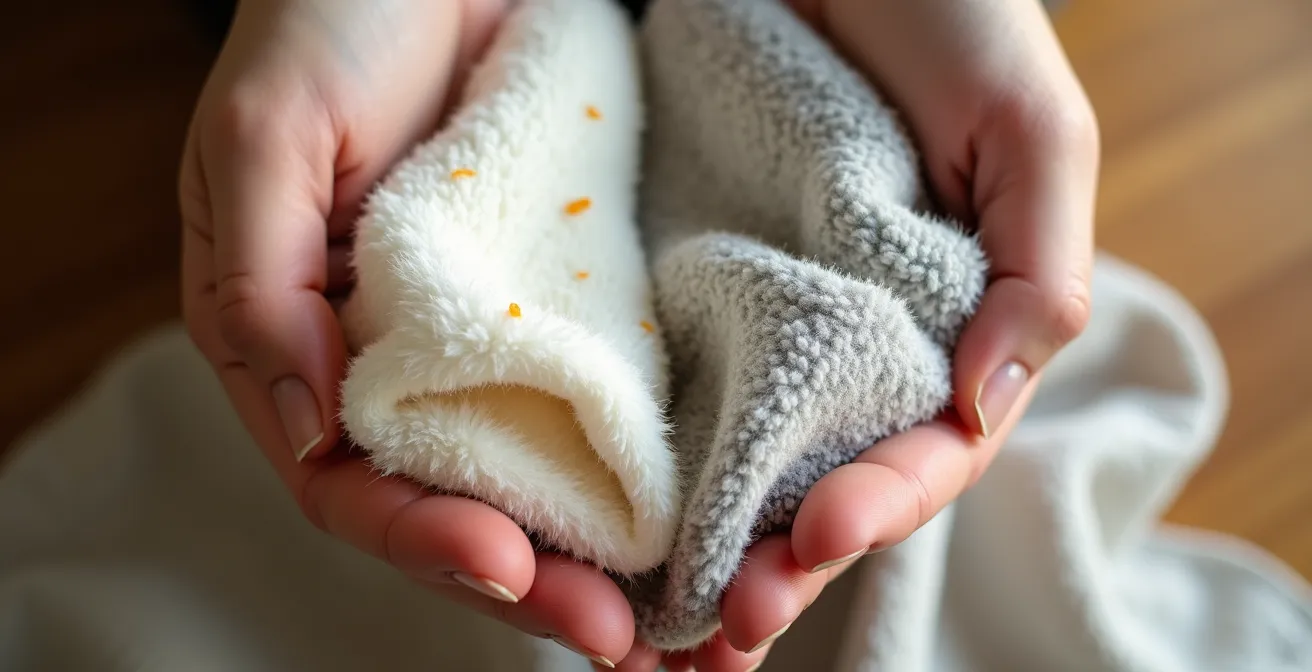
A structured approach turns this tip into an actionable plan. The following table outlines a reliable protocol for progressive scent swapping.
| Scent Type | Message Conveyed | Collection Method | Introduction Day |
|---|---|---|---|
| Bedding scents | Territorial markers | Swap sleeping blankets | Day 1 |
| Toy scents | Play/relaxation association | Exchange favorite toys | Day 2 |
| Cheek pheromones | Friendly/affiliation signals | Soft cloth rubbed on cheeks | Day 3 |
| Under-door sniffing | Direct but safe exploration | Allow natural investigation | Day 4 |
Visual Barriers or Baby Gates: Which to Choose for High-Prey Drive Dogs?
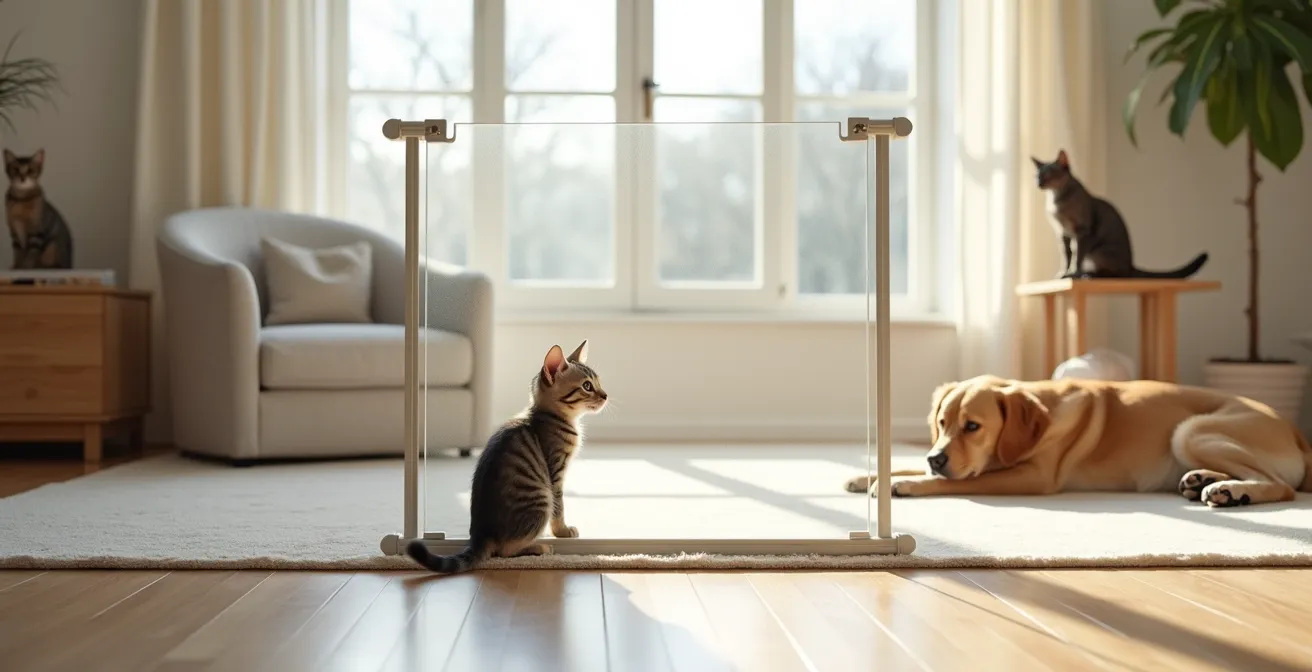
After several days of positive or neutral scent swapping, you can move to the first visual introduction. However, the choice of barrier is critical, especially when introducing a kitten to a dog with a high prey drive (like a terrier or sighthound). A standard baby gate can become a “frustration barrier,” intensifying the dog’s fixation and potentially increasing its prey drive. The goal here is not just containment; it is counter-conditioning. You must rewire the dog’s brain to associate the sight of the kitten with a positive reward, not an object of prey.
For a high-prey drive dog, a superior method is to use two baby gates stacked on top of each other, making the barrier too high to jump. Initially, this double-gate should be completely covered with a blanket. The visual reveal should be gradual: lift the blanket for only a few seconds at a time. During these brief moments, the dog must receive an extremely high-value treat (like small pieces of chicken or cheese) that it gets at no other time. The sight of the kitten must predict the arrival of this amazing reward. If the dog remains fixated, cannot look away, or whines, the blanket is lowered, and the session ends.
For other pets, the choice of barrier can be adapted. As feline behaviorist Jackson Galaxy advises, “A pet gate works better than a baby gate because pet gates are high and have a walk-through door in them.” This prevents humans from having to constantly step over a barrier, which can become tedious and lead to compliance fatigue. For introductions between two cats, a solid screen door or a piece of plexiglass can work well, as it allows for sight and smell without any risk of physical contact.
Your Action Plan: Barrier Selection Checklist
- For high-prey drive dogs: Use two stacked baby gates. Start with the barrier fully covered by a blanket.
- For curious, low-prey drive dogs: A single tall pet gate with vertical bars is sufficient.
- For resident cats: A screen door or a temporary plexiglass barrier allows visual access while preventing claws from passing through.
- Implement gradual reveal: Regardless of the barrier, start with it covered. Raise the cover by an inch or two each day, only if all pets remain calm.
- Pair with high-value rewards: Only provide the best treats (e.g., chicken, cheese) when the pets can see each other, creating a powerful positive association.
The Feeding Mistake That Causes 80% of Early Feline Aggression
One of the most common and damaging mistakes owners make is creating perceived resource competition during feeding time. The well-intentioned advice to “feed them together” is often misinterpreted. The real mistake isn’t just proximity; it’s allowing the animals to see or sense each other while in a state of hunger-driven arousal. This can instantly trigger a primitive, zero-sum game mentality, leading to resource guarding and aggression. A hungry cat is a neurologically primed cat, with heightened senses and anxiety. Combining this state with the stress of a perceived rival is a recipe for disaster.
The correct method is the “Eat-and-Associate” technique. This involves feeding the pets at the same time but on opposite sides of the closed door to the kitten’s safe room. Start with the bowls several feet away from the door. If both pets eat calmly, you can move the bowls a little closer to the door at the next meal. This process may take days. The goal is to have them eventually eat peacefully right on their respective sides of the door. This powerful exercise associates the scent of the other animal with the positive, dopamine-releasing act of eating.
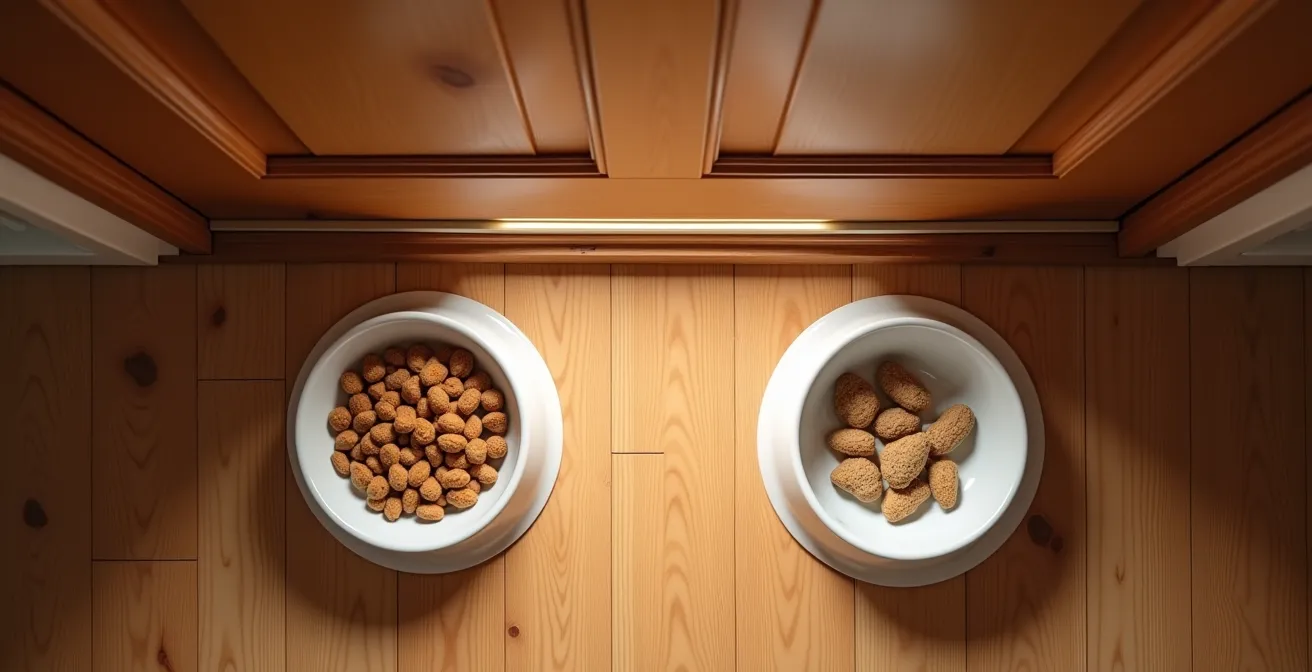
This technique is essential for building a positive foundation, especially with the rise of multi-pet homes. It is a cornerstone of creating harmony and is a far cry from simply placing two bowls next to each other and hoping for the best. Free-feeding should be suspended during this phase; scheduled meals create the predictable, positive events needed for this conditioning to work.
When to Intervene: Rough Play vs. Predatory Drift Signs
After days of successful scent, sight, and feeding exercises, you can attempt the first supervised, physical interaction in a neutral, open space. This is the moment of highest risk and requires your full attention. Your job is to be the lifeguard, ready to intervene before things escalate. To do this, you must know the critical difference between healthy, rough play and the dangerous phenomenon known as predatory drift. As the PAWS Animal Shelter warns, ” Dogs can kill a cat very easily, even if they’re only playing.”
Healthy play is governed by the rules of reciprocity and reversibility. It involves turn-taking; one pet chases, then the other chases back. There are breaks in the action, and body language is loose and bouncy. Predatory drift, on the other hand, is silent, one-sided, and fixated. The pursuing animal’s body will be stiff and low to the ground, with a locked, unbreaking stare. This is not play; it is the moment a dog’s or even a cat’s prey drive takes over, and it is extremely dangerous. Any sign of this requires immediate, calm intervention to separate the animals.
Pay attention to the sounds—or lack thereof. Play can be surprisingly noisy, with growls and chirps, but predatory aggression is often eerily silent. The checklist below provides clear indicators to help you distinguish between the two states. Your ability to read these signals is what will keep your new kitten safe.
| Behavior Aspect | Safe Play | Predatory Drift | Action Required |
|---|---|---|---|
| Vocalizations | Growls, chirps, playful yelps | Eerily silent, no sounds | Immediate separation if silent |
| Body Posture | Loose, relaxed muscles | Stiff, low stalking position | Distract and redirect |
| Chase Dynamics | Turn-taking, role reversal | One-sided pursuit only | Physical intervention |
| Claw Use | Sheathed claws | Unsheathed, ready to strike | End session immediately |
| Eye Contact | Brief glances, breaks in focus | Fixed, unbreaking stare | Block visual contact |
| Interruptibility | Easily distracted by sounds | Locked focus, hard to break | Use loud noise or water spray |
Where to Place the Litter Box to Avoid “Corner Trapping” Stress?
A frequently overlooked source of conflict in multi-pet homes is litter box placement. The problem is not just about location, but about egress. A cat using a litter box is in a vulnerable position. To feel secure, it needs to know it can escape easily if a rival approaches. Placing a litter box in a “corner trap”—a location with only one way in and out, like a small bathroom, a closet, or the end of a narrow hallway—can be a source of immense stress. It creates a potential ambush point where a more dominant pet can block the exit, trapping the other cat.
This is also why the classic “N+1 Rule” (one box per cat, plus one extra) is often misunderstood. Having three litter boxes lined up in the same room is useless from a cat’s perspective; it still only counts as one resource location. A dominant cat can easily guard all three boxes at once. To achieve true territorial equity, you must place the N+1 boxes in socially distinct areas of the home. This ensures that even if one location is being guarded or feels unsafe, there are always other options available.
Think of your home as a map with red and green zones. Red Zones are to be avoided: noisy laundry rooms where a spinning washing machine can startle a cat, high-traffic hallways, and areas next to food and water (cats are hardwired not to eliminate near their food source). Green Zones are ideal: quiet corners of living rooms or home offices that offer clear sightlines and, most importantly, multiple escape routes. Blocking off “unders”—the spaces under beds or furniture where a scared cat might hide and be cornered—is also a priority. If you’ve ever tried to break up a cat fight under a bed, you’ll know why this is so important.
Diffusers vs. Sprays: Which Pheromone Works for Multi-Cat Tension?
Synthetic pheromones can be a powerful tool for providing biochemical support during an introduction, but using the wrong product for the situation can render them useless. It is crucial to differentiate between product types and their specific purpose. For a new kitten introduction, you should be using two different types of pheromones strategically. The guiding rule is this: diffusers for the environment, sprays for events.
First, in the kitten’s solitary safe room, you should use a Feliway Classic diffuser. This product synthesizes the feline facial pheromone, which is the scent a cat deposits when it rubs its face on objects (and you). This pheromone signals “safety” and “familiarity” within its own territory. It helps the new kitten feel secure in its basecamp. In the main, shared areas of the house, you should use a Feliway Multicat (also known as Feliway Friends) diffuser. This product mimics the cat appeasing pheromone, which a mother cat releases to soothe her kittens. Its specific function is to reduce social conflict and tension between cats living in the same space.
As one feline behavior expert from Cattitude Adjustment puts it, “Before you even bring home the new cat, make sure you have Feliway multicat… going in the main area of your house as well as in the room you will use for holding.” Pheromone sprays, on the other hand, are for targeted, short-term use. A spray can be applied to a blanket before a scent swap or inside a carrier before a supervised meeting. It is not designed for ambient, long-term environmental management.
| Product Type | Best Use Case | Active Ingredient | Placement |
|---|---|---|---|
| Feliway Classic Diffuser | Kitten’s safe room | Facial pheromone (safety signal) | Single room coverage |
| Feliway Multicat Diffuser | Common areas for all pets | Cat appeasing pheromone | Main living spaces |
| Pheromone Spray | Specific events/items | Same as diffusers | Carriers, blankets, doorways |
Key Takeaways
- The “safe room” is a non-negotiable decompression zone, not an optional step.
- Scent is a cat’s primary language; manage scent swapping with a clear, progressive protocol.
- Distinguish between healthy play (reciprocal, loose) and predatory drift (silent, fixated) to ensure safety.
Why Your Cat Scratches the Sofa Despite Having a Post?
A common and frustrating behavior that often emerges after a new kitten arrives is the resident cat suddenly scratching furniture, especially the sofa. Owners are baffled, pointing to a perfectly good scratching post sitting unused in the corner. The key to solving this is understanding that scratching is not just about claw maintenance; it is primarily about sign-posting. The act deposits both a visual mark and a powerful scent from the interdigital glands in a cat’s paws. The arrival of a new pet triggers an urgent need in the resident cat to re-establish its territory, and a sofa—a large, central object in a high-traffic social area—is the equivalent of a giant public billboard.
The problem is rarely the cat; it’s almost always an inadequate post. An effective scratching post must meet the “Triple-S” criteria: Stability (it must be heavy and not wobble, as any instability feels unsafe), Size (it must be tall enough for the cat to get a full, satisfying vertical stretch), and Surface (sisal rope is vastly superior to carpet, which can snag claws). Furthermore, location is paramount. A post in a distant corner is useless. The new, improved post must be placed directly next to the piece of furniture the cat is currently scratching.
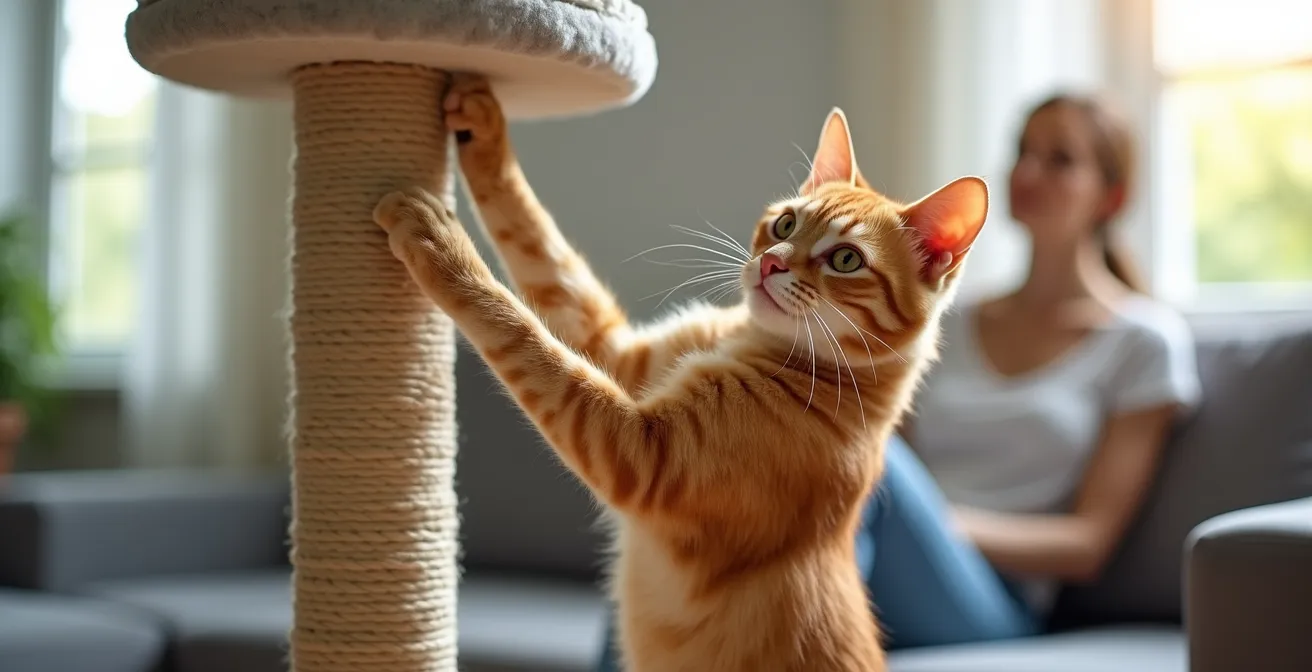
The solution is a three-step process. First, make the undesirable target (the sofa) unattractive by using double-sided sticky tape or a citrus-based spray. Second, make the alternative irresistible by placing a new “Triple-S” post right next to the sofa and rewarding its use with praise or catnip. Finally, and most importantly, address the root cause: the cat’s territorial anxiety. The scratching is a symptom. According to shelter data that reveals territorial stress increases with new additions, this anxiety is predictable. Adhering strictly to the introduction protocol, increasing playtime, and ensuring resource abundance are the ultimate cures for this behavior.
By now, you have a complete framework for managing this delicate process. The path to a harmonious multi-pet household is not a matter of chance but of deliberate, informed action. Every step, from the initial separation to the management of shared resources, is designed to respect the innate behavioral needs of your pets, reducing anxiety and building a foundation of trust. To truly succeed, it’s essential to never forget the foundational principle that a new pet is an intruder until you teach it to be a friend.