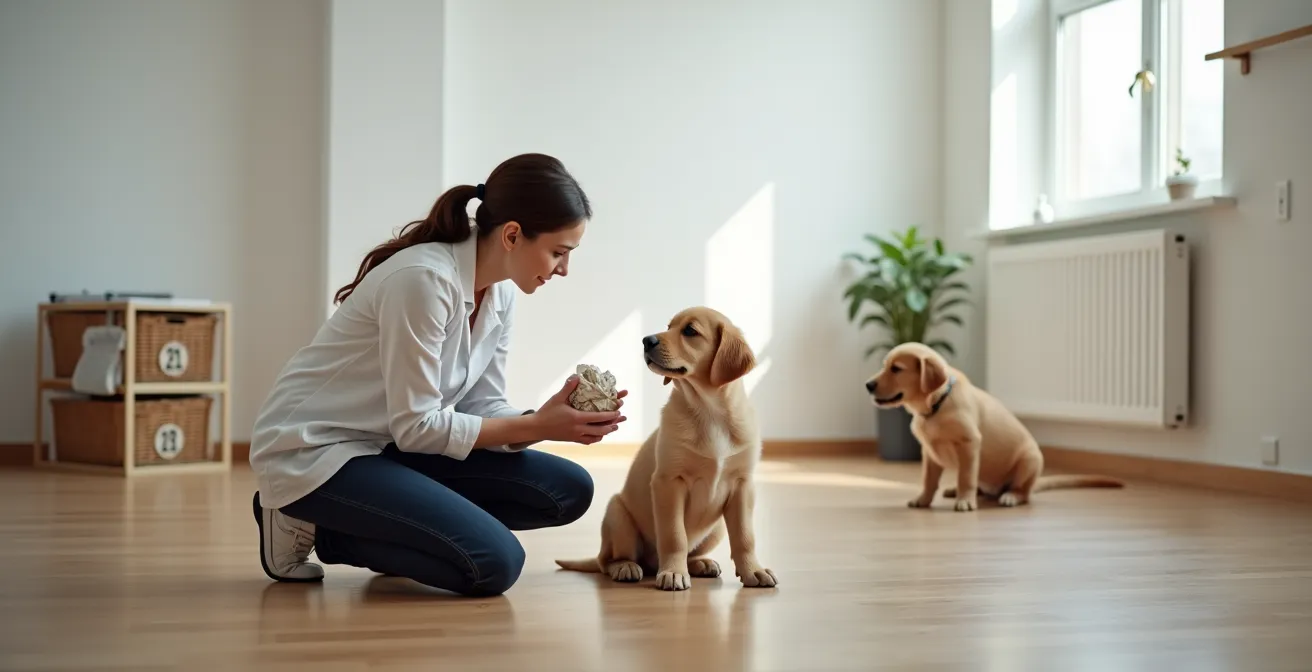
The Volhard test’s purpose is not to find the “best” puppy, but to decode its innate operating system and find the right match for your life.
- A puppy’s scores are a map to its temperament, not a pass/fail grade.
- Parental genetics and official health clearances are more predictive of future behaviour and health than any single test.
Recommendation: View the test scores as a compatibility guide to predict a successful long-term relationship, not as a search for a perfect score.
Standing before a litter of tumbling, playful puppies is a moment of pure joy mixed with overwhelming anxiety. Which one is “the one”? They all seem perfect. In the quest to make this monumental decision, many prospective owners turn to tools like the Volhard Puppy Aptitude Test (PAT), hoping for a scientific answer. The internet is filled with descriptions of its ten steps, from social attraction to sound sensitivity, presenting it as a foolproof method to sort the good from the challenging.
However, this common approach misses the entire point. Most people treat the PAT like a final exam, looking for the puppy with the highest “score.” They fixate on the ten minutes of testing and ignore the lifetime of context surrounding it. This misunderstanding often leads to a mismatch, where a family ends up with a high-drive dog in a low-energy home, a recipe for frustration and, too often, surrender.
But what if the true genius of the Volhard test wasn’t in the scores themselves, but in how you interpret them? The secret isn’t to find the “best” puppy, but to understand each puppy’s innate operating system and see which one is compatible with your family’s lifestyle. This is not about judging; it’s about matchmaking. The test is merely one diagnostic tool in a holistic assessment that must include parental genetics, verifiable health records, and a clear plan for the critical first few months.
This guide will walk you through that holistic process. We will reframe the Volhard test not as a grading system, but as a map. We’ll explore why meeting the parents is non-negotiable, what health paperwork is mandatory, and how to translate test results into a concrete plan for raising a well-adjusted, lifelong companion.
This article will guide you through a comprehensive approach to choosing your puppy. By understanding the full context, you can make a decision based on genuine compatibility, ensuring a happy future for both you and your new companion.
Summary: A Holistic Guide to Choosing Your Puppy with the Volhard Test
- The “Meet the Parents” Rule: Why Seeing the Mother Is Non-Negotiable?
- High Drive vs. Low Arousal: Which Puppy Fits a Family with Toddlers?
- Marking vs. Moods: The Real Differences Between Dog Sexes
- Hip Scores and Eye Tests: What Paperwork Must You See?
- Is the “Runt” of the Litter Always a Health Risk?
- What to Expect During the First 3 Days, 3 Weeks, and 3 Months?
- The Maternal Antibody Gap: Why the 16-Week Shot Is the Most Critical?
- Why Socialization Ends at 16 Weeks for Puppies?
The “Meet the Parents” Rule: Why Seeing the Mother Is Non-Negotiable?
Before you even look at a puppy, you must look at its mother. A puppy’s temperament is not a blank slate; it’s a direct inheritance. The mother’s behavior is the most significant predictor of her puppies’ future reactions to the world. A calm, confident, friendly dam is likely to produce puppies with a similar baseline. Conversely, a fearful, anxious, or reactive mother passes on not just her genes but also models this behavior during the puppies’ first eight weeks of life. This is the genetic blueprint of the litter.
Observing the mother gives you invaluable data that no temperament test can replicate. How does she react when you, a stranger, arrive? Does she approach with a relaxed posture and a wagging tail, or does she retreat, bark excessively, or show signs of fear? A breeder with nothing to hide will welcome this interaction. As one experienced breeder notes, a puppy’s reaction to a stranger is heavily influenced by how its mother models stranger interactions. A puppy from a stable mother will settle with a new person in about 5-10 minutes, demonstrating learned resilience.
Don’t forget the father. While he is often not on-site, a reputable breeder should be able to provide videos of him in various settings: at home, in public, and during activities like competition or training. Ask about temperament certifications like the AKC’s Canine Good Citizen (CGC) or working titles. Inquiring about the grandparents’ temperaments can also reveal patterns of behavior, both good and bad, within the bloodline. Seeing the parents is your first and most important temperament test.
High Drive vs. Low Arousal: Which Puppy Fits a Family with Toddlers?
For a family with young children, safety and predictability are paramount. This is where the Volhard test transforms from a generic score sheet into a crucial matchmaking tool. You are not looking for the most outgoing or smartest puppy; you are looking for a puppy with low arousal levels and high stress resilience. Specifically, you want a puppy that scores predominantly 3s and 4s on the PAT. These scores indicate a puppy that is adaptable, forgiving, and less likely to be overwhelmed by the unpredictable nature of toddlers.
Key tests to focus on are Sound Sensitivity and Touch Sensitivity. A puppy that startles easily at a dropped set of keys (scoring a 1 or 6) may find the normal chaos of a family home deeply stressful. A puppy that reacts negatively to having its paws handled (a low score on touch sensitivity) may struggle with a child’s clumsy but well-intentioned petting. The ideal puppy for a toddler-filled home is one that recovers quickly from a startling noise and accepts gentle restraint and handling without panic. This demonstrates an innate ability to cope with pressure.
This is precisely what testing at the 49-day mark helps reveal. Research and practice show that this age is optimal for seeing how puppies react to different circumstances, including sudden noises and slight discomfort. A puppy with a low arousal level will process these minor stressors and return to a calm state quickly. A high-drive puppy (often scoring 1s and 2s) is better suited for competitive sports or highly active working homes, not for a living room with a 3-year-old. The goal is to find a calm, stable companion who will grow with your children, not be stressed by them.
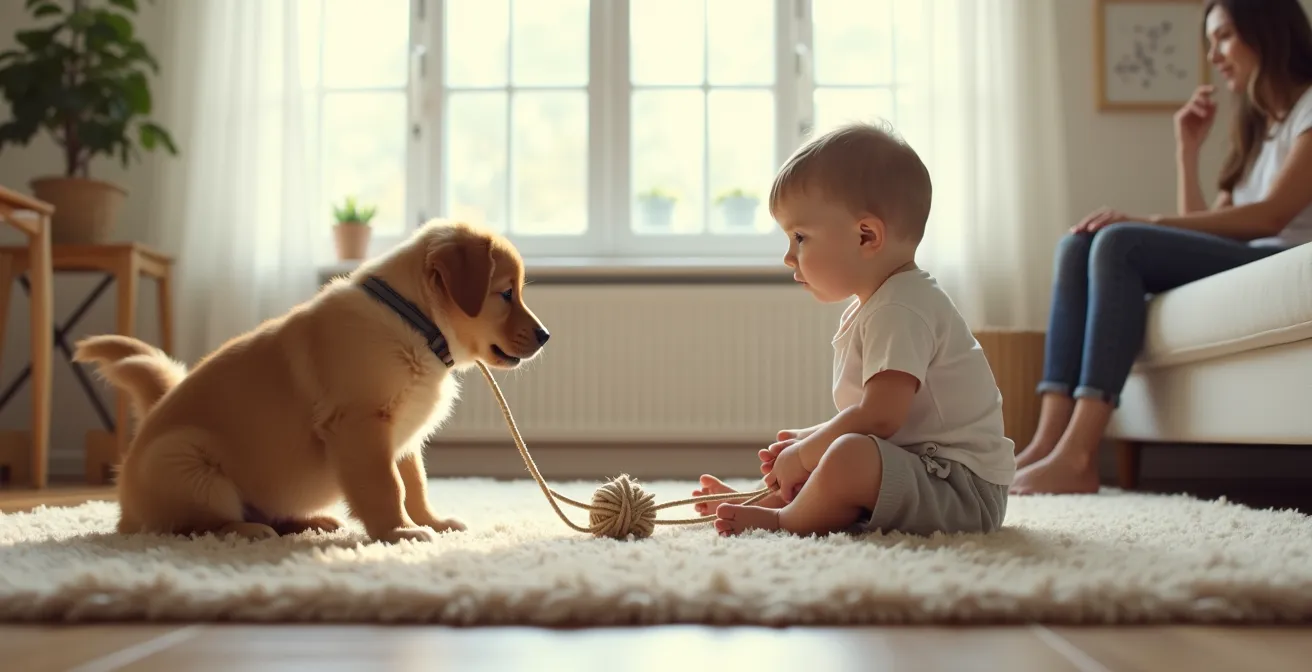
As this image illustrates, the desired outcome is a harmonious and safe interaction. This is achieved not by chance, but by selecting a puppy whose innate temperament—their “operating system”—is hardwired for the calm and patience required in a family environment. Choosing a puppy with low arousal is a proactive step towards creating this peaceful coexistence.
Marking vs. Moods: The Real Differences Between Dog Sexes
A common question that arises is whether to choose a male or a female puppy. The differences are often exaggerated by myths, but there are some general tendencies to consider. Males can sometimes be more easy-going and affectionate but may be more prone to marking territory and getting distracted by scents. Females are often more focused and quicker to mature, but their moods can be influenced by hormonal heat cycles if they are not spayed. However, these are broad generalizations, and individual personality is far more important than sex.
This is where the Volhard test’s core philosophy becomes essential. The guidelines state that the scores are not to be averaged, and there are no winners or losers. As Volhard testing emphasizes, each test is scored separately and interpreted on its own merits. The entire purpose is to select the right puppy for the right home. A “dominant” score (a 1 or 2 on Social Dominance) in a female might present differently than in a male, but in either case, it signals a need for an experienced owner who can provide clear leadership.
Ultimately, the choice between a male and a female puppy is a personal one that should be based on your specific circumstances and preferences. As the official testing protocol wisely states, it is a decision that must align with your own lifestyle.
You have to decide for yourself, which suits your life style.
– Volhard Puppy Aptitude Test Guidelines, PRIMA Dobermans Volhard Testing Protocol
Instead of getting bogged down by gender stereotypes, focus on the individual puppy’s scores. A submissive and gentle male (scoring 4s or 5s) will be a far better fit for a novice owner than an assertive and independent female (scoring 2s). The PAT provides the data; your job is to make the right lifestyle compatibility match, regardless of the puppy’s sex.
Hip Scores and Eye Tests: What Paperwork Must You See?
A puppy’s temperament is only one half of the equation for a happy, healthy life. The other half is its structural and genetic health, and this is where paperwork becomes non-negotiable. A responsible breeder invests significant time and money into health testing their breeding dogs to reduce the risk of passing on hereditary conditions. Asking to see these health clearances is not rude; it is the mark of a well-informed and responsible buyer. If a breeder cannot or will not provide this documentation, you should walk away.
For many breeds, especially those prone to joint issues like Labradors, German Shepherds, and Golden Retrievers, the most critical clearances are from the Orthopedic Foundation for Animals (OFA). You must see official OFA certificates for both parents showing their hip and elbow scores. For hips, you are looking for ratings of “Excellent,” “Good,” or “Fair.” Avoid any dog bred with “Borderline,” “Mild,” “Moderate,” or “Severe” hip dysplasia. For elbows, the rating should be “Normal.”
Beyond joints, eye health is crucial. A CAER (Companion Animal Eye Registry) exam, conducted by a board-certified veterinary ophthalmologist, should be done annually on breeding dogs to check for conditions like Progressive Retinal Atrophy (PRA). Furthermore, DNA testing has become a standard of care. For example, the American Kennel Club recommends that Labrador Retrievers undergo multiple DNA tests, including those for Exercise-Induced Collapse (EIC) and Centronuclear Myopathy (CNM). Seeing “Clear” certificates for these conditions in the parents ensures your puppy will not be affected by these devastating diseases.
Your Checklist for Essential Health Certifications
- OFA Hip Scores: Request to see the official certificates for both parents. Confirm ratings are “Excellent,” “Good,” or “Fair.”
- OFA Elbow Certification: Verify both parents have a “Normal” rating to screen for elbow dysplasia.
- CAER Eye Exam: Check for a recent (within one year) certification from a canine ophthalmologist for both parents.
- Breed-Specific DNA Tests: Ask for proof of DNA clearance for common hereditary diseases in the breed (e.g., EIC, PRA, CNM for Labradors).
- Cardiac Evaluation: For breeds prone to heart issues, inquire about cardiac evaluations like a TVD (Tricuspid Valve Dysplasia) screening.
Is the “Runt” of the Litter Always a Health Risk?
The term “runt” often conjures images of a weak, sickly puppy that is doomed to a life of health problems. While a significantly undersized and lethargic puppy can be a cause for concern, being the smallest in the litter is not automatically a red flag. It is crucial to distinguish between a puppy that is simply smaller and one that is failing to thrive. A smaller puppy that is active, engaged, and eating well may have just had a less favorable position in the womb but is otherwise perfectly healthy.
In fact, the smallest puppy can sometimes be a hidden gem. They may have a wonderfully resilient and adaptable temperament. This is another area where the Volhard test is invaluable. A smaller puppy that scores well on the PAT—showing confidence, a good recovery from startling noises, and a willingness to engage—is not a high-risk choice. Their temperament scores are far more predictive of their future as a companion than their size at eight weeks old.
The focus should be on the puppy’s overall vitality. Is it playing with its littermates? Does it have a good appetite? Is its coat healthy and its eyes bright? A small puppy that is otherwise vigorous can grow up to be just as strong and healthy as its larger siblings. Don’t dismiss the “runt” out of hand. Instead, evaluate it using the same holistic criteria: its Volhard test scores, its observable energy level, and the health and temperament of its parents. You may find that the best lifestyle compatibility match for you comes in the smallest package.
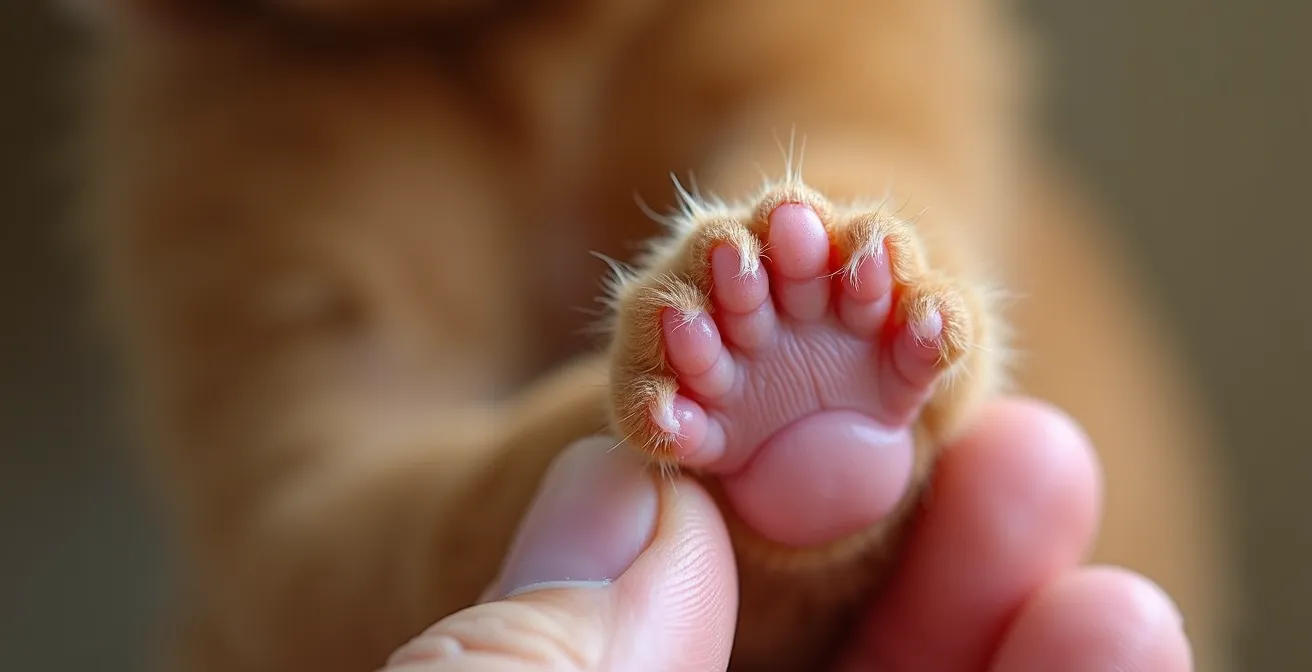
The gentle examination during a touch sensitivity test, as shown here, is a perfect example of how to assess a puppy’s resilience, regardless of its size. A calm acceptance of this handling is a far better indicator of a stable temperament than a few ounces of weight difference at birth. A thorough assessment will reveal the puppy’s true nature.
What to Expect During the First 3 Days, 3 Weeks, and 3 Months?
The Volhard test’s utility doesn’t end once you’ve chosen your puppy. Its real power is as a roadmap for the crucial first few months of ownership. The scores provide a preview of your puppy’s innate tendencies, allowing you to create a customized onboarding and training plan. The ideal age for testing is at 49 days, as Volhard research confirms that at 49 days a puppy is neurologically complete, and testing can predict future adult traits. Whether tested at 7 or 8 weeks, this data is your guide.
The first three days should be a “decompression protocol.” This means creating a quiet, predictable environment with minimal visitors. The focus is on establishing a routine for potty breaks, feeding, and sleep. This helps the puppy adjust to its new life away from its mother and littermates. For a puppy that scored a 2 on the Following test, you can begin recall training with high-value treats immediately, reinforcing the desire to stay close to you.
During the first three weeks, you can begin to address specific tendencies revealed by the PAT. For a puppy that scored a 5 on Sound Sensitivity, this is the time to start a gradual desensitization program, playing recordings of various sounds at a very low volume and rewarding calm behavior. In the first three months, you should be documenting your puppy’s behavioral changes in a journal and comparing them to the initial Volhard scores. This allows you to track progress and adjust your training plan, ensuring you are proactively shaping your puppy’s behavior based on its innate operating system.
Key Takeaways
- The Volhard test is a tool for compatibility matching, not for finding a “perfect” puppy.
- Assessing the mother’s temperament is the most reliable predictor of a puppy’s future behavior.
- Non-negotiable health clearances (OFA, CAER, DNA) are the hallmark of a responsible breeder.
The Maternal Antibody Gap: Why the 16-Week Shot Is the Most Critical?
One of the biggest challenges during the critical socialization window is balancing the need for exposure with the need for safety from disease. Puppies receive initial immunity from their mother’s milk, but these maternal antibodies begin to wane between 8 and 16 weeks of age. This creates an “immunity gap” where they are not yet fully protected by their vaccinations but are increasingly vulnerable. The 16-week vaccination is often the most critical because it ensures protection after maternal antibodies have likely disappeared.
This does not mean your puppy must be kept in a bubble. The risk of developing lifelong behavioral problems from a lack of socialization is far greater than the risk of contracting a disease if you take sensible precautions. As leading veterinary sources confirm, you can and should take your puppy out in public safely.
The key is controlled, low-risk exposure. Avoid high-traffic areas where unvaccinated dogs may have been, such as dog parks or public potty areas. Instead, focus on experiences where you can manage the environment. The following table from VCA Animal Hospitals provides a helpful guide for navigating this period.
| Activity | Risk Level | Implementation Method |
|---|---|---|
| Hardware Store Visits | Low | Carry puppy through pet-friendly stores |
| Vaccinated Dog Playdates | Low | Private yard with known healthy adult dogs |
| Farmer’s Market | Low-Medium | Use shopping cart with blanket |
| Puppy Classes | Low | Require vaccination records from all participants |
| Dog Parks | High | Avoid completely until fully vaccinated |
Why Socialization Ends at 16 Weeks for Puppies?
The 16-week mark is not an arbitrary deadline; it is a biological one. Between 3 and 16 weeks of age, a puppy’s brain is in a state of incredible growth. This is the critical socialization period, a finite neuroplasticity window during which their brains are uniquely wired to accept new sights, sounds, and experiences as normal. After about 16 weeks, this window closes, and the puppy’s brain shifts from a state of open acceptance to one of caution and suspicion towards novelty.
This is not just a training theory; it’s a neurological fact. Neuroscience research reveals that dogs who missed proper socialization before 16 weeks make up the vast majority of cases referred to behaviorists for severe issues like aggression and anxiety. Experiences that a 10-week-old puppy would take in stride, like meeting a person in a hat or hearing a vacuum cleaner, can become a source of lifelong fear for a 6-month-old dog who was not exposed to them during this critical window.
The goal of socialization is not to just expose the puppy to as many things as possible, but to create positive, non-threatening associations. Every ride in a car, every new surface walked on, and every friendly stranger met builds a foundation of resilience. Missing this opportunity means a lifetime of remedial behavior modification to manage fear-based behaviors, rather than a lifetime of enjoying a confident, well-adjusted companion. The clock starts ticking the moment you bring your puppy home.
By using the Volhard test as part of a holistic assessment, you move from being a simple buyer to a proactive and informed partner in your dog’s future. The next step is to begin your search for a responsible breeder who shares this philosophy of health, temperament, and long-term commitment.