
Contrary to common belief, your dog’s relentless pacing isn’t a sign of disobedience; it’s a vocational crisis stemming from unemployed genetics.
- Hyperactivity in working breeds is often a displacement behavior for instincts that have no constructive outlet.
- Mental work, like scent games, is more effective at tiring these dogs than purely physical exercise.
Recommendation: Stop trying to suppress the energy and start redirecting it by providing your dog with a “job” that satisfies its innate drive to work.
The constant, rhythmic sound of paws on the floor. The endless circling. The inability to settle, even after a long walk. For an owner of a high-energy breed like a Spaniel, Pointer, or Collie, this scene is all too familiar. You’ve provided a loving home, regular walks, and plenty of toys, yet the dog remains a bundle of neurotic energy. The common advice is to provide more exercise, but often, more running only creates a fitter athlete with even more stamina. This leads to frustration for both you and your dog.
Many owners assume this behavior is a sign of stubbornness, anxiety, or a simple lack of training. They might turn to puzzle feeders or endless games of fetch, which are good starts but often fail to address the core issue. The problem isn’t just boredom; it’s a deeper, genetic imperative. These dogs were bred for centuries to perform complex tasks in partnership with humans. Their minds and bodies are finely tuned for work, and in a suburban home without a flock to herd or a field to hunt, that programming has nowhere to go.
But what if the key wasn’t to simply tire your dog out, but to give it a sense of purpose? The true solution lies in reframing your role from pet owner to enrichment coach. This article will guide you through a paradigm shift: instead of fighting your dog’s instincts, you will learn to channel them. We will explore how to turn that frantic pacing into focused work, transforming your hyperactive companion into a calm and fulfilled partner. It’s time to stop managing behavior and start providing a vocation.
This guide provides a structured approach to understanding and redirecting your dog’s innate drives. Below, you will find a complete roadmap, from teaching the foundational skill of calmness to implementing advanced, instinct-based activities that give your dog the job it craves.
Summary: Why Your Spaniel Paces: The Consequence of Unmet Working Instincts
- Capturing Calmness: How to Teach a Border Collie to Do Nothing?
- Find It Games: Burning Energy in 15 Minutes Without Running
- Performance Kibble: When Does a Dog Actually Need 30% Protein?
- The 18-Month Rule: Why Jumping Is Ban for Puppies Under 1 Year?
- Long Line Training: How to Walk a Pointer Who Wants to Hunt?
- The Extinction Burst: Why Bad Behavior Gets Worse Before It Stops?
- High Attachment vs. Low Attachment: Which Setup for Your Sport?
- How to Start Urban Mushing (Canicross/Bikejor) with One Dog?
Capturing Calmness: How to Teach a Border Collie to Do Nothing?
For a dog bred for perpetual motion, the hardest job can be stillness. The first step in addressing hyperactivity is not more action, but teaching inaction. For working breeds, “settle” isn’t a default state; it’s a trained skill. It provides an “off-switch” for their high-drive minds, giving them a way to manage their own arousal levels. According to some trainers, this is a cornerstone of emotional regulation. As Shannon Kenney, a certified dog trainer, notes, “Learning to relax is just as important as learning to work. Settle training teaches your dog that rest is part of the job.”
The genetic blueprint of these animals is geared towards constant vigilance and action. In fact, research shows that Border Collies have been specifically bred for over a century to manage livestock all day. Without a clear signal that the workday is over, they remain in a state of readiness, which manifests as pacing and restlessness. Teaching a “settle” gives them that signal. It transforms a simple mat into an observation post, where their job is to watch and be calm, channeling their vigilance into a stationary task.
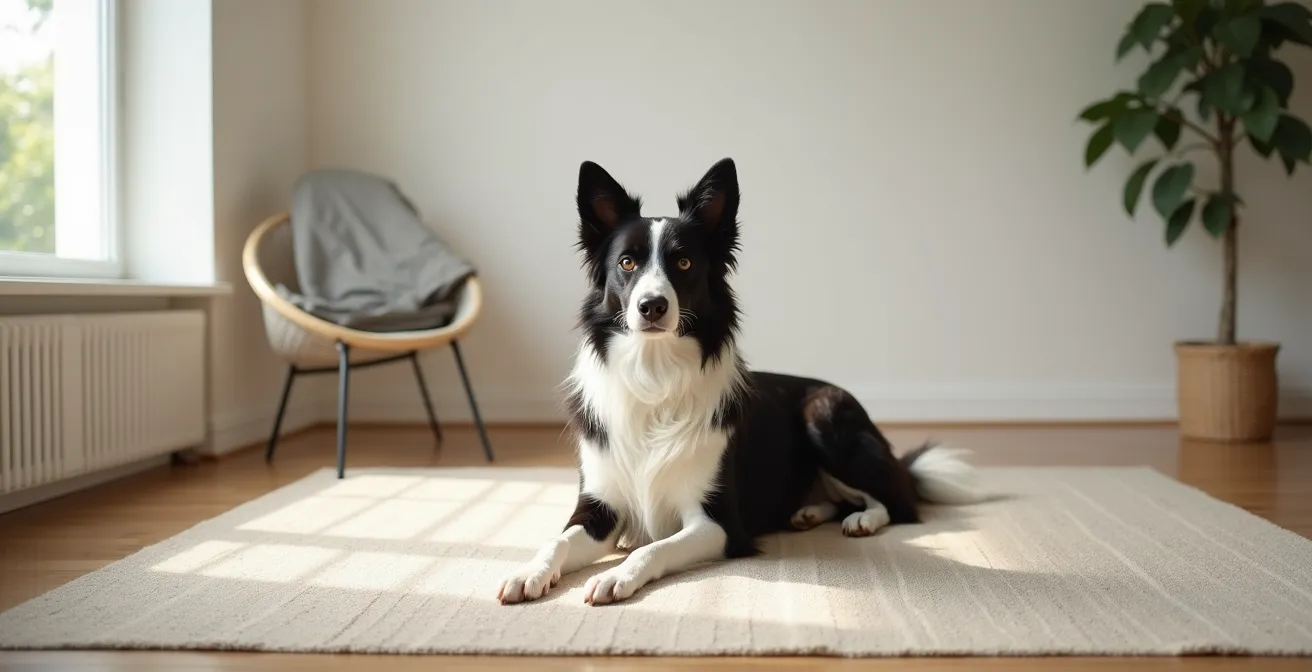
This process, often called “capturing calmness,” involves rewarding the dog for choosing to relax on its own. It’s about making stillness more valuable than frantic energy. By creating a designated calming station and gradually increasing the duration of the settle, you build a powerful tool for managing energy in any environment. This is the foundation upon which all other “jobs” can be built.
Your Action Plan: The Settle Protocol
- Establish the Station: Designate a specific ‘place’ or mat as your dog’s calming station.
- Cue the Behavior: Teach a clear ‘go to your place’ command as the start of the “job.”
- Model Calmness: Practice a ‘functional freeze’ with your dog on the mat, using your own regulated breathing to co-regulate.
- Build Duration: Gradually extend the time your dog is expected to remain settled, starting from a few seconds and building up to several minutes.
- Teach the End: Use a clear release command to signal that the “job” of settling is complete.
- Create a Post: Reframe the mat as an ‘observation post,’ where the dog’s task is to remain vigilant but still.
Find It Games: Burning Energy in 15 Minutes Without Running
One of the biggest misconceptions about tiring out a high-energy dog is that it requires intense physical exertion. While running is important, it often fails to engage the most powerful energy-burning tool your dog possesses: its brain. Scent work, or “find it” games, taps into a dog’s natural desire to hunt and forage, providing a high degree of cognitive load that can be more exhausting than a long run.
Professional trainers have found that structured scent games tire a working dog more effectively than an hour of mindless running. This is because processing scent information requires significant brainpower. You can start simply by hiding treats around a room and encouraging your dog to “find it.” As your dog becomes more proficient, you can increase the difficulty using a “Cognitive Load Ladder” approach. This involves progressing from finding high-value food to searching for specific, non-food items, or increasing scent contamination to make the search more challenging.
This table illustrates how different activities compare in terms of energy expenditure and mental engagement. It clearly shows that mentally demanding tasks can be a far more efficient use of time for burning off excess energy.
| Activity Type | Energy Burn Rate | Duration Needed | Mental Engagement |
|---|---|---|---|
| Running/Walking | High Physical | 60+ minutes | Low |
| Basic Find It | Moderate | 20-30 minutes | Moderate |
| Constructed Hunt | High Mental | 15-20 minutes | Very High |
| Scent Puzzles | High Mental | 10-15 minutes | Maximum |
By turning mealtime into a hunt or dedicating 15 minutes to a structured search, you provide a fulfilling “job” that satisfies their instincts. This mental stimulation directly combats the root cause of neurotic behaviors like pacing, leaving you with a dog that is not just tired, but truly satisfied.
Performance Kibble: When Does a Dog Actually Need 30% Protein?
The pet food aisle is filled with “performance” and “active” formulas boasting high protein content, typically around 30%. Most owners associate these diets with physically demanding activities like sled pulling or competitive agility. However, the definition of a “working dog” in the context of nutrition needs to be expanded. If you are providing the constructive work and cognitive challenges discussed here, your dog might qualify as a performance athlete, even without running marathons.
The brain is a metabolically expensive organ. Intense concentration, problem-solving, and learning all consume significant energy. In fact, nutritional research indicates that advanced training sessions of just 30 minutes can be as metabolically demanding as some forms of physical exercise. A dog engaged in daily scent work, complex training, or sports like Canicross is placing a higher demand on its body for muscle repair and cognitive function.
A 30% protein diet is generally formulated for dogs that need to build and repair muscle tissue efficiently while also fueling brain function. This is not necessary for every pet dog. However, if your Spaniel has transitioned from a life of pacing to a life with a “job”—be it structured scent work, urban mushing, or advanced obedience—its nutritional needs have changed. The higher protein helps maintain lean muscle mass and provides the essential amino acids needed for neurotransmitter function, which is critical for learning and focus.
The decision to switch to a performance kibble should be based on the dog’s actual workload, both mental and physical. A dog that has a genuine “job” several days a week is a prime candidate. It’s not about the breed, but about the lifestyle you have built to satisfy its instincts.
The 18-Month Rule: Why Jumping Is Ban for Puppies Under 1 Year?
When you have a hyperactive puppy, the temptation is to wear it out with high-impact activities like jumping for a frisbee or running long distances. This is one of the most common and dangerous mistakes an owner can make. Until a puppy is around 12 to 18 months old (depending on the breed), its growth plates are still open. These soft areas of cartilage at the ends of the bones are responsible for longitudinal growth and are extremely vulnerable to injury.
Repetitive, forced impact from activities like jumping can cause premature closure or damage to these growth plates, potentially leading to bone deformities, joint problems, and lifelong orthopedic issues like hip or elbow dysplasia. This is why the “18-month rule” is a critical guideline for any owner of a medium to large breed puppy. The goal during this period is not to build a physical athlete, but to build a thinking athlete.
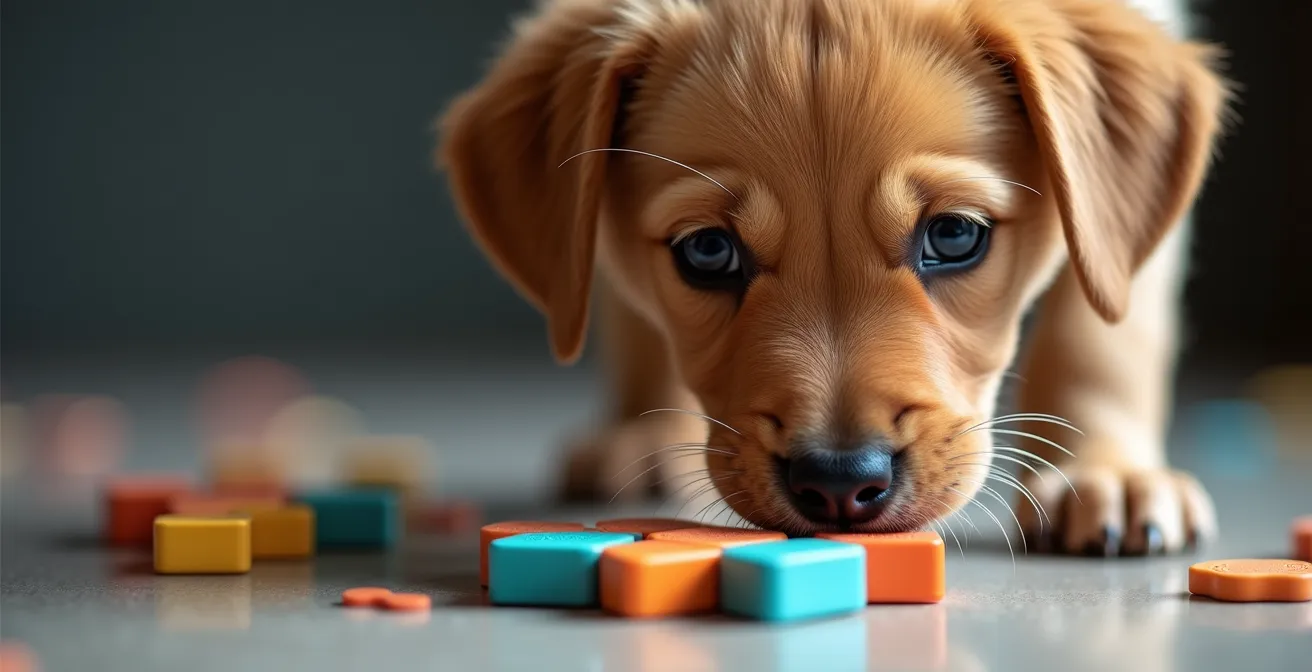
Instead of high-impact games, focus on low-impact activities that build confidence, impulse control, and problem-solving skills. This is the perfect time to lay the groundwork for a future working partner without risking their physical development. These activities provide crucial mental stimulation that satisfies their busy minds while protecting their growing bodies.
- Introduce scent work games for mental stimulation without physical stress.
- Practice ‘place’ and ‘settle’ exercises to build impulse control.
- Use puzzle feeders and interactive toys for problem-solving skills.
- Teach basic obedience with minimal physical demands.
- Focus on proprioception exercises using unstable surfaces at ground level to build body awareness.
By respecting your puppy’s physical limitations and focusing on its cognitive development, you are making a long-term investment in a healthy, well-adjusted, and capable adult dog.
Long Line Training: How to Walk a Pointer Who Wants to Hunt?
Walking a hunting breed like a Pointer or a Spaniel can feel less like a leisurely stroll and more like a constant battle against instinct. The moment they catch a scent, they want to follow it, often pulling relentlessly on the leash. The common reaction is to shorten the leash and try to force a “heel.” This approach fights against the dog’s core genetics and creates immense frustration for both handler and dog.
The key is to reframe the walk from an exercise in restraint to an opportunity for a cooperative hunt. According to Sharon Fitzpatrick, President of the German Shorthaired Pointer Club of America, “Dogs are known for stopping, pouncing, and eating their prey, but what’s different about a specific hunting breed is its ability to work as a partner with their owner.” This partnership is impossible on a short leash. The long line is the tool that makes it possible. It is not a restraint but a communication device.
A long line (15 to 30 feet) gives the dog the freedom to explore scents and follow its nose, which is an intrinsically rewarding behavior. Your job is not to stop the hunting but to become part of it. When the dog “points” or becomes birdy, you acknowledge it, praise it, and then cue it to continue the “hunt” with you. As noted in training guides, a Pointer can be capable of pointing at just two months old without ever being taught; it’s pure instinct. By allowing this behavior within a structured framework, you validate the dog’s purpose. The line is there to ensure safety and to use subtle pressure as a means of communication, not to drag the dog away from what it was bred to do.
This approach transforms a stressful walk into a fulfilling job. The dog learns that it can express its hunting drive in partnership with you, which dramatically reduces pulling and frantic behavior. You are no longer just walking your pet; you are managing a specialist on a mission.
The Extinction Burst: Why Bad Behavior Gets Worse Before It Stops?
You’ve started implementing a new plan. You’re ignoring the pacing and rewarding calm behavior instead. But suddenly, the pacing is more frantic than ever before. This is not a sign of failure; it’s a predictable and often necessary stage of behavior modification known as the extinction burst. It’s the behavioral equivalent of pressing an elevator button, and when it doesn’t work, pressing it again faster and harder before giving up.
The extinction burst occurs when a previously reinforced behavior is no longer producing the desired result. Your dog learned, perhaps unintentionally, that pacing got some kind of reaction from you (attention, verbal cues, etc.). Now that you’ve removed that reinforcement, your dog’s first instinct is to try the behavior with more intensity. It’s testing the system to see if the old rule still applies. This is especially true for behaviors that are self-rewarding; behavioral research demonstrates that pacing becomes self-reinforcing as it can provide a minor dopamine release, making it harder to extinguish.
For working dogs, the intensity of an extinction burst provides valuable information. It reveals just how deeply the original behavior was meeting an instinctual need. A massive burst in pacing when you begin a “settle” protocol shows you just how much pent-up vocational energy there is. It’s not a setback; it’s a data point confirming that you are on the right track by providing alternative, constructive outlets.
Understanding and anticipating the extinction burst is crucial for success. It gives you the resolve to stay consistent. You must “ride out the storm” without giving in, while simultaneously providing the new, appropriate “jobs” for your dog to perform instead. The burst is often the last-ditch effort before the old, unwanted behavior finally begins to fade.
High Attachment vs. Low Attachment: Which Setup for Your Sport?
As you begin to provide “jobs” for your dog, the equipment you use sends a powerful psychological signal. The point where the leash or line attaches to your dog—be it a collar, a front-clip harness, or a back-clip harness—is more than just a physical connection. It’s a key part of your communication, influencing everything from pulling behavior to confidence. Understanding the difference between a high attachment and a low attachment setup is key to choosing the right tool for the job.
A high attachment point, such as a collar or the top clip of a harness, often signals a need for closer teamwork and control. It’s a more direct line of communication, which can be beneficial for anxious dogs who need more guidance and reassurance from their handler. However, for a confident, independent dog, this close connection can sometimes lead to frustration and pulling against the perceived restraint.
A low attachment point, like the front clip on a “no-pull” harness or the lower ring on some sport harnesses, changes the dog’s center of gravity when they pull. This is often used to discourage pulling on walks. However, in the context of dog sports, a low attachment can signal a need for more independent effort from the dog, as seen with long lines for hunting. For a driven, confident dog, this can be empowering, but for a nervous dog, it can increase anxiety by making them feel less connected to their handler. The choice of equipment must match the dog’s temperament and the specific “job” at hand.
| Attachment Type | Psychological Signal | Best For | Potential Issues |
|---|---|---|---|
| High Attachment (Short Line) | Close teamwork required | Anxious dogs needing confidence | Frustration in independent dogs |
| Low Attachment (Long Line) | Independent effort expected | Confident, driven dogs | May increase anxiety in nervous dogs |
| Variable Attachment | Adaptable partnership | Dogs learning impulse control | Requires consistent training |
There is no single “best” setup. The right choice depends on the specific activity and the psychological message you want to send. For a cooperative hunt on a long line, a low-stress harness with a back clip is ideal. For precision heeling, a different setup might be required. Choosing your gear thoughtfully is part of being an effective handler.
Key Takeaways
- A working dog’s hyperactivity is often a “vocational crisis,” not a behavioral problem.
- Mental stimulation through “jobs” like scent work is more effective for calming these dogs than physical exercise alone.
- Channeling, rather than suppressing, innate instincts like hunting or herding is the key to a true partnership.
How to Start Urban Mushing (Canicross/Bikejor) with One Dog?
For the dog with boundless energy and a deep-seated need to move, some of the most fulfilling “jobs” are those that simulate purposeful travel. Urban mushing sports like Canicross (running with your dog pulling in a harness) or Bikejoring (biking with your dog pulling) are excellent outlets. These activities go beyond a simple walk or run; they provide a structured task that satisfies the instinct to migrate and work in a team.
Starting with just one dog is simple. The essential gear includes a specialized pulling harness for the dog (which distributes force safely across their body, unlike a regular walking harness), a bungee line (to absorb shock), and a waist belt for you (in Canicross) or an attachment for your bike (in Bikejoring). The harness is a crucial piece of equipment that signals to the dog that this is a “pulling job,” which helps differentiate it from a loose-leash walk. Handlers often report that establishing this clear context significantly reduces pulling during regular walks.
The core of urban mushing is teaching directional cues (“gee” for right, “haw” for left, “on-by” to ignore distractions). You start at a walking pace, heavily rewarding the dog for pulling into the harness and responding to your cues. As the dog understands the game, you can progress to a run or a bike ride. This isn’t just about speed; it’s about focused, cooperative effort. You are not just being pulled; you are the navigator for your one-dog team. As one academy puts it, “When we suppress natural behaviours without offering healthy outlets, we don’t create calmness — we create quiet frustration and unmet needs.” Urban mushing is a powerful, healthy outlet.
These activities provide the ultimate “job” for many high-drive dogs. They combine physical exertion with mental focus and teamwork, satisfying the core genetic programming that causes restlessness in the first place. It is the perfect embodiment of channeling instinct into a constructive, rewarding partnership.
Now that you understand that your dog’s pacing is a call for meaningful work, the next step is to take action. Start with one of the “jobs” outlined in this guide—whether it’s the quiet focus of “settle” training or the dynamic teamwork of Canicross—and begin the process of transforming your unemployed professional into a valued and fulfilled partner.